Your Ultimate Web Application Testing Checklist: 10 Core Areas for 2025
Master QA with our comprehensive web application testing checklist. Covers 10 critical areas from functional to security for flawless releases in 2025.
Automate and scale manual testing with AI ->
In today’s fast-paced development cycles, simply ‘testing’ a web application isn’t enough. A superficial check might catch glaring bugs, but it often misses the subtle yet critical issues in performance, security, and usability that define a user’s experience. A truly effective quality assurance process requires a structured, multi-faceted approach, and a generic web application testing checklist often falls short by providing vague advice without actionable steps.
This guide moves beyond theory to offer a prioritized, comprehensive checklist covering 10 essential testing domains. We break down each area, from functional and performance testing to security and accessibility, with clear, actionable tasks. You will learn not just what to test but how to test it effectively.
More importantly, this checklist is designed for modern, automated workflows. We’ll demonstrate how to transform these validation steps into powerful end-to-end tests using simple, human-language prompts. By integrating AI-powered tools like TestDriver, you can turn this list from a passive document into an active, automated quality gate. This approach ensures your application is not just functional on the surface but is robust, secure, and ready for production, helping your team release with speed and confidence. This checklist is your blueprint for building a scalable and efficient QA process that catches critical regressions before they impact users.
1. Functional Testing
Functional testing sits at the core of any robust web application testing checklist, acting as the first line of defense against bugs and defects. It’s the process of verifying that every feature of your application behaves exactly as specified in the functional requirements or user stories. This isn’t about how the system works internally, but simply that it works from the user’s perspective.
This testing method focuses on the main business workflows and user interactions. For an e-commerce site, functional testing would validate the entire customer journey, from adding an item to the cart, applying a discount code, and successfully completing a payment. It answers the fundamental question: “Does this feature do what it’s supposed to do?”
Key Areas and Actionable Steps
To implement functional testing effectively, your QA process should cover both positive and negative scenarios to ensure the application is both functional and resilient.
- Happy Path Testing: Verify that critical user flows work correctly under ideal conditions. For example, a user with valid credentials can log in successfully, or a valid credit card is processed without errors.
- Negative Testing (Error Path): Intentionally test with invalid inputs to see how the system responds. Examples include attempting to log in with an incorrect password, submitting a form with missing required fields, or entering an expired credit card number. The application should display clear, user-friendly error messages.
- Boundary Value Analysis: Test the system at the edges of its input ranges. If a form field accepts numbers between 1 and 100, test with 0, 1, 100, and 101 to check its behavior at the boundaries.
Pro Tip: Maintain a requirements traceability matrix. This document maps each requirement to its corresponding test cases, ensuring that every specified function is covered by your testing efforts and nothing slips through the cracks. This is a best practice championed by organizations like the ISTQB.
Prioritize testing critical business paths first to ensure the most valuable features are stable. Automating these repetitive functional tests is crucial for efficient regression testing, allowing your team to quickly confirm that new code changes haven’t broken existing functionality.
2. Usability Testing
While functional testing ensures an application works, usability testing determines if it works for the user. This crucial step evaluates how intuitive, efficient, and user-friendly your web application is from the perspective of its target audience. It moves beyond technical specifications to focus on the human experience, uncovering points of friction, confusion, and frustration that technical tests would miss.
This testing method involves observing real users as they interact with the application to complete specific tasks. For instance, a user might be asked to find a product, sign up for a newsletter, or adjust their account settings. The goal is to answer the fundamental question: “Can a real user accomplish their goal easily and without confusion?”

Key Areas and Actionable Steps
To conduct effective usability testing, structure sessions around clear tasks and recruit participants who represent your actual user base. This ensures the feedback you gather is relevant and actionable.
- Task-Based Scenarios: Provide users with specific, realistic tasks rather than vague instructions. For example, instead of saying “explore the website,” instruct them to “find a blue, medium-sized t-shirt and add it to your cart.” This provides measurable outcomes.
- Think-Aloud Protocol: Encourage users to vocalize their thoughts, feelings, and frustrations as they navigate the application. This provides direct insight into their mental process and helps identify confusing design elements or unclear navigation.
- A/B Testing: Compare two or more versions of a page or flow to see which one performs better. A common example is testing different checkout page layouts to identify which version results in a lower cart abandonment rate.
Pro Tip: Involve a diverse group of participants, including users with varying levels of technical expertise and those with disabilities. Pioneers in this field, like the Nielsen Norman Group, have long advocated that testing with even a small group of 5-8 users can uncover the majority of significant usability issues.
Integrate usability testing early and often in the development lifecycle. Conducting tests on prototypes and wireframes allows you to identify and fix major design flaws before a single line of code is written, saving significant time and resources. Regularly including usability in your web application testing checklist ensures the final product is not only functional but also a pleasure to use.
3. Performance and Load Testing
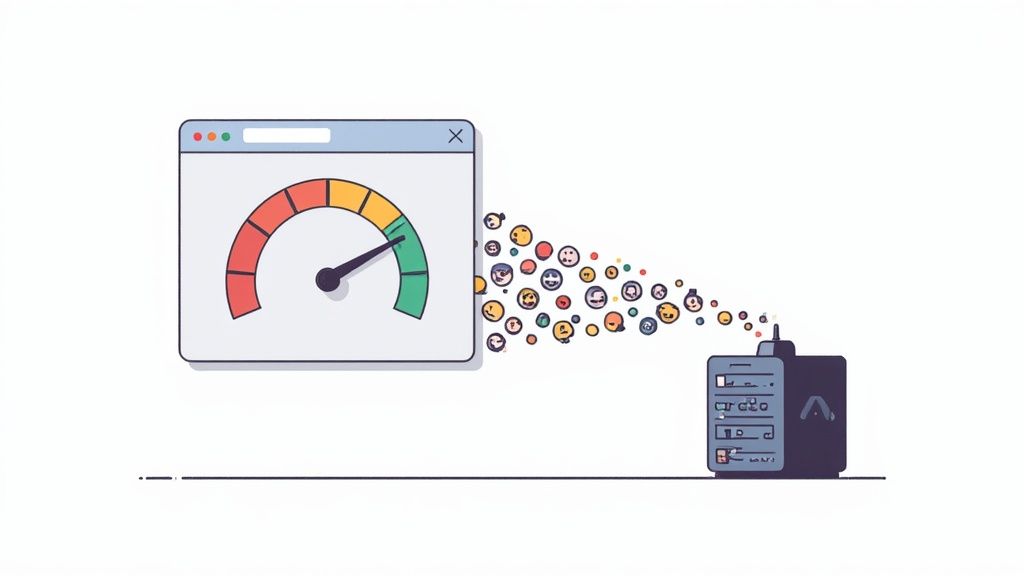
Performance testing is a critical step in any web application testing checklist that measures speed, responsiveness, and stability under a particular workload. It ensures your application can handle expected traffic volumes without degrading the user experience. This isn’t just about preventing crashes; it’s about making sure your application remains fast and efficient, even during peak usage.
Load testing, a subset of performance testing, specifically evaluates the system’s behavior as the number of concurrent users increases. For an e-commerce platform preparing for a Black Friday sale, load testing would simulate thousands of simultaneous users to identify performance bottlenecks and ensure the infrastructure can handle the surge. It answers the crucial question: “Will our application hold up when it matters most?”
Key Areas and Actionable Steps
To implement performance and load testing effectively, you must simulate realistic user behavior and monitor system health closely to identify and resolve performance issues before they impact real users.
- Baseline Testing: Establish a performance baseline by measuring response times and resource utilization under normal, low-traffic conditions. This baseline becomes the benchmark against which all future test results are compared.
- Stress Testing: Push the application beyond its expected traffic limits to find its breaking point. This helps you understand its failure modes and recovery capabilities, such as how it behaves when CPU or memory resources are exhausted. For web applications, maintaining optimal speed is critical for user satisfaction; consider these strategies for optimizing page load speed as part of your performance testing.
- Soak Testing (Endurance Testing): Run a sustained, significant load over an extended period. This is designed to uncover issues like memory leaks or performance degradation that only appear after the application has been running for a long time.
Pro Tip: Integrate performance monitoring tools (like New Relic or Datadog) directly into your testing environment. These tools provide deep insights into server resource utilization, database query performance, and API response times, helping you pinpoint the exact source of a bottleneck during a load test.
Start performance testing early in the development lifecycle rather than leaving it as a pre-launch activity. By identifying and fixing bottlenecks incrementally, you can prevent costly architectural changes later on. For a deeper dive, you can learn more about how to master performance testing.
4. Security Testing
Security testing is a critical, non-negotiable component of any comprehensive web application testing checklist. It’s the process of actively identifying vulnerabilities, threats, and weaknesses within an application that malicious actors could exploit. This goes beyond simple functionality to probe the application’s defenses, ensuring that sensitive data remains confidential, user accounts are protected, and the system is resilient against common cyberattacks.
In an era of constant digital threats, security testing answers the most important question: “Is our application safe from attack?” It involves simulating attacks and methodically checking for known security flaws to patch them before they can be exploited. This proactive stance protects not only the business’s reputation and assets but also the privacy and trust of its users.

Key Areas and Actionable Steps
Effective security testing requires a multi-layered approach, combining automated scanning with manual, in-depth analysis to uncover a wide range of potential vulnerabilities.
- Vulnerability Scanning: Use automated tools to scan for common security flaws based on known vulnerability databases. This includes checking for SQL injection, Cross-Site Scripting (XSS), and insecure server configurations. These scans provide a quick way to identify low-hanging fruit and common misconfigurations.
- Penetration Testing: Engage in authorized, simulated cyberattacks on your application. A penetration test (or “pen test”) mimics the actions of a real attacker to identify exploitable weaknesses in business logic, API endpoints, and authentication mechanisms that automated tools might miss.
- Authentication and Session Management: Rigorously test login processes, password policies (complexity, history), account lockout mechanisms, and session handling. Ensure that session tokens are securely generated, transmitted, and invalidated upon logout or timeout to prevent session hijacking.
Pro Tip: Shift security testing left. To truly build resilient web applications, it’s essential to integrate security from the ground up, embracing a comprehensive secure software development lifecycle. This means incorporating security practices and testing at every stage of development, not just as a final check before release.
Adhering to guidelines from security authorities like the OWASP (Open Web Application Security Project) Top 10 is essential. By regularly testing for these most critical risks, you can build a robust defense and significantly reduce your application’s attack surface.
5. Compatibility Testing
Compatibility testing is a critical part of any web application testing checklist, designed to ensure your application delivers a consistent and reliable experience across a diverse technological landscape. It verifies that the application functions correctly across different browsers, operating systems, devices, and screen resolutions. In today’s fragmented digital world, this testing prevents user frustration and abandonment caused by a feature working in Chrome but breaking in Safari, or a layout appearing perfectly on a desktop but being unusable on a mobile device.
This testing method focuses on the user’s environment rather than the application’s internal logic. For a SaaS dashboard, it would mean verifying that data visualizations render correctly on both a Windows machine using Firefox and a MacBook using Safari. It answers the crucial question: “Does our application work for all our users, regardless of how they access it?”
Key Areas and Actionable Steps
To implement compatibility testing effectively, your QA strategy must systematically address the wide range of environments your target audience uses, prioritizing based on real user data.
- Cross-Browser Testing: Verify that all features, CSS styling, and JavaScript functionalities work as expected on major browsers like Chrome, Firefox, Safari, and Edge. Pay close attention to rendering differences and API support.
- Operating System (OS) Compatibility: Test the application on different operating systems such as Windows, macOS, and Linux. This helps identify issues related to OS-level notifications, font rendering, and shortcut key conflicts.
- Responsive and Device Testing: Ensure the application’s layout and functionality adapt seamlessly to various screen sizes, from small mobile phones to large 4K monitors. Test on real devices or high-fidelity emulators to check for touch-specific interactions and performance.
Pro Tip: Use your website’s analytics data to create a browser/OS support matrix. This allows you to prioritize testing efforts on the platforms used by the vast majority of your actual users, maximizing ROI. This data-driven approach is a core principle advocated by web standards bodies like the W3C.
Prioritize testing on the most popular user configurations first to cover the largest user segments. Cloud-based testing platforms can provide on-demand access to hundreds of browser and device combinations, making it feasible to automate large-scale compatibility checks within your CI/CD pipeline and catch regressions early.
6. Accessibility Testing
Accessibility testing is a critical component of a modern web application testing checklist, ensuring your application is usable by people with disabilities. This practice involves verifying that individuals with visual, auditory, motor, or cognitive impairments can navigate, understand, and interact with your web application effectively. It goes beyond simple functionality to create an inclusive and equitable digital experience for all users.
This testing method validates compliance with established standards, most notably the Web Content Accessibility Guidelines (WCAG). For a social media platform, this would mean ensuring a user who is blind can use a screen reader to read and post updates, or a user with motor impairments can navigate the entire site using only a keyboard. It answers the crucial question: “Can everyone, regardless of ability, use this application?”
Key Areas and Actionable Steps
To implement accessibility testing thoroughly, your QA strategy must combine automated checks with manual, human-centered validation to address the nuances of user experience.
- Keyboard-Only Navigation: Ensure every interactive element, including links, buttons, forms, and menus, is reachable and operable using only the Tab, Shift+Tab, Enter, and Arrow keys. The focus order must be logical and predictable.
- Screen Reader Compatibility: Test critical user flows using popular screen readers like NVDA, JAWS, or VoiceOver. Verify that all images have descriptive alt text, form fields are properly labeled, and dynamic content changes are announced to the user.
- Color Contrast and Visual Cues: Use automated tools to check that text and background color combinations meet WCAG contrast ratio requirements (e.g., 4.5:1 for normal text). Ensure that color is not the only means of conveying information.
Pro Tip: Aim for WCAG 2.1 Level AA compliance as a baseline standard. This level is the globally accepted benchmark for web accessibility and is often a legal requirement. Organizations like the W3C Web Accessibility Initiative (WAI) provide extensive documentation and resources to guide this effort.
Integrating accessibility checks early and often prevents costly remediation later. Start with automated tools for a quick first pass, but always supplement them with manual testing to capture the human element of usability. To dive deeper, explore the essential tools and procedures for effective accessibility testing.
7. API Testing
API testing is a critical part of a modern web application testing checklist, focusing on the business logic layer rather than the presentation layer. It involves testing Application Programming Interfaces (APIs) directly to determine if they meet expectations for functionality, reliability, performance, and security. Since most web applications rely on APIs to handle data and business logic, ensuring their stability is paramount for the entire system’s health.
This testing method validates the core backend services that power the user interface. For a mobile banking app, API testing would verify that a request to transfer funds correctly updates account balances in the database, sends the right response code (e.g., 200 OK), and returns a payload with the correct transaction details. It answers the key question: “Do our backend services communicate and function correctly on their own?”
Key Areas and Actionable Steps
To implement effective API testing, your QA strategy must validate not just successful requests but also how the API handles failures, unexpected loads, and security threats. This ensures the backbone of your application is both robust and secure.
- Endpoint and Method Validation: Test every API endpoint with all its supported HTTP methods (GET, POST, PUT, DELETE, etc.). Verify that a POST request successfully creates a new resource and a GET request retrieves it correctly.
- Schema and Payload Validation: Ensure the API responses match the defined schema. Check that data types are correct, required fields are present, and the structure of the JSON or XML payload is as expected.
- Error Handling: Send malformed requests, requests with missing authentication tokens, or requests for non-existent resources. The API should respond with appropriate HTTP status codes (e.g., 400, 401, 404) and a clear, useful error message in the response body.
- Security and Authentication: Test authentication mechanisms like OAuth or API keys. Attempt to access protected endpoints without credentials to ensure they are properly secured against unauthorized access.
Pro Tip: Leverage API documentation tools like Swagger (OpenAPI) as a single source of truth for your tests. These specifications can be used to automatically generate client code and even baseline test cases, ensuring your tests are always in sync with the API’s design.
Prioritize testing endpoints that are crucial for core business functions or are consumed by multiple client applications. Automating API tests within a CI/CD pipeline is essential for catching integration issues early and enabling rapid, confident deployments. To deepen your expertise, explore these essential resources for mastering API testing.
8. Regression Testing
Regression testing is the safety net of your web application testing checklist, ensuring that new code doesn’t break old features. It acts as a critical verification step after any code change, whether it’s a new feature, a bug fix, or a dependency update. The core purpose is to re-execute a subset of existing test cases to confirm that previously developed and tested software still performs correctly.
This testing method is fundamental to agile development and continuous integration environments where code is frequently modified and deployed. For example, after fixing a bug in the payment processing module, regression testing would re-validate the login, shopping cart, and user profile functionalities to ensure they were not inadvertently affected. It answers the crucial question: “Did the recent change break anything else?”
Key Areas and Actionable Steps
To implement regression testing efficiently, you need a strategic approach that balances comprehensive coverage with speed. Simply re-running every single test is often impractical and time-consuming.
- Prioritize Critical Paths: Focus your initial regression suite on the most critical user flows and business-critical functionalities. This includes core features like user authentication, checkout processes, and primary data submission forms.
- Automate Extensively: The repetitive nature of regression testing makes it a prime candidate for automation. An automated suite can run quickly and consistently within a CI/CD pipeline, providing immediate feedback after every code commit.
- Test Impact Analysis: Instead of running the entire suite, use test impact analysis to identify which parts of the application could be affected by recent changes. This allows you to select and run only the most relevant test cases, saving significant time and resources.
Pro Tip: Maintain your regression suite diligently. Regularly review and prune outdated or redundant tests, and add new tests to cover new functionality. A lean but comprehensive suite is far more effective than a bloated, unmaintained one. This practice is a cornerstone of modern Agile testing methodologies.
By integrating a robust regression testing strategy, you build confidence in your release process. It prevents the re-emergence of old bugs and ensures that application stability is maintained as it evolves, making it an indispensable part of any comprehensive web application testing checklist.
9. Cross-browser and Cross-platform Testing
Cross-browser and cross-platform testing is a critical step in a modern web application testing checklist, ensuring your application delivers a consistent and reliable user experience regardless of how users access it. It validates that your application’s functionality, design, and performance are maintained across various web browsers (like Chrome, Firefox, and Safari), operating systems (Windows, macOS, Linux), and devices (desktops, tablets, and smartphones).
This testing addresses the inconsistencies in how different browsers and platforms interpret HTML, CSS, and JavaScript. For an e-commerce application, it means ensuring the product images render correctly, the “Add to Cart” button is clickable, and the checkout process is smooth whether a user is on Safari on an iPhone or Chrome on a Windows laptop. It answers the crucial question: “Does our application work for all our users, not just those using a specific setup?”
Key Areas and Actionable Steps
To implement cross-browser testing effectively, focus on both visual consistency and functional integrity across your target environments. This ensures your application is not only usable but also looks professional everywhere.
- Baseline and Prioritize: Use analytics data to identify the most popular browsers, OS, and device combinations among your user base. Establish a baseline (e.g., the latest version of Chrome) and prioritize testing on other environments based on user share.
- Visual Regression Testing: Automate the process of capturing and comparing screenshots across different browsers and viewport sizes. This helps quickly detect unintended UI bugs, such as misaligned elements, font rendering issues, or broken layouts that might otherwise go unnoticed.
- Functional Validation: Ensure core features like user login, form submissions, and critical workflows perform as expected across all targeted platforms. Test for JavaScript compatibility issues, as different browser engines can execute scripts differently.
Pro Tip: Leverage cloud-based testing platforms like BrowserStack or Sauce Labs. These services provide instant access to a massive grid of real browsers and devices, eliminating the need to maintain a costly and complex in-house device lab. This approach allows you to scale your testing efforts efficiently.
Integrate this testing early in your development cycle to catch compatibility bugs before they become deeply embedded in the codebase. By validating on a diverse range of environments, you protect your brand’s reputation and ensure a wider market reach for your web application.
10. User Acceptance Testing (UAT)
User Acceptance Testing (UAT) is the final, critical validation phase before a web application is released to production. It moves testing from the hands of developers and QA professionals to the actual end-users or clients who will use the system daily. The core purpose of UAT is to confirm that the application meets the business requirements and provides genuine value from the user’s perspective, acting as the final sign-off.
This testing method isn’t about finding bugs like incorrect code implementation or syntax errors; instead, it focuses on validating the overall business flow and usability. For example, a finance team would conduct UAT on a new invoicing system to ensure it correctly handles their specific billing cycles and reporting needs, while an external customer might test a new SaaS feature to confirm it solves their problem as intended. It answers the crucial question: “Does this solution actually work for us?”
Key Areas and Actionable Steps
Effective UAT bridges the gap between technical development and real-world business needs, ensuring the final product is fit for purpose. A structured approach is essential for gathering meaningful feedback and securing stakeholder approval.
- Real-World Scenario Validation: Provide users with test scenarios that mirror their day-to-day tasks. For an HR application, this would involve creating a job posting, reviewing applicants, and scheduling interviews, all using realistic (but anonymized) data.
- Business Process Confirmation: Verify that the application supports the complete end-to-end business process. A sales team testing a new CRM feature would validate the entire flow, from lead entry and opportunity tracking to closing a deal and generating a report.
- Feedback and Defect Triage: Establish a clear and simple process for users to report feedback, bugs, or suggestions. Use a dedicated tool (like Jira or a simple spreadsheet) to log each finding, and hold regular triage meetings to prioritize issues with business stakeholders before the production release.
Pro Tip: Involve end-users early in the development lifecycle, not just at the final UAT stage. Inviting them to review wireframes or participate in early demos can uncover fundamental misunderstandings in requirements, saving significant rework and ensuring the final product aligns with their expectations from the start. This practice is a cornerstone of user-centric design and agile methodologies.
Before starting UAT, ensure users receive proper training on the new system and have clear instructions and test cases to follow. This preparation makes the feedback more focused and valuable, making UAT a true validation of business readiness rather than a chaotic bug hunt.
10-Point Web Application Testing Checklist Comparison
| Test Type | 🔄 Implementation Complexity | ⚡ Resource Requirements | ⭐ Expected Outcomes | 📊 Ideal Use Cases | 💡 Key Advantages / Tips |
|---|---|---|---|---|---|
| Functional Testing | Medium — structured test cases, moderate design effort | Medium — testers + automation tools | High — verifies feature correctness and workflows | Feature validation, acceptance criteria, regression basis | Automate repetitive tests; prioritize critical business paths |
| Usability Testing | Medium — planning sessions and moderating users | High — participant recruitment, facilitators, labs | Medium‑High — improves UX and task success rates | UI/UX improvements, conversion flows, navigation checks | Recruit target users; use think‑aloud and record sessions |
| Performance and Load Testing | High — complex scenarios and environment setup | High — load generators, infrastructure, monitoring | High — identifies bottlenecks and capacity limits | Peak traffic simulations, capacity planning, DB tuning | Establish baselines; use realistic loads and monitor resources |
| Security Testing | High — expert analysis and evolving threat models | High — specialized tools and skilled testers | High — uncovers vulnerabilities and compliance gaps | OWASP Top 10 checks, pen tests, data protection validation | Combine automated scanners with manual pen testing; follow OWASP |
| Compatibility Testing | High — many platform/version combinations | High — devices, OS/browser matrix or cloud services | Medium‑High — wider consistent user experience | Cross‑browser/device support, responsive behavior | Prioritize by analytics; prefer cloud device farms and real devices |
| Accessibility Testing | Medium‑High — WCAG rules + assistive tech checks | Medium — tools + assistive tech and user testing | High — legal compliance and inclusive UX | WCAG compliance, screen reader and keyboard navigation | Test with real assistive tech; automate first pass and follow WCAG |
| API Testing | Medium — depends on API complexity and schemas | Low‑Medium — API tools and dev/test environments | High — ensures backend reliability and integration | REST/GraphQL validation, microservices, CI pipelines | Automate in CI; validate schemas, error handling and rate limits |
| Regression Testing | Medium — maintain and run large test suites | Medium — automation framework and CI resources | High — prevents regressions and stabilizes releases | Post-change verification, CI/CD, refactoring validation | Prioritize critical tests; keep suite lean and automate runs |
| Cross‑browser & Cross‑platform Testing | Very High — exponential combinations to cover | Very High — broad device/browser/OS coverage | Medium‑High — consistent rendering/functionality | Multi‑platform apps, broad audience web products | Use analytics to prioritize; leverage cloud labs and visual tests |
| User Acceptance Testing (UAT) | Medium — coordinating end users and scenarios | Medium‑High — scheduling users, test data, facilitation | High — validates business requirements and sign‑off | Final release validation, business process confirmation | Involve real end users early; provide clear tasks and sign‑off checklists |
From Checklist to Continuous Quality: Your Next Steps
We’ve journeyed through a comprehensive web application testing checklist, covering everything from the foundational pillars of functional and usability testing to the critical defenses of security and performance assessments. This guide isn’t just a collection of tasks to tick off before a release; it’s a strategic blueprint for embedding quality deep within your development lifecycle. By systematically addressing functional integrity, user experience, performance bottlenecks, security vulnerabilities, and broad compatibility, you build a resilient and reliable product that earns user trust.
The power of a checklist lies in its ability to transform abstract quality goals into concrete, repeatable actions. It ensures no critical area is overlooked, from API endpoint validation to ensuring your application is accessible to all users. Remember, each item on this list represents a promise to your users: a promise of reliability, security, and a seamless experience.
From Static List to Dynamic Strategy
A static checklist, however, is only the starting point. The ultimate goal is to evolve beyond periodic, pre-release testing and foster a culture of continuous quality. This means integrating these testing principles directly into your daily development workflows, making quality a shared responsibility rather than a final gatekeeping step.
The key to this evolution is a strategic, phased approach. Don’t try to implement every test type overnight. Instead, prioritize based on risk and impact.
- Prioritize Ruthlessly: Start with the tests that address your biggest risks. For an e-commerce platform, robust functional testing of the checkout flow and rigorous security testing are non-negotiable. For a content-heavy media site, performance and cross-browser compatibility might be the top priorities.
- Automate Intelligently: Repetitive, high-value tests are prime candidates for automation. Regression suites, cross-browser checks, and API tests can be automated to run with every code commit, providing immediate feedback and freeing up your QA team to focus on more complex exploratory testing.
- Integrate and Observe: Embed your testing within your CI/CD pipeline. This ensures that quality checks are an inseparable part of the development process, not an afterthought. Complement this with robust observability and monitoring to catch issues in production that even the most thorough checklist might miss.
The True Value of a Meticulous Testing Process
Mastering the concepts within this web application testing checklist does more than just prevent bugs; it provides a profound competitive advantage. It accelerates your delivery velocity by catching issues early when they are cheaper and easier to fix. It builds brand reputation by consistently delivering a stable, high-performing product. Most importantly, it demonstrates a commitment to your users, showing that you value their time, their data, and their experience.
By adopting these practices, you transform testing from a cost center or a bottleneck into a strategic enabler of business growth. Your team can release new features with confidence, innovate faster, and respond to market changes with agility, all while maintaining a high bar for quality. This proactive, integrated approach is the hallmark of modern, high-performing engineering teams. The checklist is your map; the journey toward continuous quality is the destination.
Ready to turn your web application testing checklist into an automated, efficient, and AI-powered reality? TestDriver helps you generate complex end-to-end tests from simple, natural language prompts, drastically reducing the time and effort required to build and maintain your test suite. Stop scripting and start testing. See how it works at TestDriver.
Automate and scale manual testing with AI
TestDriver uses computer-use AI to test any app - write tests in plain English and run them anywhere.