Mastering the Automation of Regression Testing in CI/CD
A practical guide to the automation of regression testing. Learn to build a strategy, leverage AI, integrate into CI/CD, and maintain a resilient test suite.
Automate and scale manual testing with AI ->
Trying to run manual regression tests in a CI/CD environment is like entering a marathon wearing flippers. It’s not just slow; it’s a recipe for disaster. You create bottlenecks, delay releases, and honestly, you just burn out your team. This is where the automation of regression testing comes in—it’s the safety net that gives your developers the confidence to actually ship code quickly.
Why Your CI/CD Pipeline Needs Automated Regression Testing
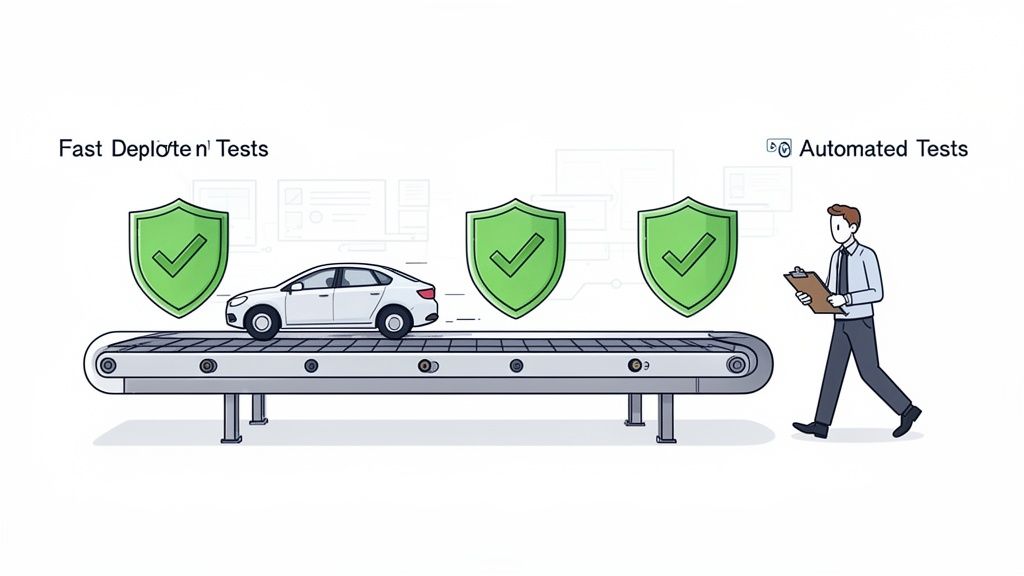
In a fast-paced development cycle, code commits are flying in constantly. Every new feature, bug fix, or even a tiny refactor creates a ripple effect. A seemingly innocent tweak to the login flow could completely wreck the payment process. As your application grows, this risk doesn’t just add up; it multiplies.
Sticking with manual checks in this environment introduces real, tangible risks. It’s not just about slowing down your release cadence. One bad release can instantly shatter user trust, leading to churn and a tarnished reputation. Plus, you’re paying a massive opportunity cost when your best engineers are stuck chasing down preventable bugs instead of building what’s next.
The Accelerating Shift to Automation
This pressure is exactly why the entire industry is making a massive shift. A recent report shows that 84% of DevOps teams are now baking automated testing right into their CI/CD pipelines. They know it’s the only way to keep regressions from derailing their launches.
The money follows the need. The global test automation market is on a tear, jumping from USD 28.1 billion in 2023 to a projected USD 55.2 billion by 2028. That’s not just a trend; it’s a clear signal that manual testing is becoming a relic for any team that wants to stay competitive. You can discover more insights about the state of test automation and see how other teams are getting ahead.
Let’s break down exactly what makes this shift so critical. This table cuts through the noise and shows the day-to-day reality of each approach.
Manual Vs Automated Regression Testing a Reality Check
| Metric | Manual Regression Testing | Automated Regression Testing |
|---|---|---|
| Speed & Feedback Loop | Days or Weeks. Bugs are found late in the cycle, making them harder and more expensive to fix. | Minutes. Developers get immediate feedback after a commit, catching issues instantly. |
| Consistency | Prone to human error. Repetitive tasks lead to missed steps and inconsistent results. | 100% Consistent. The same exact steps are executed perfectly every single time. |
| Coverage Scope | Limited. QA can only cover critical paths due to time constraints, leaving edge cases untested. | Extensive. Can run thousands of tests across different browsers and devices in parallel. |
| Team Focus | Repetitive Execution. QA engineers spend their time on mundane, checklist-driven tasks. | Strategic Quality. QA can focus on exploratory testing, performance, and complex user scenarios. |
| Cost Over Time | High & Increasing. Every new feature adds more manual test cases, scaling costs linearly. | Decreasing. High initial setup cost, but the ROI grows with every test run. |
The takeaway is clear: automation isn’t just about going faster. It’s about building a fundamentally more resilient and efficient development process.
This move provides three huge wins for any team:
- Increased Confidence: Developers can merge code knowing a robust test suite is there to catch anything they might have missed. No more fear of breaking production.
- Faster Feedback Loops: Bugs get flagged within minutes of a commit, not days later during a formal QA handoff.
- Improved Focus: Your QA team can finally stop being a roadblock and start contributing in more meaningful ways, like exploratory testing and hunting down complex edge cases.
By automating the predictable, you free up your team to focus on the unpredictable. It’s a fundamental shift from gatekeeping to enabling, which is the true heart of a modern quality culture.
Ultimately, integrating automated regression testing isn’t just a nice-to-have technical update—it’s a core business strategy. It’s how you build a more stable product, a more productive team, and a faster path from a great idea to happy customers.
Building a Smarter Regression Automation Strategy
It’s easy to get carried away and jump into the automation of regression testing without a solid plan. I’ve seen countless teams make the same mistake: they try to automate everything. This almost always ends in a bloated, slow, and brittle test suite that nobody on the team trusts or wants to maintain.
The real goal isn’t 100% automation. It’s about achieving maximum confidence with the minimum amount of effort.
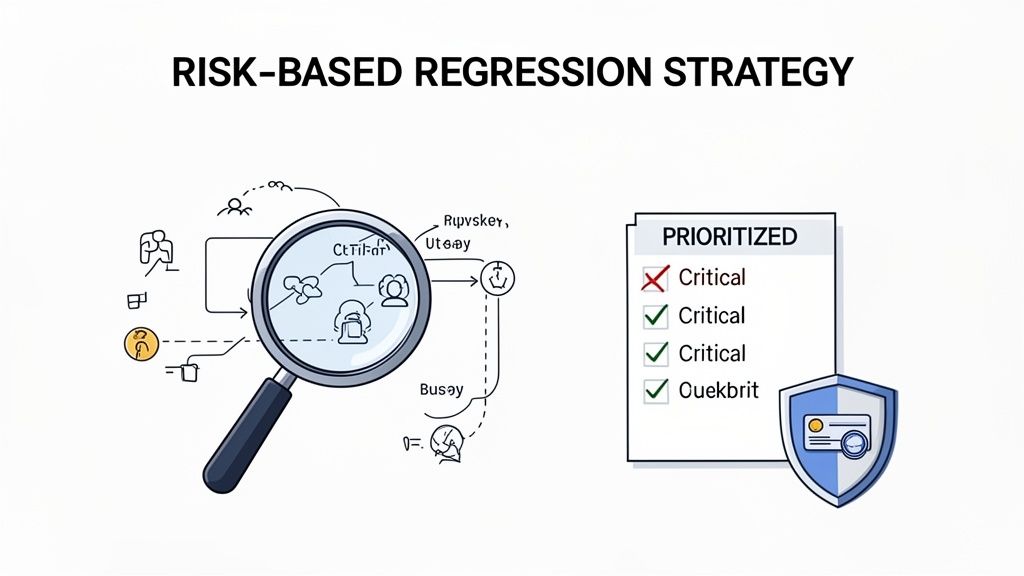
To do that, you have to start with a fundamental question: what absolutely, positively cannot break? Instead of blanketing every feature with tests, a risk-based strategy forces you to focus your precious time and resources on protecting the most critical parts of your application.
Identifying Your Core Functionality
Before you even think about writing a test, your first job is to map out your application’s “crown jewels.” These are the user journeys that, if they failed, would create a real headache—think major business disruption, lost revenue, or a serious hit to your brand’s reputation.
Here’s a checklist I use to pinpoint what truly matters:
- Business-Critical Workflows: What’s the main reason people use your software? For an e-commerce site, it’s the entire flow from finding a product to checking out. That’s your top priority.
- High-Traffic Areas: Dive into your analytics. The features people use most are where bugs will cause the most widespread pain. A defect in a popular workflow is far more damaging than one hidden in an obscure settings menu.
- Revenue-Generating Features: Any part of your app that touches money needs to be locked down. This means subscription sign-ups, payment gateways, and in-app purchases get VIP testing treatment.
- Historically Problematic Modules: Let’s be honest, every team has that part of the codebase. You know, the fragile part that always seems to break. These areas are perfect candidates for heavy regression coverage.
This selective process ensures you’re building a lean, effective safety net, not a sprawling, inefficient one. It’s the difference between a surgical tool and a sledgehammer.
Adopting a Risk-Based Prioritization Model
Once you know what to test, you need to decide the order of attack. Not all critical paths are created equal. I find it helpful to rank them by weighing two key factors: impact and likelihood.
- Impact: How bad would it be if this broke? A broken “Add to Cart” button is a financial disaster. A typo in the website footer? Not so much.
- Likelihood: How likely is this feature to break? This depends on things like code complexity, how often it’s changed, or its dependencies on flaky third-party services.
A bug in a low-traffic, low-impact feature is an annoyance. A bug in a high-traffic, high-impact feature like your payment processor is a crisis. Your regression strategy must reflect this reality.
By plotting your features on a simple impact/likelihood matrix, a clear roadmap emerges. You’ll want to start automating the high-impact, high-likelihood scenarios first. This immediately protects your most valuable and vulnerable assets. This methodical approach is the secret to building a test suite that actually delivers value.
It’s also worth mentioning that a smart strategy depends on a stable foundation. Implementing robust Infrastructure as Code best practices is crucial for ensuring your test environments are consistent and reliable—without that, your automation will never be trustworthy.
With a focused, risk-based plan in hand, you’re ready to start generating the tests that will become the backbone of your quality process. The next step is to find modern tools that can help you create these tests quickly, without getting bogged down in writing brittle code.
Using AI to Generate Resilient End-to-End Tests
Let’s be honest: traditional test scripting is a major bottleneck for regression testing. It’s slow, demands specialized coding skills, and often walls off team members who know the product inside and out but can’t write a line of Selenium. This manual coding grind almost always produces brittle tests that shatter with the slightest UI tweak, trapping teams in a never-ending cycle of maintenance.
But that’s starting to change. A more modern, AI-driven approach is finally here. Instead of getting bogged down in code, you can now spin up robust end-to-end tests using plain English. This shift opens up test creation to everyone, from product managers to manual QAs, letting them directly contribute to the automation suite.
From Plain English to Executable Tests
The concept is as simple as it is powerful: you describe a user flow in natural language, and an AI agent like TestDriver translates that into a fully executable test. It completely removes the need to fuss with scripting languages or fragile locator strategies. You just focus on what the user needs to accomplish, and the AI figures out how to do it.
This is a huge leap forward for efficiency. The industry is catching on fast, with some projections showing that AI-powered automation could slash manual regression testing efforts by as much as 45% by 2026. AI is perfectly suited for handling the repetitive work of script creation and maintenance, and it can even get smart about predicting where new bugs might crop up. For a closer look at these trends, you can read the full report on QA trends.
The real magic, though, is in the resilience of the tests themselves. AI agents don’t just blindly record clicks. They understand user intent. They use intelligent locators that can adapt when a button’s text changes or a developer tweaks a CSS class—drastically cutting down on flaky tests and the maintenance headache that comes with them.
Crafting Effective AI Test Prompts
The quality of your AI-generated tests hinges entirely on the quality of your prompts. If you give vague instructions, you’ll get ambiguous tests. The trick is to be specific and descriptive, laying out each action and expected result just like you would for a human team member.
Here’s my advice for writing prompts that work:
- Be Explicit: Clearly spell out every single action. Don’t just say, “Test the login.” Instead, write, “Navigate to the login page, enter ‘[email protected]’ in the email field, enter ‘Password123!’ in the password field, and click the ‘Log In’ button.”
- Specify Your Data: Always provide the exact test data you want the AI to use. This makes your tests repeatable and predictable.
- Define Your Assertions: This is critical. A test without a check is just a script. Tell the AI exactly what to verify, like, “Verify that the text ‘Welcome, Test User!’ is visible on the dashboard.”
A well-crafted prompt is like a detailed user story. It gives the AI all the context it needs to generate a test that is not only functional but also meaningful and easy to understand.
Even with AI doing the heavy lifting, human expertise is still essential. You always need to review and validate the generated test cases. Make sure they align with your business requirements and cover all the necessary checks. For a deeper dive into this, our guide on the best practices for validating AI-generated test cases walks through how to build a reliable review process.
Example AI Prompts for Common Regression Scenarios
To make this more tangible, here’s a quick-reference table showing how to translate testing needs into effective prompts for an AI test generation agent like TestDriver.
| Test Scenario | Example Prompt for TestDriver |
|---|---|
| Login with MFA | Navigate to the login page. Enter the username ‘qa-user’ and password ‘securepass123’. Click ‘Sign In’. On the next screen, enter the 2FA code ‘123456’ and click ‘Verify’. Confirm that the dashboard page loads and the heading ‘My Account’ is visible. |
| Add Varied Products to Cart | Go to the products page. Search for ‘Laptop’. From the results, add the ‘15-inch Pro Laptop’ to the cart. Then, search for ‘Mouse’ and add the ‘Wireless Ergonomic Mouse’ to the cart. Navigate to the cart and verify that both items are listed with the correct names and quantities. |
| Complex Form Submission | Open the ‘Contact Us’ form. Fill in the ‘Full Name’ with ‘Jane Doe’. Enter ‘[email protected]’ for ‘Email’. Select ‘Technical Support’ from the ‘Department’ dropdown. Type ‘My aplication is running slow.’ in the ‘Message’ text area. Click ‘Submit’ and verify the success message ‘Thank you for your message!’ appears. |
These examples show just how accessible complex E2E scenarios become when you can describe them in plain English. This capability is part of a much bigger trend where AI is being adopted for efficiency across the board. To get a sense of this wider context, check out this guide on the top AI tools for business.
By shifting from code-heavy frameworks to intent-driven prompts, teams can build and maintain regression suites at a speed that simply wasn’t possible before.
Weaving Regression Tests into Your CI/CD Pipeline
Having a solid suite of automated tests is great, but it’s only half the battle. The real magic happens when you get those tests running automatically inside your development workflow. By plugging your regression suite directly into your CI/CD pipeline, you transform it from a manual chore into a powerful, always-on quality gate.
This is where you get that immediate feedback loop every team dreams of. No more waiting for a nightly build or a frantic pre-release QA cycle. Developers can see the impact of their changes almost instantly, letting them catch regressions the moment they’re introduced—long before they ever get close to production.
Setting Up Smart Workflow Triggers
The heart of CI/CD integration is deciding when to run your tests. This is a balancing act. You need thoroughness, but you can’t grind development to a halt by running a massive, hour-long test suite on every single commit.
A tiered approach is what I’ve seen work best in practice:
- On Every Pull Request: Kick off a quick “smoke test” suite. This should just be a handful of your most critical tests—things like login, core navigation, and maybe a key checkout flow. The goal is a fast pass/fail signal, ideally in under five minutes.
- On Merge to Main/Develop: This is where you run a more comprehensive regression suite. Before any code gets into your main branch, you need to be confident it hasn’t broken anything. This is your primary line of defense.
- Before Production Deployment: Time for the full show. Run the entire regression suite, including all your end-to-end tests across different browsers and device configurations. This is your final sign-off before real users see the changes.
This strategy gives you the best of both worlds: rapid feedback for developers day-to-day, with deeper checks at the most critical points in the process.
Practical Configuration Examples
Putting this strategy into action is surprisingly straightforward with modern tools like GitHub Actions, Jenkins, or GitLab CI. The concept is always the same: define a job, specify a trigger, and tell it what test command to run.
And with modern AI tools, creating the actual test files that plug into these pipelines has become much faster.
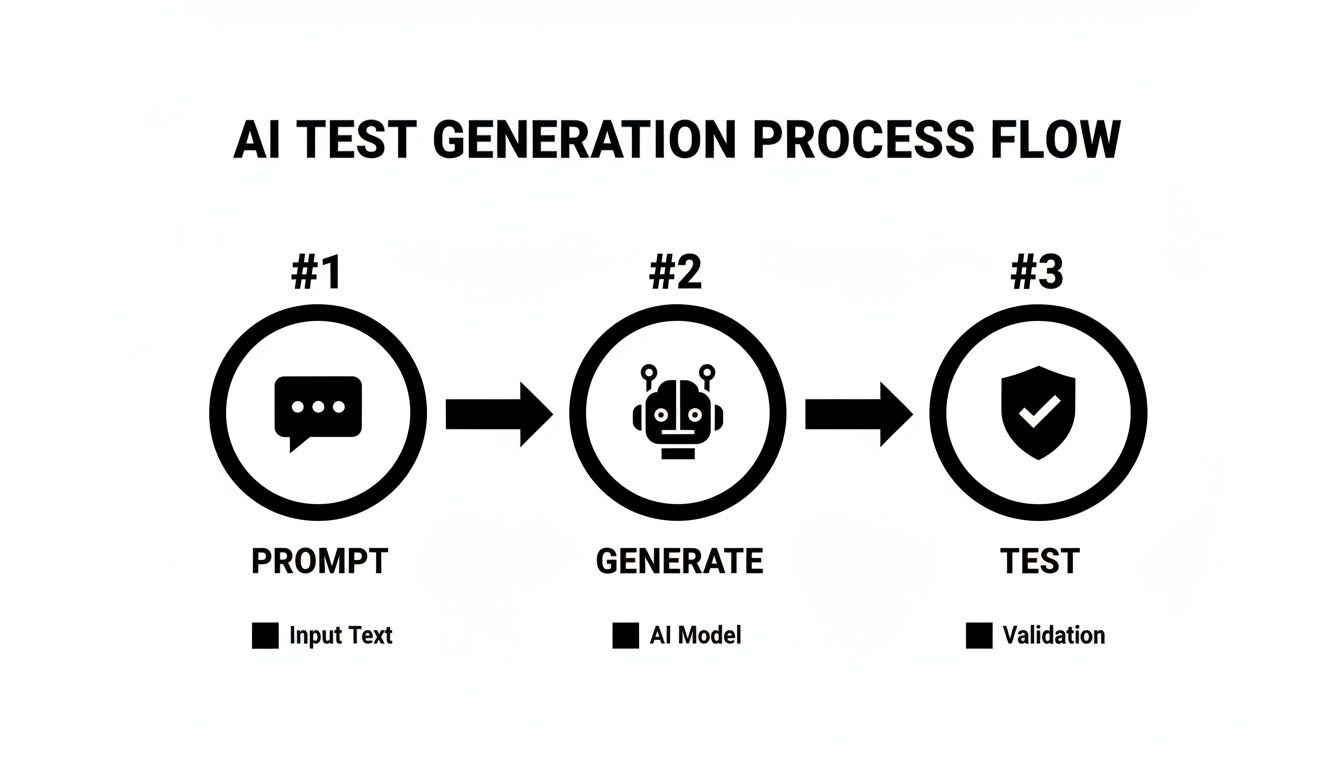
The simple prompt-generate-test workflow means you can build out the assets for your pipeline much more quickly.
Here’s a real-world example of a GitHub Actions configuration that runs your test suite on every pull request targeting the main branch. It’s a great starting point.
name: E2E Regression Tests
on:
pull_request:
branches: [ main ]jobs:
test:
runs-on: ubuntu-latest

steps:

- uses: actions/checkout@v3

- name: Set up Node.js

  uses: actions/setup-node@v3

  with:

    node-version: '18'

- name: Install Dependencies

  run: npm install

- name: Run E2E Tests

   run: npm test
A simple YAML file like this automates the whole process, giving your team pass/fail feedback right inside the pull request. No context switching needed.
The Shift Towards Smarter Pipelines
This isn’t just a niche trend; it’s a massive industry shift. A recent study found that a staggering 63% of organizations are upping their investment in QA automation, with a clear focus on catching bugs earlier in the CI/CD cycle. It makes sense, especially when you consider that regression testing used to eat up nearly half of all testing time.
The goal is to make quality an automatic, non-negotiable part of the process. When tests are baked into the pipeline, developers don’t have to remember to run them—the system enforces quality by default.
If you want to dig deeper into this, our article on the best practices for integrating testing into your CI/CD pipeline provides a more detailed walkthrough.
Keep Your Pipeline Fast with Parallel Execution
As your app grows, so does your test suite. Soon, that quick 10-minute run becomes a 30-minute run, then an hour-long slog. When the pipeline becomes a bottleneck, developers start looking for ways to bypass it.
The solution is parallelization.
Nearly all modern CI/CD platforms and test runners let you split your test suite across multiple machines or containers. By running tests in parallel, you can slash execution times. For instance, a suite that takes 60 minutes to run sequentially could be done in just 10 minutes if you spread it across six parallel jobs. This is how you ensure the pipeline remains a source of rapid feedback instead of a frustrating delay.
Dealing with Flaky Tests and the Maintenance Grind
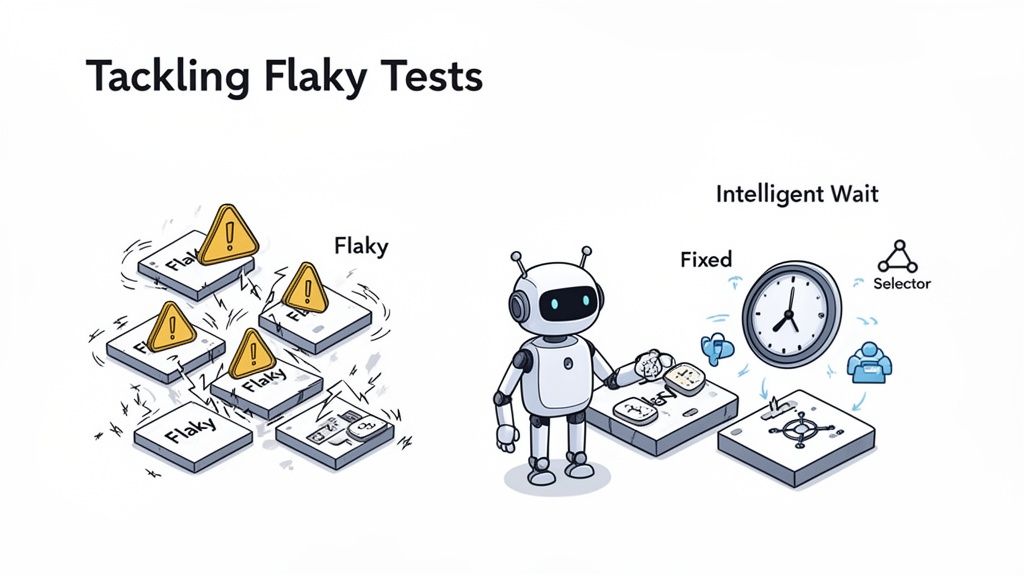
Let’s be honest. The biggest threat to any automation of regression testing effort isn’t a complex feature; it’s the slow, soul-crushing drain of flaky tests and the maintenance they demand. A test suite that constantly throws false failures is more than just an annoyance—it’s actively harmful.
It erodes trust, slows down your pipeline, and eventually, the team starts ignoring the very system designed to protect them.
When a test fails, it needs to mean something real: a bug was found. If your team’s first reaction is a collective sigh followed by, “It’s probably just the test again,” you’ve got a serious flakiness problem on your hands. This completely undermines the value of your automation investment.
Figuring Out Why Your Tests Are Flaky
Flaky tests aren’t usually random acts of chaos. They’re symptoms of deeper issues in how the tests are written or how the environment behaves. Before you can stamp them out, you have to know what you’re actually fighting.
From my experience, the culprits almost always fall into a few familiar categories:
- Timing and Sync Issues: This is the number one offender. Your test script zips along, but the application’s UI can’t keep up. The script tries to click a button that hasn’t even loaded yet, and boom—failure. Sticking a
sleep(5)in there is just a band-aid, not a real fix. - Brittle Element Locators: Relying on super-specific, auto-generated CSS selectors or long XPath strings is just asking for trouble. All it takes is a developer making a minor UI change—like renaming a class or wrapping a
div—and your test shatters, even if the user experience hasn’t changed at all. - Unreliable Test Data: If a test passes only when “John Doe” exists in the database and fails when that user is gone, you have a data dependency problem. Your tests need to be self-sufficient; they should create the data they need and clean up after themselves to run predictably every single time.
- Network and API Dependencies: Sometimes the problem isn’t your code. Your test might fail because a third-party API timed out or the network had a hiccup. These external factors can still bring your test runs to a grinding halt.
The moment your team spends more time debugging the tests than the actual application, your automation has become a liability. The goal is a trusted signal of quality, not a source of constant noise.
How to Build a More Resilient Test Suite
The good news is that you can build resilience into your test suite from the very beginning. Instead of just reacting to failures, you can be proactive by building tests that know how to handle instability.
A huge part of this is moving away from fragile, hard-coded locators. Modern AI-powered tools approach this differently. They don’t just follow a rigid script; they understand the user’s intent. They can find the “Login” button even if its ID or class changes because they recognize its purpose on the page.
This shift toward self-healing tests is a game-changer for reducing maintenance. For a deeper dive, our guide on how to overcome flaky tests and maintenance explores these advanced techniques.
A Practical Triage Process for Failures
Even with the best tests, failures are going to happen. The key is how you respond. Having a solid triage process helps your team quickly separate the real problems from the noise.
When a test fails in the CI/CD pipeline, don’t panic. Follow a simple, repeatable process:
- Re-run the Failed Test: Before you do anything else, run that one failed test again by itself. If it passes on the second try, you’re almost certainly looking at a flaky test, not a real bug.
- Analyze the Failure: Check the logs, screenshots, or video recordings from the moment of failure. Did it time out waiting for an element? Did an assertion fail? The context clues will almost always point you to the root cause.
- Separate Bugs from Flakes: If the test fails consistently in the exact same way, every time, then congratulations—you’ve probably found a legitimate regression. Get a detailed bug report written up. But if its failure is inconsistent, quarantine that flaky test and create a ticket to fix its underlying instability later.
By following a structured process like this, you ensure real bugs get the attention they deserve while you systematically improve the reliability of your entire test suite.
Measuring Success and Building a Culture of Quality
So, you’ve put in the work to automate your regression testing. How do you actually prove it’s paying off? Without the right metrics, your efforts can easily be dismissed as just another cost center instead of the massive value driver they are.
The biggest mistake I see teams make is focusing on vanity metrics, like the total number of automated tests. That number is meaningless on its own. It tells you nothing about business impact. Real success isn’t about the quantity of tests; it’s about making a measurable dent in your team’s speed and the quality of your product.
Tracking What Truly Matters
Your goal is to build a dashboard that tells a clear story, connecting your automation work directly to business outcomes. Forget the fluff and start tracking these core indicators to show the real-world value you’re creating.
- Fewer Bugs in Production: This is the big one. Track the number of critical or major defects that slip past you and get reported by actual users. A steady downward trend here is undeniable proof that your regression suite is doing its job.
- Faster Release Cadence: How often are you shipping new code? If you can release more frequently and with confidence, that’s a direct win for automation. A reliable safety net makes everyone braver.
- Shorter Cycle Time: Measure the time it takes for a code commit to make it all the way to production. Automation slashes this cycle by giving developers near-instant feedback, eliminating those long, agonizing waits for manual QA.
- Hours Reclaimed from Manual Testing: Do a back-of-the-napkin calculation of the hours your team used to burn on manual regression. This metric is a powerful way to show cost savings and highlight how you’ve freed up your QA team for more strategic work, like exploratory testing.
The point isn’t just to catch bugs—it’s to create a system where your team can ship better software, faster. Your metrics need to tell that story, focusing on speed, stability, and cutting down on mind-numbing manual work.
Cultivating a Team-Wide Quality Mindset
Having solid metrics is great, but they’re only half the battle. The real magic happens when you build a culture where quality is everyone’s responsibility, not just a task for the QA department. This is where your automation efforts can really shine.
Start by weaving the tests directly into your developers’ daily workflow. When a dev can run a targeted test suite and get feedback within minutes of a commit, they become the first line of defense against regressions. It’s no longer an abstract problem for someone else to find later; it’s immediate and actionable. This builds a powerful sense of ownership.
Finally, you have to change the conversation around test failures. A failed build shouldn’t be a cause for finger-pointing. It should be a trigger for a quick, collaborative huddle: “What broke, and how can we make sure this doesn’t happen again?” When you start celebrating the stability and speed that good automation provides, you reinforce the idea that quality is a team sport, and everyone wins.
Common Questions We Hear
Even with a solid plan, a few questions always pop up when teams start seriously automating their regression testing. Let’s tackle some of the most common ones I’ve come across.
How Much of Our Regression Suite Should We Actually Automate?
It’s tempting to aim for 100% automation, but that’s rarely the right move. The sweet spot is the good old 80/20 rule.
Focus your energy on automating the critical 20% of your tests that cover about 80% of your core user-facing functionality. Think about the absolute must-work parts of your application.
This usually includes things like:
- User login and account creation flows
- The entire checkout and payment process
- Core feature interactions that define your product’s value
Leave things that require nuanced visual checks or brand-new, highly volatile features for manual testing, at least for now. This way, you get the biggest bang for your buck without getting stuck in an automation rabbit hole.
The real goal isn’t 100% automation. It’s 100% confidence in your most critical user journeys. That’s where the value is.
When’s the Right Time to Run Our Automated Regression Tests?
The most effective strategy is to weave your tests directly into your CI/CD pipeline. For instant feedback, run a small set of essential smoke tests on every single code commit. This catches showstoppers immediately.
Then, schedule your full regression suite to run nightly. You can also trigger it right before a deployment to staging or production. This approach gives you comprehensive coverage and catches regressions early, all without bogging down your developers’ daily workflow.
Ready to stop scripting and start testing? With TestDriver, your team can generate resilient end-to-end tests from simple English prompts, cutting down maintenance and accelerating your release cycles. See how it works at https://testdriver.ai.
Automate and scale manual testing with AI
TestDriver uses computer-use AI to test any app - write tests in plain English and run them anywhere.