regression testing best practices for Flawless releases
Discover regression testing best practices to automate, prioritize risk, and stabilize test suites for faster, reliable releases.
Automate and scale manual testing with AI ->
In the fast-paced world of software development, new features and bug fixes are constantly being deployed. But how do you ensure that these updates don’t inadvertently break existing functionality? This is where a robust regression testing strategy becomes your most valuable asset. It acts as a critical safety net, verifying that code changes haven’t introduced new defects or resurrected old ones.
Simply re-running old tests isn’t enough; a modern approach requires a blend of smart automation, strategic prioritization, and intelligent maintenance. Neglecting these regression testing best practices can lead to critical bugs slipping into production, damaging user trust and costing valuable resources. The goal is to maximize test coverage and confidence while minimizing the time and effort required to run the regression suite. This means moving beyond manual, repetitive checks and embracing a more dynamic, risk-aware process.
This guide moves past generic advice to provide a concrete, actionable framework. We will break down 10 essential practices that transform regression testing from a tedious chore into a powerful, automated quality gate. You will learn how to:
- Strategically select and prioritize tests to focus on high-risk areas.
- Integrate regression testing seamlessly into your CI/CD pipeline for rapid feedback.
- Manage test data and environments effectively to prevent flaky, unreliable results.
- Monitor key metrics to continuously improve your testing process and overall software quality.
By implementing these proven techniques, your team can ensure every release improves your product without introducing new problems, delivering a stable and reliable experience for your users.
1. Automate Regression Test Suites
The cornerstone of any effective, modern quality assurance strategy is automation. Automating your regression test suite involves using specialized frameworks and tools to execute tests systematically without manual intervention. This approach replaces the slow, error-prone, and resource-intensive process of manually re-testing existing functionality with a fast, repeatable, and consistent verification process, forming a fundamental pillar of regression testing best practices.

This practice is essential because it enables teams to run a comprehensive set of tests frequently, such as after every code commit or nightly build. This consistent execution ensures that new code changes haven’t introduced unintended side effects, providing a reliable safety net that allows developers to innovate with confidence. When focusing on efficient test execution, consider general strategies for automating repetitive tasks, which can significantly boost productivity across all development stages.
How to Implement Test Automation Effectively
Successful implementation requires a strategic approach rather than attempting to automate everything at once. Focus first on the most critical and stable parts of your application.
- Start Small and Prioritize: Begin by automating tests for high-value, frequently used features or core business-critical workflows. These areas provide the highest return on investment for your automation efforts.
- Select the Right Tools: Choose frameworks that align with your technology stack. Popular choices include Selenium WebDriver for web applications, JUnit/TestNG for Java, and NUnit for .NET.
- Utilize Data-Driven Testing: Separate test data from test scripts. This technique allows you to run the same test script with multiple data sets, maximizing test coverage with minimal code.
- Establish Robust Reporting: Implement clear logging and reporting mechanisms. Detailed reports help you quickly identify what failed, why it failed, and where, which is crucial for rapid debugging and resolution.
2. Maintain a Regression Test Suite Repository
A disorganized test suite quickly becomes a liability rather than an asset. Maintaining a centralized and well-structured repository for your regression test cases is crucial for consistency, collaboration, and efficiency. This repository acts as a single source of truth, ensuring that every team member can access, update, and execute the same standardized set of tests, which is a foundational element of regression testing best practices.

This practice is essential because it prevents test case duplication, eliminates confusion over which tests are current, and simplifies the process of managing test assets over time. By treating your test suite with the same rigor as your application code, you create a scalable and maintainable testing framework. For teams looking to formalize this process, it is important to implement version control in your test suite, which allows for tracking changes, collaborating effectively, and reverting to previous versions if needed.
How to Implement a Test Suite Repository Effectively
A successful test repository is more than just a folder of scripts; it’s a living system that requires deliberate organization and ongoing maintenance. Start by establishing clear standards that everyone on the team agrees to follow.
- Use Meaningful Naming Conventions: Adopt a clear and consistent naming scheme for test cases and suites. A good name, like
Test_Login_ValidCredentials, instantly communicates the test’s purpose. - Tag Tests with Metadata: Implement a tagging system to categorize tests by priority (e.g., P0, P1), type (e.g., smoke, sanity, full regression), or feature area. This allows for flexible test execution, letting you run specific subsets of tests as needed.
- Document Dependencies and Setup: Clearly document any prerequisites, such as specific test data, user accounts, or system configurations required to run a test. Include detailed setup and teardown procedures to ensure a clean test environment.
- Review and Prune Regularly: Schedule periodic reviews to identify and remove obsolete or redundant tests. A lean, relevant test suite is faster to run, easier to maintain, and provides more reliable feedback.
3. Prioritize and Categorize Regression Tests
As a regression suite grows, running every test for every small change becomes impractical and inefficient. A core component of regression testing best practices is to organize tests into distinct categories and prioritize their execution based on risk, business impact, and frequency of use. This strategic approach ensures that the most critical functionalities are validated first, providing rapid feedback to development teams and optimizing resource allocation.
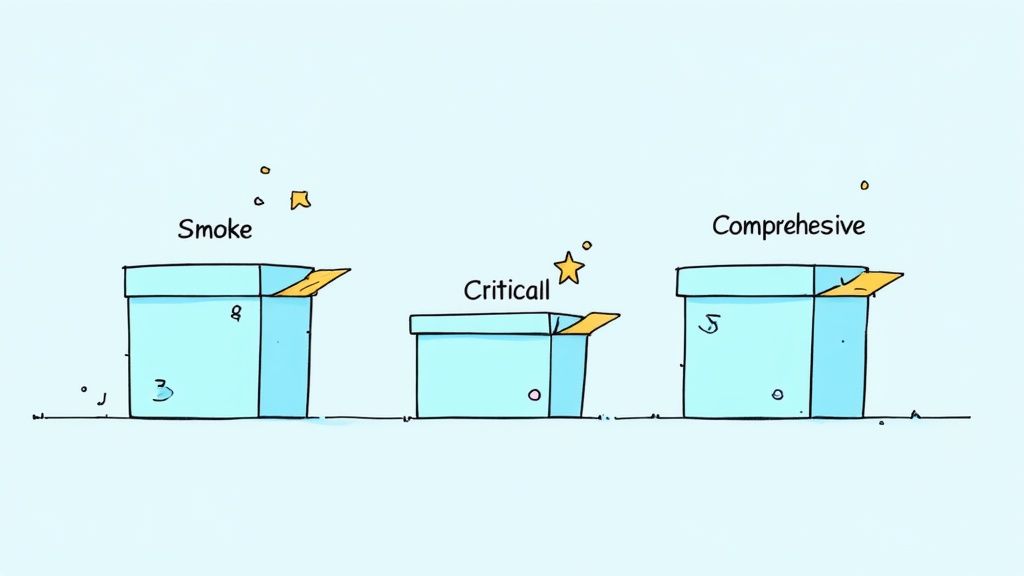
This practice is essential because it allows teams to tailor their testing efforts to the specific context of a code change. Instead of a one-size-fits-all approach, you can run a small set of smoke tests for minor commits or a full comprehensive suite for major releases. This tiered strategy, as seen in complex projects like Mozilla Firefox’s test execution, ensures that you get the right level of confidence at the right time without creating bottlenecks in the development pipeline.
How to Implement Test Prioritization and Categorization
Effective implementation involves segmenting your test suite into logical groups and executing them strategically. This ensures that you can quickly identify high-impact regressions without waiting for the entire suite to complete.
- Create Tiered Test Suites: Segment your tests into distinct categories. A common structure includes a smoke test suite (5-15% of total tests) for quick build verification, a critical path suite covering core user journeys like payment processing, and a comprehensive suite for full regression before a major release.
- Use a Risk Assessment Matrix: Prioritize tests by evaluating the business impact of a feature and the likelihood of its failure. High-risk, high-impact functionalities should be tested earliest and most frequently.
- Analyze Defect History: Review historical defect data to identify areas of the application that are historically prone to bugs. Increase the priority of tests covering these unstable modules.
- Track Execution Times: Monitor how long each test takes to run. This data is crucial for balancing test coverage with feedback time, ensuring that your most important suites are also your fastest.
4. Implement Continuous Integration and Test Automation
Integrating your automated regression suite into a Continuous Integration/Continuous Deployment (CI/CD) pipeline is a transformative step. This practice embeds testing directly into the development lifecycle, automatically triggering your regression tests whenever new code is committed or a new build is created. This creates a powerful, automated feedback loop that identifies regressions almost instantly, preventing defective code from ever moving further down the pipeline toward production.
This approach is one of the most critical regression testing best practices because it shifts quality assurance from a separate, often delayed phase into an integral part of development. By running tests on every change, teams get immediate validation that their new code hasn’t broken existing functionality. This rapid feedback cycle allows developers to address issues while the context is still fresh, dramatically reducing the cost and effort of bug fixes. You can discover more by reading about the best practices for integrating testing into your CI/CD pipeline, which will help ensure a seamless implementation.
How to Implement CI/CD Testing Effectively
A successful integration hinges on speed, reliability, and clear communication. The goal is to make testing a frictionless part of the developer workflow.
- Establish Automated Triggers: Configure your CI server (like Jenkins, GitLab CI, or GitHub Actions) to automatically run your regression suite upon every code commit to the main branch or on every pull request. This ensures no code gets merged without being validated.
- Keep Feedback Loops Short: Aim to have your regression suite complete its run in under 15 minutes. Long-running test suites can become a bottleneck. Use parallel execution to run multiple tests simultaneously and drastically reduce the total pipeline duration.
- Implement Smart Notifications: Set up alerts in communication channels like Slack or email. These notifications should immediately inform the team of a build failure, allowing them to take swift action. A dedicated dashboard can also provide a high-level view of pipeline health.
- Use Stage Gates: Configure your pipeline to act as a “gatekeeper.” If the regression tests fail, the pipeline should automatically block the code from being deployed to the next environment, such as staging or production, thereby protecting your live system.
5. Use Risk-Based Testing Approaches
Not all features are created equal, and a one-size-fits-all approach to regression testing can waste valuable time and resources. A risk-based testing approach involves strategically analyzing and prioritizing tests based on the potential business impact and likelihood of failure. This method ensures that your most critical application areas receive the most thorough attention, optimizing test efforts and maximizing the value of your regression suite.
This practice is a cornerstone of efficient regression testing best practices because it shifts the focus from testing everything equally to testing what matters most. For example, a financial services application would prioritize transaction processing and security functions over a less-critical settings page. Similarly, an e-commerce platform would concentrate regression testing on its payment gateway and checkout flows, as failures there directly impact revenue. This targeted strategy helps catch the most damaging defects with limited resources.
How to Implement Risk-Based Testing Effectively
Implementing a risk-based strategy requires a collaborative effort to identify and quantify potential risks. It transforms testing from a purely technical task into a business-aligned quality assurance function.
- Create a Risk Assessment Matrix: Develop a matrix that plots the business impact of a feature failure against the likelihood of it failing. This visual tool helps categorize features into high, medium, and low-risk tiers to guide test prioritization.
- Involve Stakeholders in Risk Identification: Collaborate with product managers, business analysts, and developers to get a holistic view of what constitutes a risk. Their diverse perspectives are crucial for accurately assessing business impact.
- Use Historical Defect Data: Analyze past bug reports and production incidents to identify areas of the application that are historically unstable or defect-prone. This data provides an empirical basis for assigning higher risk scores.
- Review and Update Risk Assessments Regularly: Risks are not static; they evolve with new features, code refactoring, and changing user behaviors. Revisit and adjust your risk assessment periodically, especially before major releases, to ensure it remains relevant.
6. Implement Test Data Management and Isolation
Effective test data management is the unsung hero of reliable regression testing. This practice involves systematically creating, maintaining, and isolating data environments to ensure tests run consistently and are not influenced by external factors or each other. By managing test data properly, you eliminate a primary source of test failures-data dependencies-and guarantee that each test execution is reproducible, a core tenet of regression testing best practices.
This discipline is crucial because inconsistent or polluted data can cause tests to fail for reasons unrelated to code changes, leading to wasted debugging time and a loss of confidence in the regression suite. For example, a test designed to verify a “user checkout” flow will fail if the test product is out of stock. Proper data management ensures the necessary preconditions, like available inventory, are always met, allowing tests to accurately validate application logic.
How to Implement Test Data Management Effectively
A robust test data strategy ensures that your tests are self-contained and dependable. This requires a proactive approach to creating and resetting test environments.
- Create Reusable Data Fixtures: Develop a set of predefined, reusable data states (fixtures) that can be loaded before a test run. This ensures a consistent starting point for critical tests, such as a user account with a specific subscription level.
- Use Database Snapshots and Resets: For complex data setups, leverage database snapshots to quickly restore the environment to a known good state before each test suite execution. This prevents data from one test from impacting another.
- Implement Data Factories: Utilize data factories or builders to generate dynamic, valid test data on the fly. This is especially useful for creating unique records like new user accounts or orders, avoiding conflicts from hardcoded data.
- Mask Sensitive Information: Never use raw production data in testing environments. Implement data masking or anonymization techniques to protect personally identifiable information (PII) and comply with regulations like GDPR and HIPAA.
7. Execute Cross-Browser and Cross-Platform Testing
Ensuring an application delivers a consistent and reliable user experience is no longer limited to a single browser or operating system. Executing cross-browser and cross-platform testing involves validating your application’s functionality, performance, and appearance across a diverse range of environments. This practice is a critical component of modern regression testing best practices, as it confirms that new code changes do not break the user experience for any segment of your audience.
This process is essential for maintaining brand reputation and user satisfaction in a fragmented digital landscape. A feature that works perfectly in Chrome on a desktop might fail spectacularly on Safari for iOS or render incorrectly in Firefox on a tablet. By systematically testing across these variables, you prevent environment-specific regressions from reaching production, ensuring your application is robust and accessible to all users, regardless of their chosen technology.
How to Implement Cross-Environment Testing Effectively
A successful cross-environment strategy requires careful planning to maximize coverage without creating an unmanageable testing workload. Focus on the platforms your target audience uses most and leverage tools that streamline execution.
- Prioritize Popular Environments: Analyze your user analytics to identify the most common browser, operating system, and device combinations. Focus your initial regression testing efforts on these high-traffic configurations to cover the largest portion of your user base.
- Leverage Cloud-Based Testing Services: Platforms like BrowserStack and Sauce Labs provide access to thousands of real and virtual device-browser-OS combinations on demand. This approach is more cost-effective and scalable than maintaining an in-house device lab.
- Utilize Parallel Execution: Drastically reduce test execution time by running your regression suite in parallel across multiple environments. Tools like Selenium Grid enable you to distribute tests simultaneously, providing faster feedback on potential regressions.
- Incorporate Visual Regression Testing: Use specialized tools to capture and compare screenshots of your application’s UI across different browsers and viewports. This helps catch subtle visual bugs, such as misaligned elements or font rendering issues, that automated functional tests might miss.
8. Monitor and Analyze Test Metrics and Reporting
A regression testing strategy is incomplete without a robust system for monitoring and analyzing its performance. This practice involves systematically collecting, tracking, and interpreting key metrics from your test executions to gain actionable insights into your quality assurance process. By moving beyond simple pass/fail results, you can adopt a data-driven approach to identify bottlenecks, measure effectiveness, and continuously improve your testing framework, making it a critical component of regression testing best practices.
This data-centric view is essential for understanding the health of your application and the efficiency of your QA efforts. It transforms testing from a reactive bug-finding activity into a proactive quality engineering function. For instance, platforms like TestRail provide comprehensive reporting dashboards that visualize test trends over time, while Jenkins can display pass/fail rates and execution durations directly within the CI/CD pipeline, offering immediate feedback to the development team.
How to Implement Effective Test Monitoring
Successful implementation depends on tracking the right metrics and making them visible and accessible to all stakeholders. This transparency helps align the team around quality goals and highlights areas needing attention.
- Track Key Performance Indicators (KPIs): Focus on metrics that provide a clear picture of quality and efficiency. Key metrics include test execution time, pass/fail rate trends, test coverage by feature, and the defect escape rate (the number of bugs discovered in production).
- Establish Baselines and Trends: Don’t just look at numbers from a single run. Establish baseline performance metrics and monitor them over time to spot trends. A gradual increase in test execution time could signal performance degradation in the application.
- Create Role-Specific Dashboards: Build customized dashboards to communicate relevant information to different stakeholders. An executive dashboard might show high-level quality trends, while a developer-focused view could highlight recent test failures and code coverage gaps.
- Integrate with Project Management Tools: Connect your test reporting tools with platforms like Jira. This integration allows you to automatically link failed tests to bug reports, track resolution times, and provide a unified view of quality within your development workflow.
9. Reduce Test Flakiness and Maintain Test Stability
One of the most significant threats to a regression suite’s credibility is test flakiness, which occurs when tests pass or fail inconsistently without any underlying code changes. These unreliable results erode trust in the automation suite, leading teams to ignore genuine failures and waste valuable time investigating false alarms. A core component of regression testing best practices is to proactively identify, manage, and eliminate these flaky tests to ensure the reliability of your quality gate.
This practice is essential because a stable test suite provides clear, dependable feedback on the application’s health. When tests are reliable, a failure signals a real regression, allowing developers to act swiftly and with confidence. Companies like Google have invested heavily in building internal systems to detect and quarantine flaky tests, highlighting the industry-wide importance of maintaining a stable and trustworthy test environment. Strategies for how to overcome flaky tests and maintenance in functional test automation are critical for long-term success.
How to Mitigate Test Flakiness Effectively
A systematic approach to identifying and fixing the root causes of instability is required. Instead of simply re-running failed tests, focus on building resilience and predictability into your test code from the start.
- Implement Smart Wait Conditions: Replace fixed delays (like
Thread.sleep()) with dynamic waits. Use explicit waits that poll for an element to be clickable or visible, which makes tests more resilient to variations in page load times. - Isolate Test Cases: Ensure each test is self-contained and does not depend on the state left by a previous test. Reset the application state before each run to guarantee a consistent starting point and prevent cascading failures.
- Use Retry Mechanisms Sparingly: Frameworks like TestNG and Pytest offer built-in retry logic. Use this as a temporary measure to manage intermittent environmental issues, but limit retries (e.g., to one or two attempts) to avoid masking real, underlying problems.
- Analyze and Monitor Test History: Regularly review test execution logs to identify patterns of flakiness. A test that fails sporadically across different builds is a prime candidate for investigation. Tools that track test history are invaluable for this analysis.
10. Maintain Strong Documentation and Test Case Management
A regression test suite is only as valuable as it is understandable and maintainable. Maintaining strong documentation and a structured approach to test case management ensures that your testing efforts remain effective, scalable, and transparent over time. This practice involves creating clear, detailed, and accessible documentation for every test case, procedure, and expected outcome, forming a critical component of any mature regression testing best practices.
This disciplined approach is essential for long-term project health. Without it, test suites become a “black box,” making it difficult for new team members to contribute, for existing members to debug failures, or to update tests as the application evolves. Clear documentation provides a single source of truth, ensures consistency across the team, and preserves institutional knowledge. For effective test case management, robust and clear documentation is non-negotiable; exploring comprehensive software documentation best practices can guide this effort.
How to Implement Strong Test Case Documentation
Effective implementation hinges on consistency, clarity, and integrating documentation into the workflow rather than treating it as an afterthought. Use dedicated tools and establish clear standards from the outset.
- Adopt a Test Management Tool: Utilize platforms like TestRail or plugins within JIRA to provide a structured repository for your test cases. These tools help organize tests into suites, link them to requirements, and track execution history.
- Write Clear and Concise Test Cases: Each test case should be a self-contained unit with a clear objective. Write step-by-step instructions in simple language, specify the necessary test data, and define the exact expected result for each step.
- Link Tests to Requirements: Establish traceability by linking each test case back to the specific user story, feature, or requirement it validates. This context is invaluable for understanding a test’s purpose and prioritizing it during regression cycles.
- Schedule Regular Documentation Reviews: Treat your test documentation like code. Periodically review and refactor test cases to remove outdated steps, clarify ambiguities, and ensure they align with the current state of the application.
Regression Testing Best Practices: 10-Point Comparison
| Item | Implementation complexity (🔄) | Resource requirements (⚡) | Expected outcomes (📊) | Ideal use cases (💡) | Key advantages (⭐) |
|---|---|---|---|---|---|
| Automate Regression Test Suites | 🔄🔄🔄 High initial setup and scripting | ⚡⚡ Automation infra and specialized engineers | 📊 Consistent, fast, repeatable runs; measurable results | 💡 Frequent releases, large or complex codebases | ⭐ Speed, parallel execution, reliable reporting |
| Maintain a Regression Test Suite Repository | 🔄🔄 Moderate organization and versioning | ⚡ Low–moderate (storage, VCS tooling) | 📊 Single source of truth; traceability and reuse | 💡 Collaborative teams, multi-project reuse | ⭐ Reusability, version history, easier onboarding |
| Prioritize and Categorize Regression Tests | 🔄 Low–moderate one-time & ongoing tuning | ⚡ Low (stakeholder time, simple tools) | 📊 Faster feedback on critical functionality | 💡 Time-constrained runs; critical business flows | ⭐ Efficient resource use; risk-focused testing |
| Implement Continuous Integration and Test Automation | 🔄🔄🔄 Complex pipeline integration and maintenance | ⚡⚡⚡ CI infrastructure, orchestration, experts | 📊 Immediate feedback; fewer integration regressions | 💡 Continuous delivery, frequent commits/PRs | ⭐ Early detection of regressions; improved quality |
| Use Risk-Based Testing Approaches | 🔄🔄 Moderate: assessments and periodic updates | ⚡ Low–moderate (analysts, historical data) | 📊 Optimized coverage for high-impact areas | 💡 Regulated systems or high-business-impact features | ⭐ Maximizes value per test; business-aligned focus |
| Implement Test Data Management and Isolation | 🔄🔄🔄 High: data design, masking, isolation | ⚡⚡⚡ Storage, tooling, data engineering effort | 📊 Repeatable, reliable tests; reduced data-related flakiness | 💡 Data-sensitive apps; parallel/concurrent testing | ⭐ Reproducibility, compliance support, stability |
| Execute Cross-Browser and Cross-Platform Testing | 🔄🔄 Moderate–high: environment matrix management | ⚡⚡⚡ Large infra or cloud testing services | 📊 Compatibility assurance across browsers/devices | 💡 Web/mobile apps with diverse user environments | ⭐ Detects platform-specific issues; improves UX |
| Monitor and Analyze Test Metrics and Reporting | 🔄🔄 Moderate: dashboards and analytics setup | ⚡⚡ Metrics tooling, storage, analyst time | 📊 Visibility into trends, coverage, and ROI | 💡 Teams improving test effectiveness and processes | ⭐ Data-driven optimization; trend and risk detection |
| Reduce Test Flakiness and Maintain Test Stability | 🔄🔄 Moderate–high: root-cause analysis & fixes | ⚡⚡ Monitoring tools and developer effort | 📊 More reliable results; fewer false positives | 💡 Mature automation suites with intermittent failures | ⭐ Increased confidence in automation; faster triage |
| Maintain Strong Documentation and Test Case Management | 🔄🔄 Moderate: authoring and regular upkeep | ⚡ Low–moderate (TMS tools, time) | 📊 Improved maintainability, traceability, onboarding | 💡 Distributed teams, frequent personnel changes | ⭐ Clarity, consistent procedures, easier maintenance |
Accelerating Your QA: The Future of Regression Testing with AI
Mastering regression testing is not just about catching bugs; it’s about building a fortress of confidence around your product. It’s the critical safety net that allows your team to innovate, refactor, and release features at speed without the constant fear of breaking what already works. Throughout this guide, we’ve unpacked the essential regression testing best practices that form the pillars of a mature quality assurance strategy. From intelligent test suite automation and risk-based prioritization to robust test data management and CI/CD integration, each practice contributes to a more stable, predictable, and efficient development lifecycle.
The journey from a manual, reactive approach to a proactive, automated one is transformative. By maintaining a centralized test repository, you create a single source of truth that eliminates ambiguity. By prioritizing tests based on business impact and code complexity, you optimize your resources, ensuring the most critical user flows are always protected. Implementing these strategies systematically moves your team from a state of constant fire-fighting to one of strategic quality engineering.
Synthesizing Best Practices into a Cohesive Strategy
The true power of these practices is unlocked when they are integrated into a holistic system rather than treated as isolated tasks. Your CI/CD pipeline becomes the engine, executing prioritized tests automatically. Your monitoring and metrics become the dashboard, providing real-time feedback on application health and test suite effectiveness. This interconnected ecosystem ensures that quality is not an afterthought but a continuous, data-driven process.
Consider the compounding benefits:
- Reduced Flakiness: Proactive maintenance and isolated test data directly combat the notorious issue of flaky tests, leading to more reliable build signals.
- Faster Feedback Loops: Integrating automated regression suites into your CI/CD pipeline means developers get feedback in minutes, not days, drastically reducing the cost and complexity of fixing defects.
- Increased Release Velocity: A stable, efficient regression strategy gives your organization the confidence to deploy more frequently, accelerating time-to-market for new features.
Key Takeaway: The goal isn’t just to implement individual regression testing best practices; it’s to weave them into the fabric of your development culture, creating a resilient system where quality is a shared responsibility, enabled by automation and intelligent processes.
The Next Frontier: AI-Powered Efficiency
While these best practices provide a powerful framework, the manual effort required for test creation and maintenance remains a significant challenge for many teams. Scripting complex end-to-end scenarios, updating selectors after UI changes, and generating appropriate test data can consume countless engineering hours. This is where the landscape of QA is rapidly evolving.
The emergence of AI-driven testing platforms marks a paradigm shift, moving the focus from manual scripting to strategic intent. As highlighted in the introduction, tools like TestDriver are abstracting away the most time-consuming aspects of test automation. Instead of writing hundreds of lines of code to simulate a user journey, engineers can now describe it in plain English. This approach democratizes test creation, empowering product managers and manual QA testers to contribute directly to the automation suite.
This AI-assisted model doesn’t replace the foundational regression testing best practices we’ve discussed; it supercharges them. It accelerates the creation of your automated test suite, simplifies the maintenance of your test repository, and allows your team to achieve comprehensive coverage faster than ever before. By offloading the repetitive, mechanical tasks to an intelligent system, your engineers are free to focus on what truly matters: designing high-impact test strategies, analyzing complex results, and driving a culture of quality across the organization. The future of regression testing is one where human expertise is augmented by AI efficiency, creating a powerful synergy that delivers higher-quality software, faster.
Ready to see how AI can revolutionize your regression testing workflow? Discover how TestDriver lets you generate and maintain complex end-to-end tests from simple text prompts, cutting your test creation time by over 90%. Visit TestDriver to learn how you can build a comprehensive, low-maintenance regression suite in a fraction of the time.
Automate and scale manual testing with AI
TestDriver uses computer-use AI to test any app - write tests in plain English and run them anywhere.