Regression Testing vs Smoke Testing: Key Differences for Faster Releases
Understand regression testing vs smoke testing to choose the right QA approach for each release and accelerate QA cycles.
Automate and scale manual testing with AI ->
When you get down to it, the smoke testing vs. regression testing debate really boils down to two things: purpose and scope. Think of smoke testing as a quick, shallow check to see if a new software build is even stable enough for the QA team to touch. On the other hand, regression testing is a much deeper, more methodical process designed to ensure that recent code changes haven’t accidentally broken something that was already working.
Understanding The Core Difference In QA Testing
Smoke testing is basically the bouncer at the door of your QA process. It answers one simple question: “Is this new build so fundamentally broken that we should stop right now?” It’s a sanity check you run the moment a new build is deployed, focusing only on the absolute most critical functions. It’s like plugging in a new TV to see if it turns on before you start fiddling with the color settings.
If a build fails the smoke test, it gets sent right back to development. This simple step saves the QA team from wasting countless hours trying to test an unstable product.
Regression testing, in contrast, is all about protecting what you’ve already built. It asks a far more complex question: “Did the new feature we just added, or the bug we just fixed, create a new problem somewhere else?” This is a much broader and deeper investigation, involving a large suite of test cases that run across the application to catch any of those nasty, unexpected side effects we call “regressions.”
Scope And Execution Time
The practical differences really stand out when you look at the time and effort involved. A recent World Quality Report noted that 68% of organizations run smoke tests right after every single build deployment. These tests are fast, usually wrapping up in just 60-150 minutes, because they only check critical paths like whether the app loads or a user can log in.
Meanwhile, a Stack Overflow Developer Survey found that 82% of QA teams rely on regression testing after major code changes or before a release. This process is a marathon, not a sprint. It can involve hundreds of test cases and take anywhere from 4-8 hours—or even longer—because its scope is so much wider.
The core distinction is simple: Smoke testing verifies that a build is stable enough to be tested, while regression testing verifies that a stable build remains stable after changes.
It’s also crucial not to mix these up with similar testing types. For a closer look at how these practices fit together, our guide on understanding retesting in software testing provides some excellent context.
Smoke Testing vs Regression Testing At a Glance
To quickly see how these two essential testing types stack up, here’s a high-level comparison.
| Attribute | Smoke Testing | Regression Testing |
|---|---|---|
| Primary Goal | Verify build stability and readiness for QA. | Ensure new code changes do not break existing functionality. |
| Scope | Narrow and shallow, covering only critical features. | Broad and deep, covering impacted and related features. |
| When to Perform | Immediately after a new build is deployed. | Before a major release or after significant code changes. |
| Typical Duration | Minutes to a couple of hours. | Hours to days, depending on the test suite size. |
| Coverage | High-level, focusing on “happy path” scenarios. | Comprehensive, including edge cases and negative tests. |
This table provides a quick reference, but the real art is knowing when and how to apply each method to protect your product’s quality without slowing down your development pipeline.
Smoke vs. Regression Testing: A Detailed Breakdown
While smoke and regression testing are both staples in any serious QA playbook, they sit on opposite ends of the testing spectrum. Think of them as different tools for different jobs. Getting their purpose, timing, and scope right is the key to using them effectively.
At its core, the difference boils down to the question each one answers.
A smoke test asks: “Is this new build stable enough to even bother testing?” It’s a quick, high-level check to catch massive, show-stopping bugs right out of the gate. On the other hand, regression testing asks: “Did our recent changes accidentally break something that used to work?” This requires a much more thorough, almost forensic, investigation.
This visual captures the distinct mission of each testing type perfectly.
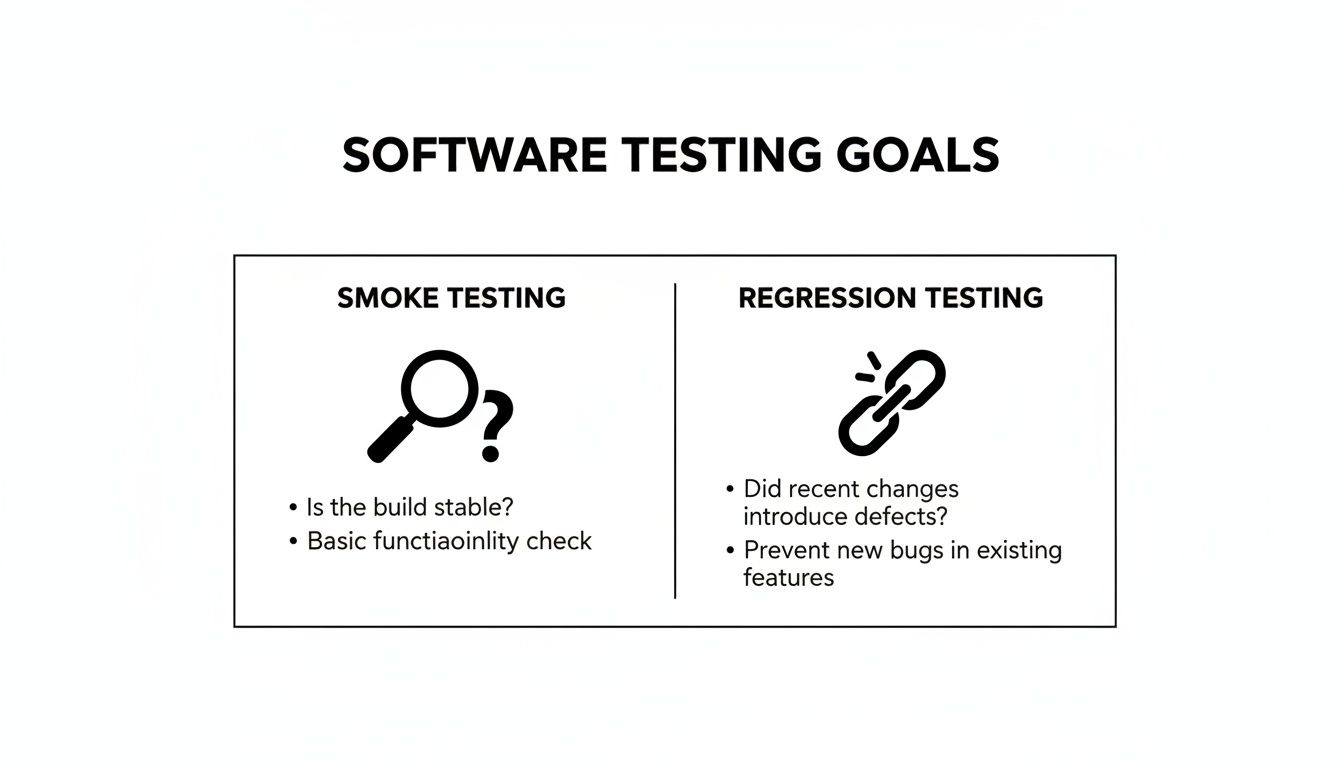
As you can see, smoke testing is all about checking for basic stability. Regression testing is a much broader hunt for unintended side effects, ensuring new code doesn’t undermine what’s already there.
Scope And Depth Of The Tests
The most glaring difference in the regression testing vs. smoke testing debate is their scope. Smoke testing is deliberately narrow and shallow. It only skims the surface, checking the most critical “happy path” workflows.
Imagine you’re testing an e-commerce site. A smoke test suite would probably just confirm a few basics:
- Does the homepage load?
- Can a user log in?
- Can they add an item to the cart?
If any of these fundamental actions fail, the build is rejected on the spot. No time wasted. The idea isn’t to find every little bug, but to confirm the application isn’t completely broken before the team invests more time.
Regression testing, in contrast, is broad and deep. Its job is to confirm that new code hasn’t caused old features to crumble. This means running a massive suite of test cases that covers not just the happy path, but also obscure edge cases, third-party integrations, and complex user flows.
For that same e-commerce site, the regression suite would test everything from the smoke test, plus a whole lot more:
- Does the “Forgot Password” link still send an email?
- Are all payment options—PayPal, Stripe, Apple Pay—still processing correctly?
- Do user profile changes save properly after the latest UI update?
This level of depth is what prevents new features from creating a domino effect of bugs across the application.
Execution Timing And Frequency
When you run these tests also reveals their distinct roles. Smoke tests are all about high frequency and immediate feedback. Ideally, you should run them automatically every time a new build is deployed to a test environment.
This rapid check serves as a gatekeeper, stopping unstable code from ever reaching the main QA pipeline. Because smoke tests are so lightweight, they can run many times a day without creating a bottleneck.
A test can actually be both a smoke test and a regression test. It’s common practice to cherry-pick a small subset of the most critical regression tests to serve as the smoke suite. This way, you get a quick pulse check before kicking off the full, time-consuming regression run.
Regression tests, however, are run less often but at critical moments. You’ll typically see them executed:
- After a new feature is developed and has passed its initial round of testing.
- Just before a major version is released to production.
- Following a critical bug fix to ensure the patch didn’t break something else.
This timing provides a comprehensive safety net right when the risk of regressions is at its highest.
Effort And Execution Realities
The difference in effort and execution speed is night and day. Smoke testing is built for speed—a manual run might take under 30 minutes, while an automated one is over in seconds. This makes it an essential part of any modern DevOps workflow.
Regression testing is a different beast entirely. It’s a meticulous, planned effort that can easily consume 20-40% of the total QA cycle. In fact, a State of Testing report by PractiTest found that 62% of SDETs called it their biggest time sink. For more insights on this, you can learn about common time sinks in QA on Testlio’s blog.
This huge time commitment is precisely why automation is a must-have for regression testing, not a nice-to-have. Trying to manually execute thousands of test cases is slow, prone to human error, and simply not viable for teams trying to ship code quickly. While simpler, smoke tests also benefit massively from automation, giving developers that instant feedback loop they need.
Ultimately, they aren’t competing methodologies. They are two essential, complementary layers in a robust quality assurance strategy.
Practical Use Cases And Real-World Scenarios
It’s one thing to know the textbook definitions of smoke and regression testing. It’s another thing entirely to see how they play out in the trenches of a real development cycle. These aren’t just abstract concepts; they’re essential tools that teams use every day to manage risk without killing their momentum.
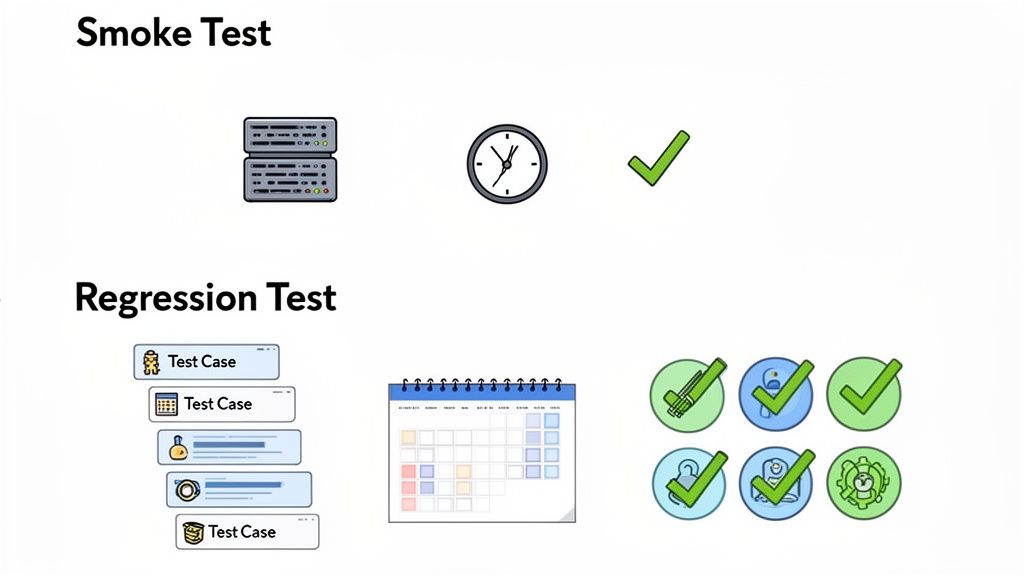
Let’s ground the theory in reality and explore a few common situations where each type of test becomes absolutely critical.
When Smoke Testing Shines
Think of smoke testing as the first line of defense—a quick, immediate gut check. Its entire purpose is to answer one simple question: Is this new build even worth our time, or is it a dud that needs to be sent back to the drawing board?
Here are a couple of classic scenarios where it saves the day:
- After a Nightly Build: Your CI/CD pipeline works its magic overnight, churning out a fresh build of the application. The very first action triggered is an automated smoke test. It doesn’t do much—just checks if the app starts, the database connects, and the login screen appears. If that fails, the team gets an alert first thing in the morning, long before any QA engineer wastes hours trying to test a fundamentally broken build.
- Deploying a Hotfix: A critical bug has been found on the live site, and a developer pushes an emergency fix. Before that code goes anywhere near production, a lightning-fast smoke test runs against the staging environment. This is a crucial sanity check to ensure the “fix” didn’t accidentally bring down the entire system, which happens more often than you’d think under pressure.
The core principle of smoke testing is risk mitigation at its fastest. It’s a low-effort, high-reward activity that prevents costly context switching and wasted QA cycles on builds that are dead on arrival.
In both these cases, the smoke test isn’t hunting for subtle flaws. It’s just a pass/fail gatekeeper, confirming the build is stable enough to even bother with deeper testing.
When Regression Testing Is Non-Negotiable
If smoke testing is a quick check-up, then regression testing is a full physical. It’s the guardian of everything you’ve already built, ensuring new code plays nicely with all the old code. You run it when the risk of unintended side effects is high.
These are the moments when a comprehensive regression suite is absolutely essential:
- Before a Major Release: The team is about to launch the big Q3 update, which includes a redesigned user dashboard and a brand-new payment integration. Before that version gets the green light, the full regression suite runs. This exhaustive check confirms the new dashboard didn’t break old profile settings and the new payment option didn’t mess up the existing credit card logic.
- After Refactoring Core Code: A dev team just spent two weeks refactoring the app’s authentication module to improve security. To the end user, nothing looks different. But under the hood, everything has changed. Running the full regression suite is the only way to be confident that user permissions, session timeouts, and the “Remember Me” feature still work perfectly across the entire application.
Sample Test Cases for Different Scenarios
To really hammer home the difference in scope and detail, let’s look at some sample test cases for a hypothetical e-commerce site. This table shows what a QA engineer might actually test in each situation.
| Testing Type | Scenario | Sample Test Case |
|---|---|---|
| Smoke Test | A new build is deployed to the QA server. | 1. Launch the application URL.2. Verify the homepage loads and the main logo is visible.3. Enter valid user credentials and click “Login.”4. Confirm the user dashboard loads successfully. |
| Regression Test | A new “Wishlist” feature is added. | 1. Run all smoke tests.2. Verify all existing user permission levels (Admin, Editor, Viewer).3. Test all payment gateways (Stripe, PayPal, Apple Pay) with valid and invalid cards.4. Validate the “Forgot Password” workflow.5. Check that adding an item to the cart updates the cart icon correctly.6. Confirm the checkout process still calculates tax and shipping accurately for multiple regions. |
Looking at them side-by-side makes the distinction obvious. The smoke test is a quick sprint down a single critical path. The regression test is a thorough, wide-ranging marathon designed to protect the entire product’s stability.
How to Choose the Right Testing Strategy
Choosing between a quick smoke test and a full-blown regression suite is more than just a technical call—it’s a strategic decision. It’s about finding that sweet spot between moving fast and maintaining quality, making sure your team’s effort goes where it counts. This means shifting away from an “always run everything” mindset to a smarter, more risk-based approach.
The right choice comes down to the nature of the change, its potential business impact, and your team’s bandwidth. A minor text update on a marketing page and a core change to the payment processing logic are worlds apart in terms of risk. Naturally, they demand different levels of testing.
Assessing the Impact of Code Changes
First things first, you have to look at the change itself. Let’s be honest, not all code commits are created equal. A small, isolated fix on a page nobody visits is low-risk. But a tweak to a shared library or a core API? That could cause chaos everywhere.
To make a smart call, you need to ask a few key questions:
- How complex is the change? Is this a one-line fix or are you refactoring an entire module? The more tangled the code, the higher the chance of breaking something unexpectedly.
- How critical is the affected feature? A bug in the login flow or checkout process is a full-blown emergency. A typo in the website footer is just an annoyance. Always prioritize based on what matters to the business.
- What’s the blast radius? Does this change only touch one isolated component, or does it affect shared services, databases, or APIs used across the entire application? A big blast radius is a flashing red light telling you to test more thoroughly.
Thinking through these points helps you make a decision based on data, not just gut feelings.
A Practical Decision-Making Framework
Once you’ve got a handle on the risk, you can use a simple framework to guide your testing strategy. This isn’t about following rigid rules, but about making intelligent trade-offs.
Think of it in terms of these scenarios:
- Low-Risk Changes: For minor UI tweaks, content updates, or fixes to non-critical bugs, a smoke test is usually all you need. The goal here is just to make sure the build isn’t broken and the immediate change works. No need to spend hours on a full regression cycle.
- Moderate-Risk Changes: Adding a new, self-contained feature that doesn’t mess with core systems? A targeted regression test is the perfect middle ground. You run your smoke tests, plus a handpicked set of regression tests that cover the affected area. This saves time while still checking that key integrations hold up.
- High-Risk Changes: For major feature releases, deep architectural changes, or fixes to critical security flaws, running the full regression suite is non-negotiable. The potential cost of a bug slipping through in these situations is just too high to cut corners.
Ultimately, you want to match your testing effort to the level of business risk. Over-testing small changes just slows everyone down, while under-testing critical updates puts your users and your reputation on the line.
This flexible approach helps teams keep up their pace for low-risk updates while applying the right amount of scrutiny where it really matters. It’s about being strategic, not just systematic. Your choice should always be deliberate, driven by a clear understanding of what could go wrong.
Automating Smoke and Regression Tests for Efficiency
In today’s fast-paced development cycles, manual testing just can’t keep up. If you want to achieve the speed and reliability needed for continuous delivery, automation isn’t just a nice-to-have; it’s a must. For both smoke and regression testing, automation is the key to expanding coverage, getting faster feedback, and ultimately, shipping with more confidence.
But the “why” behind automating these two test types is completely different. With smoke testing, the entire game is about speed. You need a simple “pass” or “fail” on a new build within minutes. This quick check tells developers right away if their latest changes broke something fundamental, stopping an unstable build in its tracks before it wastes everyone else’s time.
When it comes to regression testing, the focus shifts from pure speed to scale and consistency. No human can manually run hundreds—or thousands—of regression test cases without going crazy or making mistakes. Automation ensures this deep, wide validation happens the exact same way, every single time, protecting existing features from unexpected bugs.
Strategic Automation Approaches
These contrasting goals are easy to see in the data. Automated smoke tests can run up to 10 times faster than doing them by hand, which is why 78% of enterprises use them to validate new builds. This simple step helps block around 60% of unstable builds from ever reaching the main QA environment.
Regression test automation is a heavier lift, leading to a 65% uptake, but its impact is massive. It’s the only practical way to ensure that 88% of impacted areas are checked after an update. You can dig deeper into these benchmarks and industry trends at Harness.io.
Think of it like this: smoke test automation is your immediate gatekeeper, preventing bad code from getting in. Regression test automation is your long-term guardian, protecting the stability of the entire product.
This is where smart automation tools really shine. Instead of getting bogged down with brittle, hand-coded scripts, modern platforms can build solid tests from simple, human-readable instructions.
The diagram below illustrates how an AI-powered system can fit into this process, generating and running tests automatically within a CI pipeline.
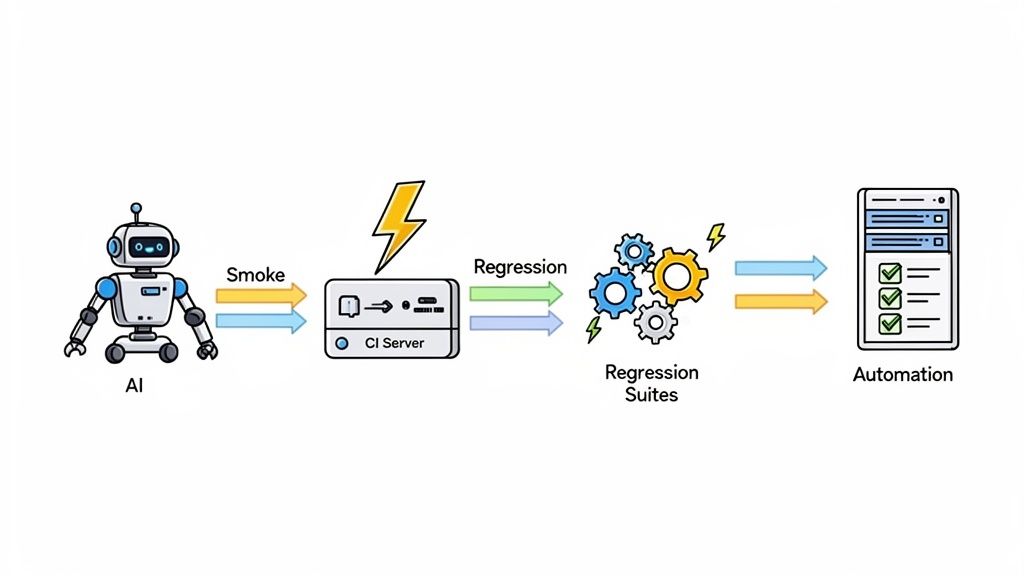
This modern approach makes it so much easier to create both quick smoke checks and thorough regression suites. It lets your team spend less time on tedious scripting and more time thinking about what really needs to be tested.
The Role of AI in Modern Test Automation
AI-powered tools like TestDriver are fundamentally changing how teams approach test automation. By using an AI agent, QA teams can create and maintain both smoke and regression tests from one place, without writing endless lines of code.
Here’s what that looks like in the real world:
- For Smoke Testing: A QA engineer can simply ask the AI, “Verify that a user can log in and see the main dashboard.” Instantly, TestDriver generates a focused, working test for that critical user path. This test can then be plugged directly into the CI/CD pipeline to run on every new build.
- For Regression Testing: To cover more ground, you could prompt, “Create a full test suite for the user profile section, including editing a profile, changing a password, and updating notification settings.” The AI gets to work and builds out a whole series of end-to-end tests. This suite is then ready to run before any major release to catch regressions.
This AI-first approach directly attacks the biggest bottleneck in QA: the time it takes to create tests. It gives teams the ability to build out their smoke and regression suites much faster than with old-school methods. For more on this, check out our guide on the key considerations for effective test automation. By cutting down the manual slog, your team can finally achieve better test coverage and ship new features with real confidence.
Integrating Testing Into Your CI/CD Pipeline
Knowing the difference between smoke and regression tests is one thing; weaving them into your CI/CD pipeline is where the magic really happens. When you get this right, you build a powerful, layered defense that protects your code without bogging down your developers. This automated workflow is the key to shifting from a reactive QA process to a truly proactive one.
The smoke test is your first line of defense—the absolute gatekeeper. It should kick off automatically the second a new build successfully compiles. Think of it as the bouncer for your pipeline. Its only job is to give a fast pass/fail verdict on whether the build is fundamentally stable. If the smoke test fails, the pipeline halts immediately. This is crucial because it prevents a broken build from moving downstream and wasting everyone’s time and resources.
Configuring Pipeline Triggers
Once a build clears that initial smoke check, it’s ready for more serious scrutiny. This is where regression tests step in, but they’re triggered at very specific, high-stakes moments in the pipeline.
Typically, you’ll see them run at two key points:
- Before a Feature Branch Merge: When a developer is ready to merge their work into the main branch, a targeted regression suite should run. This is your chance to make sure the new code plays nicely with the existing, stable codebase.
- Before a Production Deployment: This is the final exam. The full regression suite runs against the release candidate, acting as the ultimate quality check before your code goes live. Passing this gives you the confidence that the release is truly solid.
This staged approach gives you the best of both worlds: quick feedback early on and deep validation when it matters most. For a more detailed look, check out our guide on the best practices for integrating testing into your CI/CD pipeline.
Treat smoke tests as your build acceptance gate and regression tests as your merge and release gates. This simple rule creates an automated quality framework that perfectly balances speed with safety.
This intelligent sequencing allows your team to spot show-stopping bugs in minutes and catch complex, subtle regressions before they ever see the light of day. Of course, this is just one piece of the puzzle. Understanding the broader role of automation in DevOps provides even more context for building a streamlined development lifecycle.
The ultimate goal is a seamless flow. Developers get instant feedback from smoke tests, and the whole team gains confidence from the thorough regression checks before a release. Interpreting the results becomes dead simple: a failed smoke test is an all-hands-on-deck “stop and fix now” signal. A failed regression test is a more deliberate “investigate before you proceed.” This clear separation makes your CI/CD pipeline an incredibly powerful tool for maintaining both velocity and quality.
Frequently Asked Questions
Even after you get the hang of smoke and regression testing, a few common questions always seem to pop up. Let’s tackle them head-on so your team can move forward with confidence.
Can Smoke Testing Replace Regression Testing?
Definitely not. They might both be types of testing, but they have completely different jobs and can’t be swapped out for one another. Think of smoke testing as a quick sniff test—is the build even stable enough to bother with more testing? Regression testing, on the other hand, is a deep-dive investigation to make sure new code didn’t silently break something that used to work perfectly.
Here’s a simple analogy: A smoke test is like asking, “Does the car start?” A regression test is asking, “Now that we’ve installed a new stereo, do the headlights, wipers, and turn signals still work?” You need to know the answer to both.
How Often Should You Run Regression Tests?
There’s no single right answer here—it really comes down to your team’s development speed and risk tolerance. However, most experienced teams run their full regression suites at a few key moments:
- Right before a major release is pushed to production. No exceptions.
- After a large new feature or a significant code change gets merged.
- On a nightly basis in a well-oiled CI/CD pipeline, which helps catch breakage almost immediately.
Should You Automate Both Testing Types?
Yes, but you’re doing it for different reasons. Smoke tests must be automated for speed—their entire value comes from getting that near-instant feedback on a build’s health. Regression tests should be automated for scale and consistency. Nobody wants to manually click through hundreds or thousands of test cases; it’s slow, expensive, and a recipe for human error. Automation is what makes both of these testing practices practical.
How Is Sanity Testing Different?
It’s easy to mix up sanity and smoke testing, but they have distinct scopes. Sanity testing is a very focused check on a specific new feature or bug fix.
Let’s break it down:
- Smoke Testing: A wide but shallow check. “Is the overall application stable?”
- Sanity Testing: A narrow but deep check. “Does this one new login feature work as expected?”
- Regression Testing: A wide and deep check. “Did adding the new login feature break anything else, like user profiles or the payment page?”
Ready to accelerate both your smoke and regression testing without the manual grind? TestDriver uses an AI agent to generate end-to-end tests from simple prompts, helping your team build comprehensive test suites in a fraction of the time. Discover how TestDriver can transform your QA process today.
Automate and scale manual testing with AI
TestDriver uses computer-use AI to test any app - write tests in plain English and run them anywhere.