A Practical Guide to Automated Testing DevOps
Discover how automated testing DevOps transforms your CI/CD pipeline. This guide covers practical strategies, tools, and AI's role in accelerating releases.
Understand what is shift left testing and how it transforms software development by integrating quality checks early, saving time, and reducing costs.
Automate and scale manual testing with AI ->
For decades, the standard way of building software followed a predictable, linear path: developers would write code, and once a feature was “complete,” they’d toss it over the wall to the Quality Assurance (QA) team. Testing was the final gate, a separate step that happened right before release. Shift-left testing turns that entire model on its head.
So, what is it? Simply put, shift-left testing is the practice of moving testing activities to the left on the project timeline—meaning, much earlier in the development process. It’s a fundamental change from a reactive, “find bugs at the end” mentality to a proactive, “prevent bugs from the start” philosophy.

To really get it, you have to stop thinking of “testing” as a distinct phase and start seeing it as an integrated activity. It’s less about a specific set of tools and more about a cultural mindset.
Think about building a house. The traditional way is like waiting until the entire house is built—walls, roof, plumbing, everything—before you check if the foundation is solid. If you find a crack then, the cost and effort to fix it are astronomical. You’d have to tear things down just to get to the source of the problem.
Shift-left is the smarter way. It’s like checking the foundation right after it’s poured, inspecting the framing before the drywall goes up, and testing the plumbing before the walls are sealed. You catch issues when they’re small, isolated, and cheap to fix.
This isn’t some brand-new buzzword. The concept has been around since Larry Smith first coined the term back in 2001. It was a direct response to the massive inefficiencies of the old waterfall model, where testing was a final, isolated gate. Under that system, a defect discovered just before launch could cost up to 100 times more to fix than if it had been caught during the initial design or coding stages.
At its core, shifting left is about making quality everyone’s job, not just the QA team’s. This cultural change is the secret sauce.
By embedding testing activities into every stage of development, teams transform quality from an afterthought into a core principle. This ensures that quality is built-in from the start, not bolted on at the end.
This collaborative approach leads to some powerful outcomes:
Getting the team to embrace this mindset is the first major hurdle. It’s essential to learn how to foster quality ownership across your team so that everyone is invested in building a rock-solid product from day one.
This table breaks down the core differences between the old way and the new. It highlights just how profound the change is when moving from a reactive to a proactive approach to quality.
| Aspect | Traditional (Right-Side) Testing | Shift Left Testing |
|---|---|---|
| Timing | Late in the development cycle, after code is “feature complete.” | Early and continuously, starting from the requirements phase. |
| Primary Goal | Defect Detection: Find bugs before the product ships. | Defect Prevention: Prevent bugs from being introduced. |
| Responsibility | Primarily the QA team’s responsibility. Siloed roles. | A shared responsibility across developers, QA, and product owners. |
| Feedback Loop | Slow. Feedback comes days or weeks after development. | Fast. Immediate feedback from automated tests as code is written. |
| Cost of Fixing Bugs | High. Fixing bugs requires more time, resources, and rework. | Low. Issues are caught when they are small and easy to resolve. |
| Automation Focus | Primarily on end-to-end UI tests, which are slow and brittle. | On unit, component, and API tests that are fast and reliable. |
| Process Nature | Reactive. Teams react to bugs found by a separate team. | Proactive. Quality is built into the process from the beginning. |
As you can see, the differences aren’t just cosmetic; they represent a complete overhaul of how a team thinks about and handles software quality.
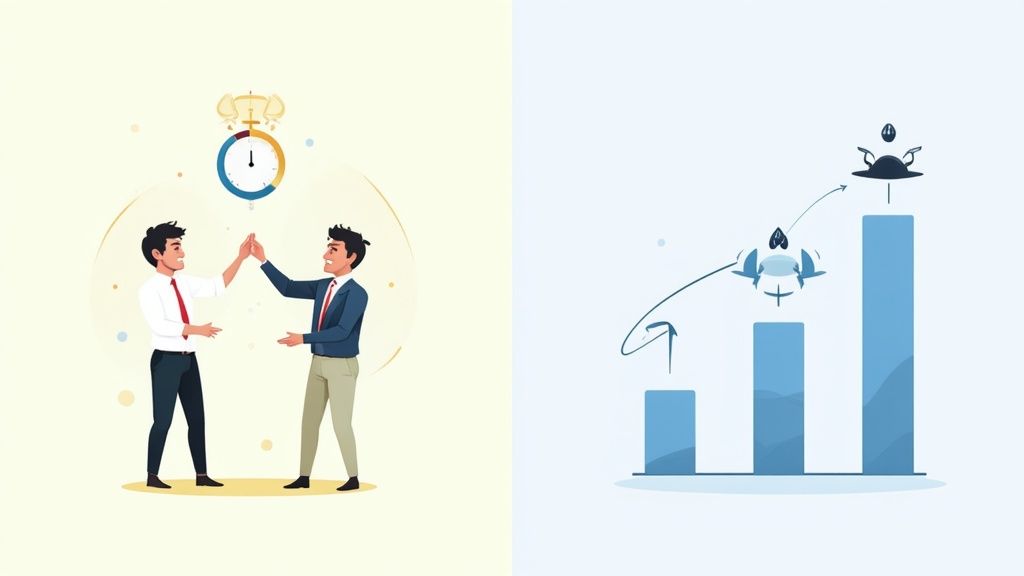
Moving to a shift-left model isn’t just a theoretical exercise; it delivers tangible results that ripple across your entire organization. The benefits go far beyond just catching bugs earlier. We’re talking about a fundamental change in how your team collaborates, builds, and ships software.
Instead of treating quality assurance as a final gate, you’re weaving it into the fabric of your development process. This simple change leads to less friction, faster delivery cycles, and a much higher-quality product that your users will love. Let’s dig into the specific, powerful advantages you can expect.
The most obvious and compelling win from shifting left is the impact on your bottom line. It’s simple math. A bug found by a developer during the coding phase is a quick, relatively painless fix. That same bug discovered after a production release? It’s a full-blown fire drill involving emergency hotfixes, frantic customer support, and potential damage to your reputation.
The numbers are pretty stark. Industry data shows that a defect fixed in production can cost up to 100 times more than if it were caught during the design or development stages. Teams that adopt shift-left practices often catch a staggering 85% of defects in the early unit testing phase. It even boosts security—finding vulnerabilities early can slash breach-related costs by 60%.
This isn’t just about saving money on fixes. It’s about freeing up resources. That time, money, and brainpower can be poured back into building new features and innovating, instead of constantly playing defense.
In a competitive market, speed is everything. The old way of testing—a big, formal QA phase right before release—creates a massive bottleneck. The entire launch schedule hinges on a testing team swamped with last-minute discoveries, often delaying a release by days or even weeks.
Shift-left testing completely dismantles this roadblock. By baking continuous testing directly into the CI/CD pipeline, you create a powerful, automated feedback loop.
This constant rhythm of feedback and improvement lets teams ship new features faster and with far more confidence. For new companies trying to gain a foothold, this speed is a massive advantage, which is why early testing is crucial for startup success.
One of the best side effects of shifting left is how it tears down the classic wall between developers and testers. That old “us vs. them” dynamic vanishes when quality becomes everyone’s job. Collaboration isn’t just encouraged; it becomes the natural way to work.
Instead of acting as the “bug police” at the end of the line, QA professionals evolve into quality coaches. Their role shifts to empowering developers with the tools, frameworks, and mindset to build quality in from the start.
This cultural shift leads to a more cohesive and effective team. Developers start thinking more like testers, considering edge cases and failure points as they write code. Testers get involved much earlier, offering input on requirements and designs to prevent issues before a single line of code is even written.
This sense of shared ownership doesn’t just improve the product. It boosts team morale and creates a far more positive and productive environment where everyone is pulling in the same direction.
Talking about “shifting left” is one thing, but actually doing it means changing how your team works every single day. It’s about building specific, practical habits into your development workflow to find and fix issues right where they start. This isn’t about adding another stage to your process; it’s about making quality a core part of building the product from the ground up.
These practices aren’t just a random checklist. They all work together to create a tight, continuous feedback loop. This transforms quality from a stressful, last-minute gatekeeper into something that’s naturally part of the development rhythm.
Long before you even run a single line of code, you can start finding problems. Static code analysis tools are like a spell-checker for your code. They scan everything you’ve written for syntax mistakes, potential security holes, and code that doesn’t meet your team’s standards—all without executing the program.
Think of it as your very first line of defense. By plugging these tools directly into developers’ IDEs and the CI pipeline, you give them instant feedback. This simple step catches a whole category of common bugs before they ever make it into the codebase.
The real foundation of any solid shift-left strategy is unit testing. These are small, focused tests that developers write themselves to make sure individual pieces of their code—the “units”—work exactly as intended on their own.
When developers are responsible for their own unit tests, they naturally develop a much deeper understanding of their code and its potential weak spots. This practice builds a crucial safety net, giving them the confidence to refactor and add new features without worrying about breaking something else. Good unit tests are non-negotiable for a stable application.
To really cement the shift-left mindset, you can adopt powerful frameworks like Test-Driven Development (TDD) and Behavior-Driven Development (BDD). Both push your team to think about quality and requirements before a single line of application code is written.
Automation is what makes shift-left testing possible at scale. Manual testing is simply too slow to keep up with the pace of modern development. Integrating automated tests early in your CI/CD pipeline is essential. This means automating not just unit tests but also API and integration tests. Doing this gives developers incredibly fast confirmation that their new changes haven’t accidentally broken another part of the system.
If you want to explore this further, take a look at our guide on the best practices for integrating testing into your CI/CD pipeline.
The numbers back this up in a big way. DORA’s 2023 report found that elite teams who master this approach deploy 208 times more frequently than low-performing teams, with lead times that are 2,555 times shorter. Other studies show that catching bugs early can cut fixing time in half and boost prototype quality by 35%. You can discover more insights about these findings on Codacy’s blog.
To see how these practices fit into the bigger picture, it helps to map them across the entire software development lifecycle (SDLC). The table below shows which testing activities happen at each stage in a shift-left model.
| SDLC Stage | Shift Left Testing Activity | Primary Goal |
|---|---|---|
| Requirements | BDD (Behavior-Driven Development), Static Analysis of Requirements | Clarify user stories, ensure requirements are testable, and eliminate ambiguity. |
| Design/Architecture | Threat Modeling, Architectural Reviews | Identify security vulnerabilities and design flaws before coding begins. |
| Development | Unit Testing, TDD, Static Code Analysis (in IDE), Peer Code Reviews | Build quality into the code, catch bugs immediately, and enforce coding standards. |
| CI/CD Pipeline | Automated Integration & API Testing, Component Testing | Verify that different parts of the application work together correctly. |
| Staging/Pre-Prod | Automated E2E & Performance Testing | Validate complete user workflows and ensure the system meets performance goals. |
| Production | Monitoring, Canary Releases, Feature Flagging | Observe real-world usage, manage risk, and gather feedback for the next cycle. |
As you can see, shifting left doesn’t mean you stop testing at the end; it means you start testing from the very beginning and continue throughout. Each stage has its own unique way of contributing to a higher-quality product.
Thinking about shifting left can feel like a massive overhaul, but it doesn’t have to be a chaotic scramble. The key is to break it down into a series of deliberate, manageable steps. This isn’t about flipping a switch and changing everything overnight. It’s about a gradual, intentional evolution of how your team builds software.
The real starting point isn’t a new tool or process—it’s your people. The absolute first move is to build a culture where quality is a shared responsibility, not a job that gets tossed over the wall to QA at the end. Once that mindset takes root, you can start putting the processes and automation in place to make it stick.
The bedrock of any real shift-left success is cultural. Before you even think about new software or workflows, you need everyone on board. This means fundamentally reframing testing from a final, separate phase into an ongoing activity that everyone—especially developers—owns.
Start by getting developers and testers in the same room from day one. Seriously. Involve your QA experts in requirements gathering and design reviews. This simple change helps everyone spot misunderstandings and potential pitfalls before a single line of code is ever written.
Here are a few practical ways to build this sense of shared ownership:
Once you have a collaborative culture brewing, automation is what gives it horsepower. The goal here is to create a lightning-fast feedback loop, so developers know almost instantly if their changes broke something. The most effective way to do this is by embedding automated tests directly into your Continuous Integration/Continuous Delivery (CI/CD) pipeline.
This is what that looks like in practice, with testing woven directly into the early stages of development.
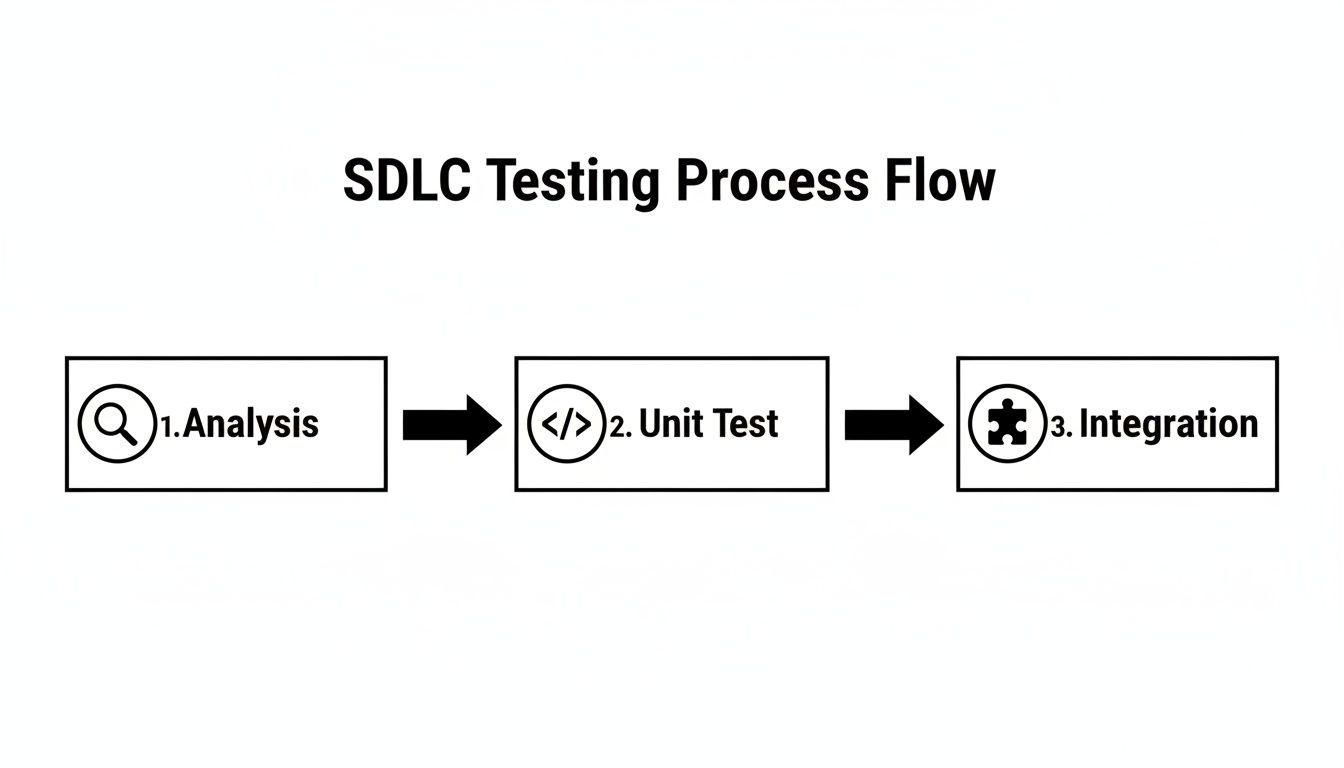
As you can see, quality checks aren’t a final hurdle to clear; they’re a continuous part of the creative process from the very start.
Kick things off by automating the essentials first:
This constant validation acts as a guardrail, preventing broken code from ever making it downstream and leading to a much more stable and predictable development cycle.
How do you know if shifting left is actually working? You need to define what “good” looks like and measure it. This is where quality gates come in. Think of them as automated checkpoints in your CI/CD pipeline. If code doesn’t meet the predefined criteria at a gate, the build fails—automatically.
Quality gates turn your standards into an enforceable reality. They ensure that no code progresses without meeting a minimum bar for quality, making your policies actionable instead of just aspirational.
Build your quality gates around clear, objective metrics. Some of the most important ones to track are:
These metrics give you hard data to track your progress and, just as importantly, to prove the value of this initiative to leadership.
Whatever you do, don’t try to roll this out to the entire organization at once. That’s a recipe for chaos and pushback. Instead, pick a single, low-risk project or a new feature to be your guinea pig.
Use this pilot to experiment with the new collaborative workflows, tools, and processes in a controlled environment. See what works and what doesn’t. Get direct feedback from the team involved and use their insights to tweak your approach. Once you’ve ironed out the wrinkles and have a clear success story to share, you’ll have a proven blueprint—and a team of champions—to help you scale this new way of working across the company.
Making the leap to shift left testing is a fantastic goal, but let’s be honest—it’s not always a straight line from A to B. Like any real change in how teams work, the path is full of bumps. You’ll likely run into everything from cultural pushback to technical headaches that can kill your momentum if you’re not ready for them.
The difference between teams that nail this transition and those who give up is how they handle these hurdles. It’s all about seeing these problems coming and having a smart plan to deal with them. This is how you turn friction into fuel for better collaboration and more efficient processes.
Almost without fail, the biggest obstacle is people. In traditional setups, developers and testers live in different silos with a wall between them. When you suddenly ask developers to own more of the testing, you can get some serious pushback. They might see it as just another task piled onto their plate, distracting them from their “real job” of writing code.
The trick is to change the narrative. Testing isn’t a chore being dumped on developers; it’s a way to empower them to write better code from the start, with more confidence and fewer bug-hunt-a-thons later.
Here’s how to start shifting that mindset:
Another classic hurdle is the initial learning curve. New tools, new frameworks, new CI/CD pipelines—it can feel like drinking from a firehose. Expecting developers to become unit testing gurus or CI/CD pipeline wizards overnight is just setting them up for failure. Even worse, picking the wrong automation tools can leave you with a brittle test suite that’s a nightmare to maintain.
The goal isn’t just to buy new tools, but to weave them seamlessly into the developer’s daily workflow. The less friction they feel, the more likely they are to actually use them.
You have to be strategic here. A phased rollout is your best friend. Start with the basics—get the foundational skills and tools in place before you try to tackle the more complex stuff. Offer real training, hands-on workshops, and make sure senior engineers or QA leads are available to mentor others. And when choosing tools, look for ones with great documentation, an active community, and killer integrations with your existing tech stack.
Finally, there’s one persistent myth that can completely sabotage your shift-left initiative: the idea that shift left testing gets rid of the need for a dedicated QA team. This couldn’t be more wrong, and it’s a dangerous idea to let fester.
Shifting left doesn’t eliminate late-stage testing. It makes it better by ensuring the code that gets to that stage is already rock-solid.
Your QA experts are actually more valuable in a shift-left world. Their role just evolves. They stop being manual gatekeepers and become strategic quality coaches. They’re the ones designing the overall test strategy, building the automation frameworks that everyone uses, and focusing their brilliant minds on the complex, tricky scenarios that developers are likely to miss, like:
By making this crystal clear, you not only reassure your QA team of their critical role but also help the entire organization understand that a true quality culture depends on expertise at every stage of the game.
As teams start exploring the shift-left approach, a lot of good questions pop up. This isn’t just about tweaking a process; it’s a real shift in culture, roles, and how everyone works together. Getting clear on these common points is the first step to getting everyone on board and moving forward.
Let’s dig into some of the most common questions that leaders, developers, and QA pros ask when they first hear about shifting left. These answers should help clear up the confusion and paint a better picture of what this looks like in the real world.
This is easily the biggest and most important question out there. The answer is a hard no. The idea that shifting left makes QA engineers obsolete is a total myth, and a pretty damaging one at that.
In reality, the QA role doesn’t go away—it evolves. It becomes far more strategic and, honestly, more valuable.
Instead of being the “bug police” at the very end of the line, QA professionals become quality coaches and champions. They start architecting the team’s entire quality strategy, shifting their focus from repetitive manual checks to much higher-impact work.
In a healthy shift-left culture, QA and dev aren’t separate functions. They’re true partners, working together from day one to build quality in from the start.
You can’t improve what you don’t measure. If you want to show that your shift-left initiative is actually working and make smart decisions along the way, you need to track the right KPIs. It’s all about moving away from vanity metrics and focusing on what truly reflects quality and speed.
Here are a handful of metrics that tell a clear story:
While the shift-left mindset is about culture, the shift-left practice absolutely runs on automation. So, yes, automation isn’t just a nice-to-have; it’s a requirement if you’re serious about this.
The whole point is to give developers fast, continuous, and reliable feedback. Manual testing is simply too slow to keep pace with a modern CI/CD pipeline. Just imagine trying to have a human manually test every single code change before it gets merged. You’d create a massive bottleneck and completely grind development to a halt.
Automation is the engine that makes the shift-left philosophy practical and scalable. It’s what enables the rapid feedback loops that empower developers to build with confidence and speed.
Automated unit, integration, and API tests can run in minutes. This gives developers the immediate insight they need to fix a problem while the code is still fresh in their minds. A solid test automation strategy is the non-negotiable foundation of any successful shift-left effort.
Trying to shift left without embracing DevOps is like trying to build a race car with bicycle wheels. You’re just working against yourself. The two concepts are deeply connected and strengthen one another.
DevOps is about breaking down the silos between developers and operations to ship faster. Shift-left is about breaking down the silo between developers and testing for the exact same reason. Both are aimed at creating a smooth, automated, and collaborative workflow.
A strong DevOps culture provides the technical backbone you need to shift left effectively:
Without these foundational DevOps practices, any attempt to shift left will feel slow, manual, and ultimately fall flat. They are two sides of the same coin, both essential for building and shipping great software, fast.
Ready to accelerate your shift-left journey with smarter, faster end-to-end testing? At TestDriver, we’ve built an AI agent that generates comprehensive test scenarios from a simple prompt, turning your intent into executable tests in minutes. Stop wrestling with flaky scripts and start empowering your team to build with confidence.
Discover how automated testing DevOps transforms your CI/CD pipeline. This guide covers practical strategies, tools, and AI's role in accelerating releases.
Master software testing in DevOps with our guide. Learn shift-left, automation, CI/CD integration, and AI-driven testing to boost quality and release speed.
Master data driven tests with our guide on setup, best practices, and CI/CD integration. Boost your test coverage and build more reliable software.
Explore the real differences in automation vs manual software testing. This guide covers when to use each, ROI, and how to build a winning hybrid strategy.
TestDriver uses computer-use AI to test any app - write tests in plain English and run them anywhere.