Automated Regression Tests A Practical Guide for Modern Teams
Build a reliable strategy for automated regression tests. Learn to prevent bugs, speed up releases, and integrate testing seamlessly into your CI/CD pipeline.
Discover how Test Automation as a Service transforms QA. This guide explains how it works, its benefits, and how to integrate it into your CI/CD pipeline.
Automate and scale manual testing with AI ->
Picture this: you need to run a bunch of complex software tests, but instead of building a whole testing department from scratch, you order them up just like you’d call a ride-share. You don’t own the car or employ the driver, you just get where you need to go. That’s the simple idea behind Test Automation as a Service (TAaaS).
It’s a model where you hand off the heavy lifting of building, running, and maintaining your automated tests to a team of specialists.
In software development today, the pressure is relentless. Ship faster. Add more features. But don’t you dare introduce new bugs. This constant cycle creates a massive bottleneck, especially for teams still stuck in the slow lane with repetitive manual testing. TAaaS is the off-ramp from that traffic jam, giving you on-demand access to a complete testing setup and the experts who run it.
Think of it as a professional cloud kitchen for your app’s quality. Your team provides the recipe, the specific user journeys and test cases you need to check. The TAaaS provider brings everything else to the table:
You just get the perfectly “cooked” results, clear bug reports and quality dashboards, without ever having to build, staff, or manage that expensive kitchen yourself.
The shift to agile and DevOps has completely changed the game. Modern CI/CD pipelines are all about speed and constant delivery, and that model breaks without automated checks at every step. Manual testing just can’t keep pace. It’s not even a fair fight. This is exactly where TAaaS comes in.
By handing off the automation work, your developers can get back to what they do best: building an awesome product. TAaaS takes over the grind of regression testing, making sure every new piece of code doesn’t accidentally break something that was already working. It’s a safety net that lets your team ship code quickly and confidently.
The numbers back this up. The global automation testing market, which is powered by services like Test Automation as a Service, is on track to explode from $36.9 billion in 2025 to a staggering $140.4 billion by 2035. This massive growth is all about the urgent need for testing solutions that can actually keep up with how software is built today.
To give you a clearer picture, let’s compare the old way with the new way.
This table breaks down the key differences between sticking with traditional manual testing and moving to a TAaaS model. It’s a high-level look at how each approach stacks up on things like speed, cost, and the ability to scale.
| Aspect | Manual Testing | Test Automation as a Service (TAaaS) |
|---|---|---|
| Speed & Frequency | Slow, tedious, and cannot run continuously. Limited by human hours. | Extremely fast. Tests run 24/7 in parallel across many environments. |
| Initial Cost | Lower initial tool cost, but high long-term salary costs. | Subscription-based. No upfront infrastructure or hiring costs. |
| Scalability | Very difficult to scale. Requires hiring and training more people. | Highly scalable. Instantly add more tests or devices on-demand. |
| Coverage | Limited. Repetitive tests are often skipped due to time constraints. | Comprehensive. Can run thousands of regression tests with every code change. |
| Accuracy | Prone to human error, inconsistency, and missed details. | Highly accurate and repeatable. Eliminates human error. |
| Team Focus | Developers and QAs get bogged down in repetitive manual checks. | Frees up the development team to focus on building new features. |
As you can see, TAaaS isn’t just a minor improvement; it’s a fundamental shift in how quality assurance gets done, moving it from a bottleneck to a business accelerator.
For a deeper dive into the principles that make this work, checking out general Quality Assurance Best Practices for AI & SaaS can provide some great background. At the end of the day, TAaaS makes top-tier, enterprise-grade testing available to everyone, regardless of team size or budget.
So, what really happens when you hand your testing over to a Test Automation as a Service platform? It might sound like a black box, but the process is surprisingly straightforward. Think of it less like outsourcing a task and more like using a professional kitchen to prepare a meal. You provide the recipe, and the service handles all the shopping, chopping, cooking, and even the cleanup.
Let’s say you need to test the login flow on your new e-commerce site. Can a new user sign in and land on their dashboard? In the old world, you’d be building the kitchen from scratch, setting up servers, installing browsers, configuring test frameworks, before you even started cooking. With TAaaS, you just hand over the recipe and wait for the finished dish.
This diagram shows how your simple “recipe” (the test idea) gets turned into a fully validated result.
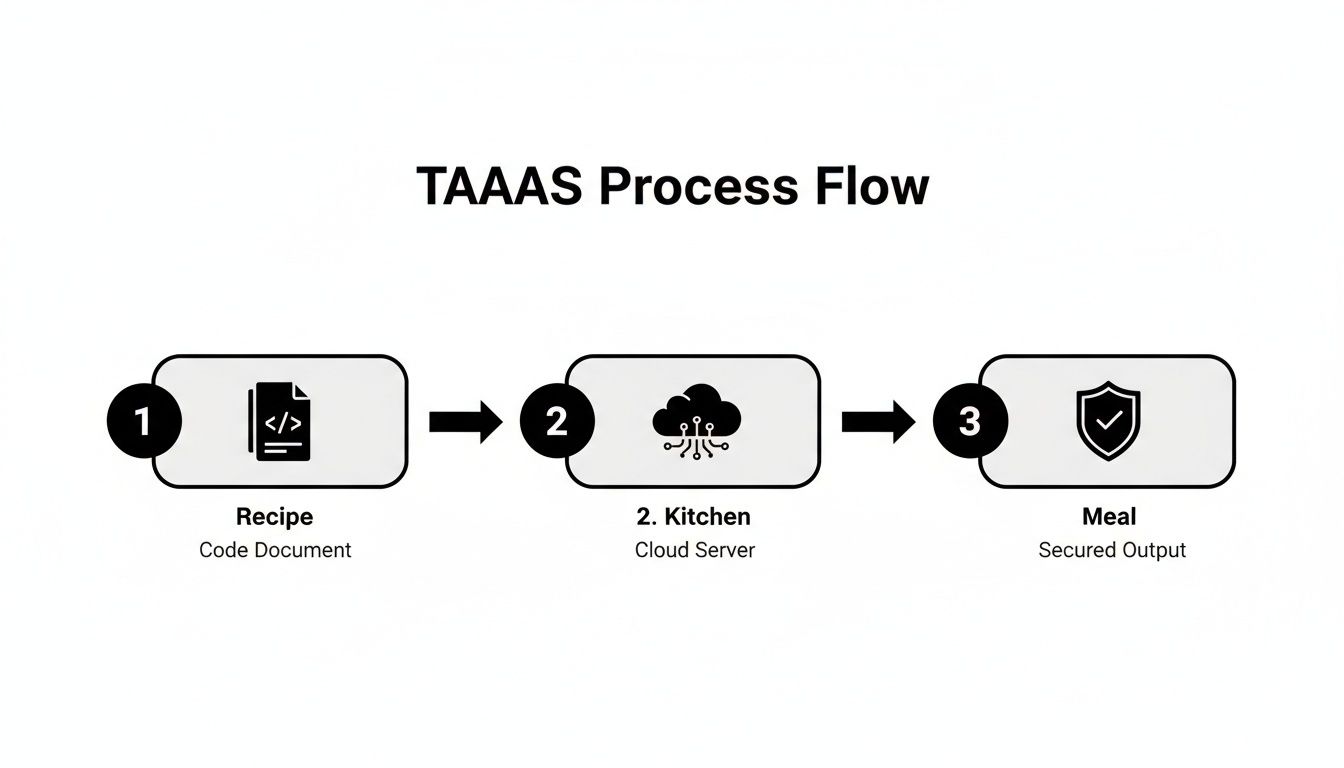
The platform essentially takes your simple instructions and handles all the complex infrastructure and execution steps for you, delivering a secure, reliable outcome every time.
Everything starts with your team deciding what to test. Traditionally, this meant a QA engineer would have to write complex, often brittle, scripts using frameworks like Selenium or Cypress. And while you can still do that, modern AI-powered platforms like TestDriver are flipping the script.
Now, you can often just describe what you want in plain English: “Verify a user with valid credentials can log in and see their account dashboard.” That’s it. Your instruction becomes the “recipe.” You’re focused on the what, not the how.
This shift to low-code and no-code testing is a game-changer. It opens the door for product managers, business analysts, and even manual QA testers to contribute directly to the automation effort. No deep coding knowledge required. It also makes the tests themselves far easier to read and maintain down the road.
Once you’ve submitted your test definition, the TAaaS provider’s engine kicks into gear. This is where the heavy lifting happens, completely out of your sight. The platform instantly starts managing all the tedious tasks that used to eat up weeks of your team’s time.
A core benefit here is that the infrastructure is completely ephemeral. As soon as the tests finish, the platform tears it all down. This means zero maintenance overhead for your team. No servers to patch, no browsers to update, and no flaky test grid to manage.
When the tests are done, you don’t just get a green “pass” or a red “fail” icon. The TAaaS platform pulls all the raw data together and presents it in a clear, consolidated report that’s built for action.
These reports typically include everything you need to debug quickly:
This rich feedback loop allows your developers to immediately see what went wrong, fix the bug, and push the next build with confidence. The entire cycle, from writing a test in simple English to getting a detailed, actionable report, is handled for you, making high-quality test automation a reality for any team.
When we talk about Test Automation as a Service (TAaaS), we’re moving beyond the technical weeds. The real conversation isn’t about how it works, but why it makes solid business sense. The decision to go with a TAaaS model really comes down to three huge wins: cutting costs, getting to market faster, and shipping a better product.
Think about what it takes to build a test automation practice from scratch. You’re looking at a mountain of capital expenses and operational headaches. Instead of buying pricey tool licenses, hunting for specialized engineers, and maintaining a messy device lab, you get to swap all that for a predictable, manageable operating expense.
This isn’t just a small shift; it’s a financial game-changer. The entire Testing as a Service (TaaS) space is exploding for a reason. It’s on track to become the biggest slice of the massive $50.7 billion software testing market by 2025. The magic is in its “zero-infrastructure” appeal, letting teams ramp up testing whenever they need it. It’s why 46% of teams say they’ve cut their manual testing grind by 50% or more. You can dive deeper into the growth of the TaaS market over at Coherent Market Insights.
The first thing you’ll notice with TAaaS is the relief on your budget. Piecing together an in-house automation setup is a serious investment, and the hidden costs sneak up on you fast.
Let’s look at the old way of doing things:
TAaaS completely flips that script. You ditch the huge upfront costs and get a flexible subscription instead. You pay for what you actually use, which frees up cash, and your team, to work on the product itself.
By offloading the infrastructure and maintenance, you’re not just saving money. You’re redirecting your most valuable asset, your team’s time and brainpower, from tedious grunt work to genuine innovation.
In a world where everyone’s trying to ship faster, speed is everything. TAaaS is built to pull testing out of the “bottleneck” category and inject it right into your CI/CD pipeline as an accelerator. The secret sauce is parallel execution. While your in-house setup might have to chug through tests one by one, a TAaaS provider can run hundreds, even thousands, of tests at the same time across their massive cloud grid.
What does that look like in practice? A full regression suite that used to take your team hours to run can now be done in minutes. This lightning-fast feedback loop means developers find out about bugs almost immediately, can merge code with confidence, and push features out the door faster than the competition. Testing stops being a painful gatekeeper at the end of the line and becomes a seamless, continuous quality check.
Now, as good as all that sounds, TAaaS isn’t a silver bullet. It’s a strategic choice that comes with trade-offs, and you need to go in with your eyes open.
The big one for many is data security. If your app deals with sensitive customer info, you have to be absolutely sure about sending that data to a third-party service. This means doing your homework. You have to verify the vendor has rock-solid security protocols, is compliant with standards like SOC 2, and is transparent about how they handle your data.
Another thing to think about is vendor lock-in. If you build your entire test suite on a provider’s proprietary, no-code platform, trying to move somewhere else, or bring testing back in-house, down the road could be a nightmare. You need to know right from the start how portable your tests are.
Finally, you are giving up a bit of control for a lot of convenience. Your TAaaS provider handles all the infrastructure, which is great, but it also means you have less direct say over the nuts and bolts of the test environment. For most teams, this is a welcome trade. But if your organization has very specific or unusual infrastructure requirements, it could feel a little restrictive.
The real magic of Test Automation as a Service (TaaS) happens when you weave it directly into your development workflow. When testing is no longer a separate, manual step but a fully automated part of your CI/CD pipeline, it becomes a powerful quality gate that stops bad code from ever reaching production.
Think of your pipeline as an assembly line for software. A developer writes code, and the pipeline’s job is to build it, test it, and get it ready for release. If you skip automated testing, you’re essentially building a car but never checking if the engine starts or the wheels turn before it rolls off the line. It’s a massive blind spot.
TaaS acts as that smart, automated quality control station on your assembly line. It’s the checkpoint that verifies every change before it’s allowed to move forward.
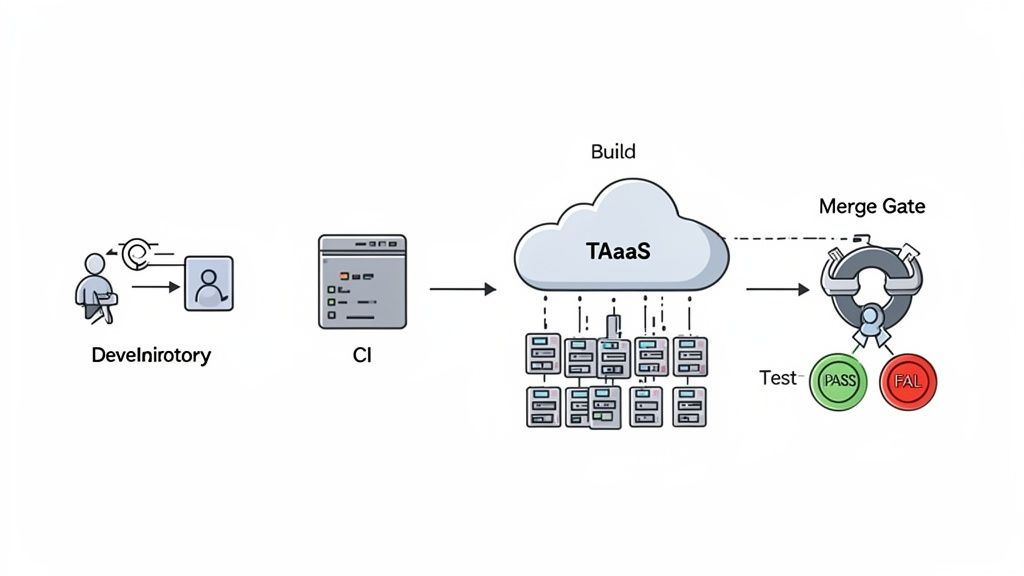
This tight integration is what allows teams to move fast without breaking things. It’s the safety net that catches bugs early on, right when they’re cheapest and easiest to fix.
Let’s break down a typical, real-world scenario. Say your team uses a tool like GitHub Actions or Jenkins to manage your CI/CD pipeline. Here’s how TaaS slots right in.
The whole thing happens automatically, from start to finish. No human intervention needed.
By embedding TaaS into the CI/CD pipeline, you create a system where every single code commit is automatically validated. This builds a culture of quality and gives developers near-instant feedback on their work, preventing regression bugs from ever being merged.
Integrating TaaS like this fundamentally changes the day-to-day rhythm of your team, for the better. That rapid, automated feedback loop takes the guesswork out of development and gives everyone more confidence.
Getting this connection right is crucial. For a deeper dive, check out our guide on the best practices for integrating testing into your CI/CD pipeline. Ultimately, this integration is what transforms testing from a slow bottleneck into a true strategic advantage, helping your team ship higher-quality software, faster.
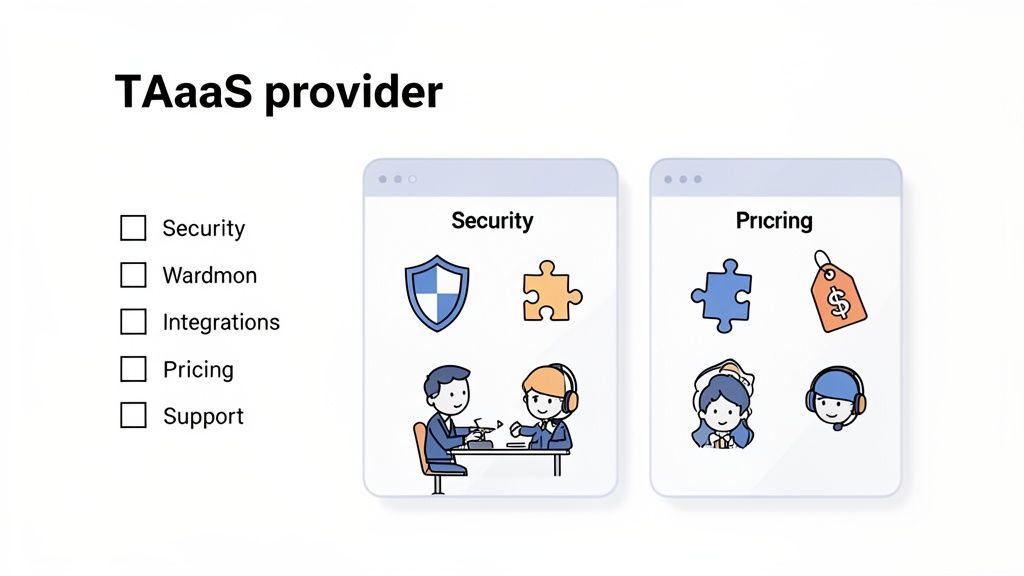
Choosing a partner for test automation as a service is a big deal. This isn’t just about buying a tool; it’s about finding an extension of your team that will fundamentally shape your development workflow and product quality for years to come. Get it right, and you’ll ship better software, faster. Get it wrong, and you’re looking at wasted time, added friction, and mounting frustration.
The market is getting crowded, making the decision even tougher. The broader Automation as a Service (AaaS) space was valued at $2.46 billion in 2025 and is expected to rocket to $13.45 billion by 2034. Why? Because 77% of companies are already using automation to boost productivity, and 68% have turned to AI to build tests up to 72% faster. You can dig into the rapid expansion of the AaaS market at Precedence Research for the full picture.
With so many vendors vying for your attention, you need a plan to cut through the noise.
First things first: can the provider actually test your application? This is the ultimate non-negotiable. If their platform doesn’t align with your tech stack, the conversation is over before it begins.
Start by asking these questions:
A TAaaS solution should feel like it was built just for your team, sliding right into your existing toolchain. It shouldn’t force you to rip out and replace tools you already love.
The best TAaaS platforms don’t operate in a silo. They connect directly to your CI/CD pipeline, project management tools, and communication channels, making quality a shared, visible responsibility across the entire team.
Look for key integrations that make life easier:
For a deeper dive, our guide on how to choose the right tools for software testing can help you build a complete evaluation framework.
You’re about to grant a third-party service access to your application, and potentially your data. This is where you need to be extra diligent.
Security isn’t just about features; it’s about trust and responsible practices. This includes understanding the vendor’s stance on ethical and legal approaches to web automation, especially around tricky areas like captchas. Look for non-negotiable credentials like SOC 2 compliance, which is a clear signal that they take data security and operational excellence seriously.
Beyond that, think about what happens when you need help. What does their support model look like? Do they offer dedicated channels and clear documentation? Is there a responsive team ready to jump in when things go wrong? Finally, make sure the pricing is transparent. The last thing you want are hidden fees that blow up your budget.
To help you stay organized, we’ve put together a checklist. Use this table to systematically compare potential TAaaS providers and ensure you’re making a well-rounded decision.
| Evaluation Criterion | Key Questions to Ask | Ideal Answer/Feature |
|---|---|---|
| Technical Fit | Does it support our web, mobile, and API testing needs? Can it handle our specific frameworks (e.g., React, Angular)? | Broad platform coverage; explicit support for your key technologies. |
| Integration | Does it integrate natively with our CI/CD pipeline (GitHub, Jenkins, etc.) and project management tools (Jira, Linear)? | Pre-built plugins or simple API hooks for your core toolchain. |
| Test Creation | How are tests created and maintained? Is it code, low-code, or AI-driven? How steep is the learning curve? | A method that matches your team’s skills and velocity goals (e.g., plain-English AI for rapid creation). |
| Security | Is the provider SOC 2 compliant? How is test data stored and secured? Do they follow ethical automation practices? | SOC 2 Type 2 certification; clear data encryption and isolation policies. |
| Support | What level of support is included? Is there a dedicated account manager or a community forum? What are the SLAs? | Multiple support channels (chat, email, phone) with clear response times. |
| Scalability | How does the platform handle parallel test execution? Can it scale to thousands of tests per day? | Cloud-based grid for unlimited parallelization; no infrastructure bottlenecks. |
| Reporting | What kind of reporting and analytics are available? Can we easily identify failure reasons with screenshots or videos? | Rich, actionable dashboards with visual logs, video recordings, and trend analysis. |
| Pricing | Is the pricing model transparent? Does it scale based on test runs, users, or features? Are there hidden costs? | A clear, predictable pricing tier that aligns with your expected usage and offers value. |
Going through this checklist for each vendor will give you a clear, side-by-side comparison, making your final choice much easier and more confident.
Switching to test automation as a service isn’t just a technical decision; it’s a serious business investment. And like any other investment, you have to be able to prove it’s paying off. Showing real value goes way beyond simply tallying up how many tests you’ve run. It’s about drawing a straight line from your automation efforts to the bottom-line results that leadership actually cares about.
To get this right, you need a smart plan. Forget trying to automate everything from day one, that’s a recipe for chaos. The teams that see the most success start small, prove the concept, and build momentum from there.
Kick things off with a focused pilot project. Pick a small but vital part of your application, like the login flow or the shopping cart checkout. This gives you a low-risk way to get comfortable with the TAaaS platform, iron out your workflow, and collect some initial data. Once you’ve shown a clear win on a smaller scale, you’ll have a much more powerful story to tell when you’re ready to expand.
The real return on investment from TAaaS isn’t measured in vanity metrics. A chart showing thousands of executed tests might look impressive, but it says nothing about whether you’re shipping better software, faster. To make a convincing case, you need to tie your efforts to Key Performance Indicators (KPIs) that reflect genuine business goals.
The point isn’t just to automate tests. It’s to use automation to ship faster, improve quality, and, most importantly, free up your engineers to do what they do best: build. The right KPIs prove you’re doing exactly that.
Here are the metrics that will truly show the impact of your investment:
To really understand your progress, you first need to know where you’re starting from. You can find a great list of metrics to track by exploring these essential QA KPIs to benchmark your quality assurance process.
Once you have your data, from the pilot and beyond, you can build a narrative that gets the attention of business leaders. It’s all about framing the results around the three pillars every executive cares about.
When you focus on tangible outcomes like these, the conversation shifts from technical jargon to strategic business value. You’re no longer just talking about testing, you’re showing how your test automation as a service strategy is a powerful engine for growth and a fantastic return on investment.
Thinking about bringing test automation as a service into your workflow? It’s a big move, and it’s smart to have questions. This isn’t just another tool; it’s a different way of thinking about quality. Let’s tackle the most common things engineering teams ask.
Not quite. It’s more like the difference between hiring a freelance contractor versus bringing in a specialized firm.
When you outsource testing, you’re typically hiring extra hands. You find the testers, you provide the tools, you manage the infrastructure, and you direct the day-to-day work. You’re still the project manager for testing.
TAaaS is a fully managed service. The provider brings the entire testing stack, the platform, the tools, the infrastructure, the experts, and the reporting. You set the high-level goals for what needs to be tested, and they handle the rest, delivering the results you need.
An in-house team isn’t always the right answer. TAaaS really shines when your team needs to:
On the flip side, if you’re working on a small, short-term project or if test automation is a central, strategic part of your company’s core business, building your own team might be the better long-term play.
The pricing is fundamentally different from building a team. With TAaaS, you’re looking at a predictable subscription fee instead of the massive upfront capital investment required for tools, infrastructure, and salaries.
This shifts your spending from a capital expense (CapEx) to an operating expense (OpEx), which often makes budgeting much simpler and can lead to major cost savings over time.
While the monthly fee for TAaaS might look higher than hiring a single contractor, it’s almost always a better deal than the total cost of building, staffing, and maintaining a dedicated in-house automation team from scratch.
Choosing your partner is the most important decision you’ll make. Don’t just look at the price tag. Dig into these four areas:
Ready to see how AI-powered test automation as a service can completely change your approach to quality? TestDriver helps you create powerful end-to-end tests from a simple prompt, so you can ship faster and with total confidence.
Build a reliable strategy for automated regression tests. Learn to prevent bugs, speed up releases, and integrate testing seamlessly into your CI/CD pipeline.
A practical guide to the automation of regression testing. Learn to build a strategy, leverage AI, integrate into CI/CD, and maintain a resilient test suite.
Master end to end testing automation with practical steps, modern tools, and CI/CD integration to boost software quality and speed up delivery.
Discover the 12 best codeless automation testing tools for web, API, and mobile. Our 2026 guide helps you choose the right platform for your QA workflow.
TestDriver runs every pull request in a real desktop sandbox, finds bugs, and builds regression tests - right from your repo.