8 Essential Test Environment Management Best Practices for 2026
Discover 8 actionable test environment management best practices for QA teams. Learn to improve stability, parity, and efficiency in your testing workflow.
Discover 10 essential test data management best practices to enhance your QA process. Learn about synthetic data, masking, versioning, and compliance.
Automate and scale manual testing with AI ->
In the high-stakes world of software development, the quality of your test data is the unsung hero, or the silent saboteur, of your entire QA process. It’s the foundation upon which reliable testing is built, yet it’s often an afterthought. When test data is outdated, incomplete, or non-compliant, it directly translates into flaky tests, missed edge-case bugs, production failures, and significant security vulnerabilities. Teams often find themselves battling with slow, manual data provisioning cycles or using unrealistic data that fails to catch critical defects, ultimately slowing down release velocity and eroding confidence in the final product.
This article cuts through the noise to provide a definitive, actionable roundup of the top test data management best practices that modern engineering teams must master. We will move beyond generic advice and dive deep into practical strategies that you can implement immediately. Forget high-level theories; we are focusing on the specific techniques that make a tangible difference.
You will learn how to implement robust data masking, generate realistic synthetic data on-demand, and establish effective data versioning and lifecycle management. We’ll also cover crucial topics like data privacy by design, environment segregation, and integrating your test data strategy directly into your CI/CD pipeline for true automation. By adopting these test data management best practices, you will build a resilient, secure, and efficient testing foundation. This foundation not only accelerates development but also ensures your applications are genuinely production-ready, giving your team the confidence to ship faster and more reliably.
Data masking and anonymization are foundational test data management best practices that involve obscuring sensitive information within a dataset while preserving its structural integrity and usability for testing. The goal is to create a realistic, non-production dataset that accurately reflects the format and characteristics of real data, allowing teams to test applications thoroughly without exposing personally identifiable information (PII) or other confidential data. This process replaces actual data with fictitious yet structurally identical values, such as swapping real names for generated ones or replacing social security numbers with validly formatted fakes.

This practice is non-negotiable for organizations subject to regulations like GDPR, HIPAA, or CCPA, as it directly addresses data privacy and security mandates. By anonymizing data before it enters testing environments, companies mitigate the risk of costly data breaches and ensure compliance.
Effective implementation requires a strategic approach that balances data realism with security. Start by identifying all sensitive data fields across your databases, including names, addresses, credit card numbers, and health information.
customers table, it must be masked identically in the orders table to keep the data valid for testing relational logic.Test data subset generation is a core practice in test data management that involves creating smaller, manageable, and statistically representative samples of a production database. Instead of copying entire multi-terabyte production environments, which is slow and costly, this technique extracts a targeted slice of data. The goal is to produce a dataset that is small enough for rapid provisioning yet large enough to accurately reflect the complexity and variety of the full production data, enabling realistic and efficient testing.
This approach significantly reduces storage costs, accelerates environment creation and refresh times, and simplifies the data management lifecycle. For example, an e-commerce platform can test new features using a subset containing just 10% of its customer and transaction data, as long as that subset accurately represents different user behaviors and product types. This is a crucial strategy for agile and DevOps teams who need fast access to realistic data without the overhead of full-scale database clones.
A successful subsetting strategy requires careful planning to ensure the resulting dataset is both compact and reliable for testing. Start by identifying the key business processes and data entities that need to be tested. This will guide which data is essential to include in your subset.
Synthetic data generation is a powerful test data management best practice that involves creating entirely artificial, yet statistically representative, data from scratch. Unlike masked data, which is derived from production, synthetic data is algorithmically generated to mimic the patterns, distributions, and characteristics of real-world information without containing any actual sensitive details. This approach provides a privacy-safe harbor, enabling teams to test extensively without ever touching production data.
This method is ideal for scenarios requiring large volumes of data, such as performance or load testing, and for early development stages where production data may not yet exist. For example, a financial services company can generate millions of synthetic transactions to test fraud detection algorithms, while a healthcare provider can create realistic but fake patient records to validate a new EMR system, all while guaranteeing 100% compliance with privacy regulations like GDPR and HIPAA.
Effective implementation hinges on accurately modeling the statistical properties and business rules of the real data you intend to replicate. The goal is to produce data that is not only safe but also fully functional and realistic for testing complex application logic.
order_date always precedes a shipping_date or that a postal code matches the corresponding city.Treating test data with the same rigor as application code is a hallmark of mature test data management best practices. This involves applying version control, automated refresh schedules, and full lifecycle management to your test datasets. By versioning data alongside code, teams ensure that tests are always run against the appropriate data state, making bug reproduction and historical testing reliable. This holistic approach manages data from its creation and provisioning through its active use and eventual retirement.
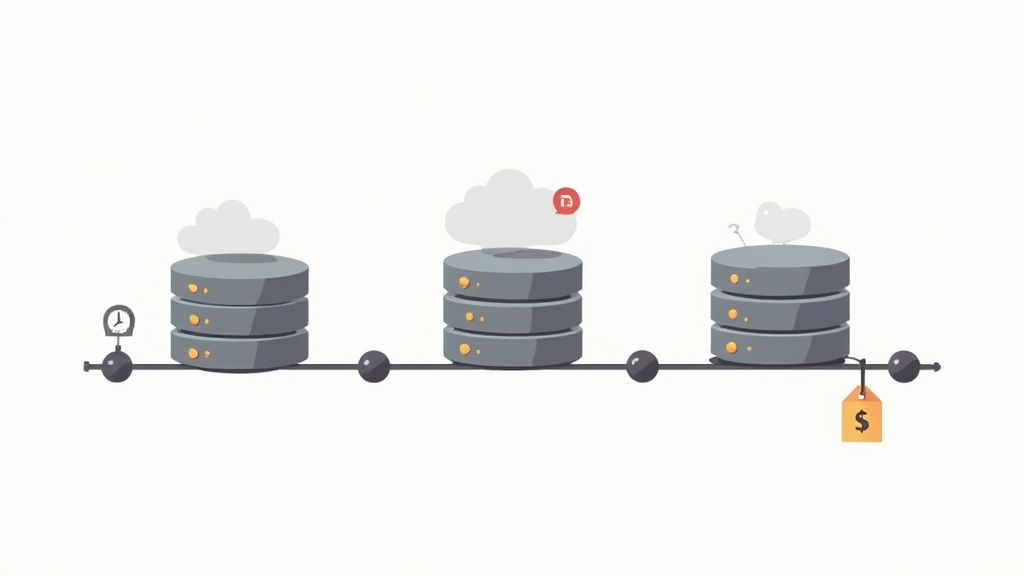
Automating data refreshes ensures that testing environments do not become stale, reflecting recent production changes and preventing “it works on my machine” issues. Companies like Netflix and Google have popularized this by maintaining version-controlled, snapshot-based test data that integrates seamlessly into their CI/CD pipelines, guaranteeing consistency and reproducibility across thousands of daily builds.
A successful implementation integrates data management directly into your existing DevOps workflows, treating data as a first-class citizen in the development process. Start by storing data generation scripts and schema definitions in your code repository.
Integrating privacy and compliance by design is a proactive test data management best practice that embeds regulatory principles directly into your processes from the very beginning. Instead of treating compliance as a final checkbox, this approach ensures that systems, policies, and data handling procedures are inherently built to meet standards like GDPR, HIPAA, and CCPA. The goal is to make compliance an automatic, inseparable part of the test data lifecycle, minimizing risk and building trust.
This forward-thinking strategy moves beyond reactive fixes and establishes a robust framework where data minimization, consent tracking, and auditability are core components. For instance, a European financial firm might implement automated “right-to-be-forgotten” workflows that purge specific user data from test environments upon request, ensuring continuous GDPR adherence without manual intervention. This approach is essential for any organization handling sensitive information in a complex regulatory landscape.
Effective implementation requires a foundational shift toward making privacy a default setting in all testing activities. Start by conducting a privacy impact assessment (PIA) for any new project that involves creating or using test data to identify and mitigate risks early on.
Test data environment segregation and sandboxing are critical test data management best practices that involve creating isolated, secure environments completely separated from production systems. The core principle is to ensure that test data manipulations, destructive tests, or experimental changes do not impact live operations, other testing tiers, or sensitive data. This practice creates a safe “sandbox” where developers and QA engineers can innovate, debug, and validate application behavior without risk.
This approach is indispensable for organizations in highly regulated industries like finance and healthcare, where environment integrity and data isolation are mandated. By establishing clear boundaries through network segmentation, separate database instances, and distinct access controls, teams can safely test sensitive scenarios, prevent data leakage, and maintain operational stability across the software development lifecycle.
Effective implementation hinges on creating reproducible, secure, and completely independent testing environments. The goal is to mirror production architecture as closely as possible while enforcing strict isolation policies. Start by mapping out your environment tiers, such as development, QA, user acceptance testing (UAT), and staging.
Test data quality assurance and validation is a critical practice focused on ensuring that your test datasets are accurate, complete, consistent, and truly representative of real-world scenarios. The goal is to prevent the “garbage in, garbage out” problem where flawed test data leads to unreliable test results and missed defects. This process involves implementing comprehensive checks to verify data integrity, business rule compliance, and statistical representativeness before the data is used for testing.
This practice is essential for building confidence in your testing outcomes. Using high-quality, validated data ensures that when a test fails, it is due to an application defect, not a data issue. For instance, an e-commerce platform must validate that test data for product inventory is consistent across all related tables to accurately test checkout and stock management features. Without this validation, a test might fail because of a data inconsistency, wasting valuable development time on a false positive.
A successful validation strategy combines automated checks with a deep understanding of data requirements. Start by defining clear quality acceptance criteria that a dataset must meet before being approved for use in any testing environment. This proactive approach is a cornerstone of effective test data management best practices.
Test data governance and metadata management involve establishing formal frameworks, policies, and systems to control the entire lifecycle of test data. This includes its creation, usage, storage, and eventual disposal. The objective is to bring order and oversight to test data assets, ensuring they are managed securely, efficiently, and in compliance with organizational and regulatory standards. By defining clear ownership, access policies, and documentation standards, companies gain visibility and control over their test data landscape.
Implementing a robust governance strategy is a critical step in maturing your test data management best practices. It transforms test data from a chaotic, siloed resource into a well-managed, auditable corporate asset. For large enterprises, especially those in regulated industries like finance and healthcare, this practice is essential for managing risk, ensuring compliance, and improving the overall quality and reliability of testing efforts.
A successful governance program requires a combination of clear policies, defined roles, and enabling technology. Start by creating a formal governance committee with representatives from development, QA, security, and legal to oversee the entire process.
Leveraging cloud-based and elastic infrastructure is a modern test data management best practice that involves using platforms like AWS, Azure, or GCP to dynamically provision, scale, and manage test environments. This approach allows teams to create isolated, on-demand test data ecosystems that can be scaled up to handle heavy load tests and scaled down or terminated to save costs, moving away from the limitations of static, on-premise hardware. It enables a pay-as-you-go model that is both cost-efficient and highly flexible.
This practice is essential for agile and DevOps teams that require rapid environment creation to support parallel testing within their CI/CD pipelines. For example, Netflix dynamically provisions test environments on AWS for various services, allowing for massive-scale testing without maintaining a costly permanent infrastructure. By adopting this cloud-native strategy, organizations can accelerate testing cycles and improve resource utilization significantly.
Successful implementation hinges on automation and treating your infrastructure as a disposable, reproducible asset. Start by defining your environment needs, including database types, data volumes, and performance requirements, then translate them into automated scripts.
Smart test data selection and intelligent curation involve using advanced algorithms and data analytics to automatically identify and provision the most valuable test data for specific scenarios. Instead of relying on bulk data subsets, this approach employs machine learning, coverage analysis, and risk-based prioritization to select the smallest possible dataset that provides the maximum test coverage. The goal is to improve testing efficiency, accelerate test cycles, and reduce the overhead associated with managing large, redundant datasets.
This practice is crucial for complex applications where exhaustive testing is impossible. By focusing on data that targets critical paths, edge cases, and high-risk functionalities, teams can achieve higher-quality outcomes with less effort. For instance, financial services firms use risk-based selection to prioritize test data for compliance scenarios, while companies like Google use coverage analysis to select optimal data for testing new Android OS features.
Effective implementation requires a shift from a “more is better” data philosophy to a “smarter is better” one. Start by analyzing your application’s code and user behavior to understand which data points are most impactful for quality assurance.
| Technique | Implementation complexity 🔄 | Resources & expertise ⚡ | Expected outcomes 📊⭐ | Ideal use cases 💡 | Key advantages ⭐ |
|---|---|---|---|---|---|
| Data Masking and Anonymization | Medium–High, rule design, validation, referential care 🔄 | Moderate compute; masking tools (Informatica, Delphix); data engineering effort | High privacy protection; usable production-like test data; some performance overhead 📊 | Regulated testing, QA with production-derived data, compliance audits | Strong compliance, preserves referential integrity, auditability |
| Test Data Subset Generation | Medium, sampling + integrity maintenance 🔄 | Moderate tooling (Delphix, Redgate); statistical sampling expertise | Large volume reduction (70–95%); faster tests; risk of missing rare edge cases 📊⚡ | Large databases, frequent environment refreshes, performance-sensitive tests | Cost and time savings; preserves production distribution; easier env management |
| Synthetic Data Generation | High, modeling, ML training, rule enforcement 🔄 | High: data scientists, ML platforms (Mostly AI, Synthesized), compute resources | Eliminates PII risk; unlimited scenarios and edge cases; may diverge from production patterns ⭐📊 | Early development, load testing, security/negative testing, when PII must be avoided | Full privacy, highly scalable, enables novel/edge-case scenarios |
| Test Data Versioning, Refresh & Lifecycle Management | High, snapshots, branching, CI/CD integration 🔄 | Storage for snapshots; orchestration tools (Delphix, Liquibase); automation engineers | Reproducible tests, traceability, faster root-cause analysis; storage/management overhead 📊 | CI/CD pipelines, debugging intermittent failures, regulated replayable tests | Reproducibility, audit trails, rollback capability, CI/CD integration |
| Data Privacy & Compliance by Design | High, policy, architecture, continuous control 🔄 | Compliance/legal experts; classification & reporting tools; security controls | Reduced regulatory risk; constrained testing flexibility; continuous monitoring required 📊 | Highly regulated industries (finance, healthcare); cross-border data handling | Minimizes legal risk, simplifies audits, builds customer trust |
| Test Data Environment Segregation & Sandboxing | Medium–High, infra isolation and orchestration 🔄 | Infrastructure (VPCs, containers, separate DBs), ops/DevOps expertise | Strong isolation; safe destructive testing; higher infra costs and drift risk 📊 | Destructive/security testing, parallel release testing, isolation-required scenarios | Prevents production impact; enables risky scenario testing; improved security |
| Test Data Quality Assurance & Validation | Medium, profiling, rule engines, automated checks 🔄 | Data quality tools (Great Expectations, dbt), analysts, compute for profiling | Higher test reliability; fewer false failures; upfront analysis overhead 📊 | Functional/regression testing, analytics pipelines, data-driven QA | Detects issues early, improves confidence in test results, documents metrics |
| Test Data Governance & Metadata Management | High, policies, stewardship, cataloging 🔄 | Governance teams, metadata catalogs (Collibra, Alation), process overhead | Organizational visibility; policy enforcement; may slow agility if heavy 📊 | Large enterprises, regulated sectors, multi-team data reuse environments | Centralized control, compliance simplification, reuse and impact analysis |
| Cloud-Based & Elastic Test Data Infrastructure | Medium, IaC, autoscaling, multi-region setup 🔄 | Cloud expertise, IaC (Terraform), cost monitoring, cloud services (AWS/GCP/Azure) | Rapid provisioning and scale; variable cloud costs; reduced setup time ⚡📊 | On-demand environments, global/regional testing, CI/CD-driven workflows | Scalability, fast environment creation, cost-efficiency when managed |
| Smart Test Data Selection & Intelligent Curation | High, ML-based selection, coverage analysis (emerging) 🔄 | ML expertise, historical test data, tooling for coverage & clustering | Minimized dataset with high coverage; may require retraining and validation ⭐📊 | Large test suites, risk-prioritized testing, optimizing CI test time | Maximizes coverage per record, reduces storage and run time, finds critical edge cases |
Navigating the complex landscape of software testing reveals a fundamental truth: the quality of your test data directly dictates the quality of your product. Throughout this guide, we’ve explored ten essential test data management best practices, moving beyond abstract theory to provide a concrete, actionable framework. We’ve seen that modern TDM is not merely about having data, but about having the right data, at the right time, in the right environment, and in a secure, compliant manner.
From the foundational security of Data Masking and Anonymization to the agile precision of Test Data Subset Generation, each practice serves a critical function. We’ve highlighted the innovative power of Synthetic Data Generation for covering edge cases and the operational necessity of robust Test Data Versioning and Lifecycle Management. These practices are not isolated tactics; they are interconnected components of a holistic strategy. A successful TDM implementation weaves these elements together, creating a system that is both resilient and adaptable.
The journey to TDM maturity is an incremental one. It’s easy to feel overwhelmed by the sheer number of practices, but the key is to adopt a phased approach. Start by identifying your most significant bottleneck. Is it slow data provisioning? Compliance risks from using production data? A lack of data for specific test scenarios?
As you master one area, you can progressively integrate others. For instance, once you have a solid subsetting process, you can enhance it with Smart Test Data Selection, using analytics to curate the most valuable data for each test run. Similarly, after establishing environment segregation, you can optimize it with a Cloud-Based and Elastic Test Data Infrastructure to manage costs and scale on demand. Continuous learning is a cornerstone of this process. For a deeper dive into current trends and innovative approaches, exploring resources like the Parakeet-AI’s TDM blog for further insights can provide valuable, up-to-date perspectives.
Ultimately, adopting these test data management best practices is an investment in speed, quality, and confidence. It’s about more than just finding bugs; it’s about building a predictable, efficient, and secure software development lifecycle. By treating test data as a first-class citizen, you empower your teams to shift left, catching defects earlier when they are cheaper and easier to fix.
This strategic approach transforms your testing function from a potential bottleneck into a powerful accelerator for innovation. Your teams can release new features faster, respond to market changes with greater agility, and deliver a superior customer experience, all while upholding the highest standards of data privacy and governance. The path to TDM excellence is a continuous journey of improvement, but it is a journey that yields profound and lasting benefits for your entire organization.
Ready to bridge the gap between high-quality test data and intelligent test execution? Discover how TestDriver can automatically generate realistic, data-driven test scenarios from your user requirements, ensuring your pristine test data is used to its maximum potential. See how our AI-powered platform can accelerate your testing cycles at TestDriver.
Discover 8 actionable test environment management best practices for QA teams. Learn to improve stability, parity, and efficiency in your testing workflow.
Master QA with our comprehensive web application testing checklist. Covers 10 critical areas from functional to security for flawless releases in 2025.
Discover how to test website on all browsers with a practical guide to cross-browser compatibility and a flawless experience on any device.
The blog post provides a comprehensive list of 12 alternatives to PyAutoGUI, a popular tool for automating desktop interactions from Python, and discusses their respective strengths and weaknesses.
TestDriver runs every pull request in a real desktop sandbox, finds bugs, and builds regression tests - right from your repo.