A Practical Guide to Automate GUI Testing From Start to Finish
Discover how to automate GUI testing with our complete guide. Learn to choose the right tools, write effective tests, integrate with CI/CD, and leverage AI.
Discover how automation testing as a service (ATaaS) transforms software quality. Our guide covers benefits, models, and vendor selection for QA and dev teams.
Automate and scale manual testing with AI ->
Automation Testing as a Service (ATaaS) represents a fundamental shift in how we think about quality assurance. It moves testing from a slow, hands-on, internal job to a flexible, on-demand service. This frees up your team from the headache of managing test environments and complex tools, letting them focus on what really matters: what to test, not how.
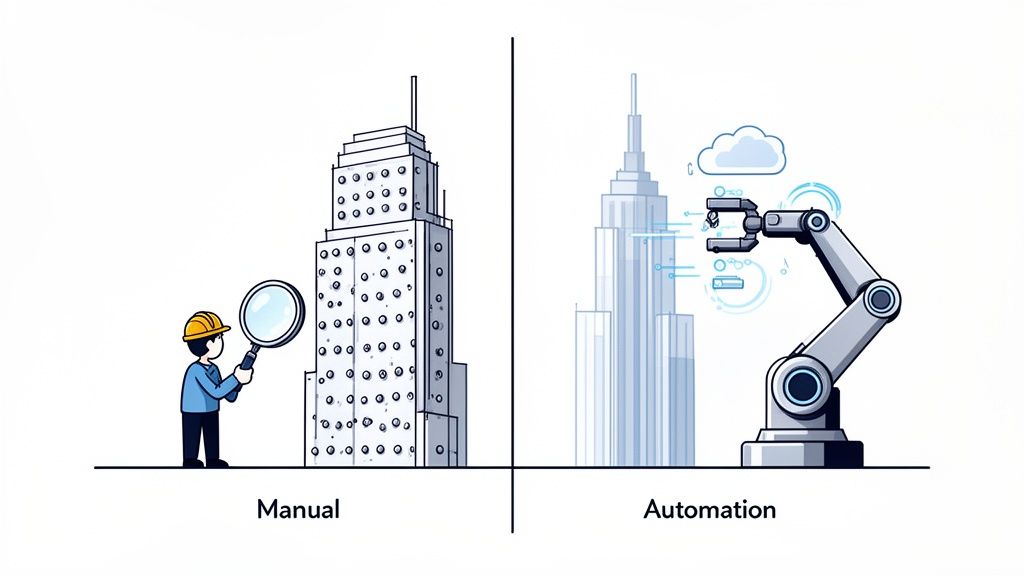
Let’s be honest, in the face of today’s complex software, traditional manual testing just can’t keep up. Think of it like trying to inspect every single rivet on a new skyscraper by hand before the grand opening. It’s not just slow and expensive; it’s a recipe for human error. That’s the reality many development teams are stuck in.
This very challenge has kickstarted a massive industry-wide change. The global Testing as a Service (TaaS) market, the engine behind solutions like TestDriver’s AI-powered testing, ballooned to USD 4,541.8 million in 2023. It’s on track to hit USD 11,376.8 million by 2030, growing at a steady 14% CAGR. This growth isn’t just a number; it’s a direct response to the chaos of modern applications with countless dependencies that need constant, reliable testing to prevent major failures.
Automation Testing as a Service flips the old QA model on its head. Instead of building and maintaining a whole testing setup from the ground up, think servers, devices, and finicky automation frameworks, teams can simply plug into a ready-made ecosystem.
This approach gives development and QA teams their time back by offloading the heavy lifting. You no longer have to worry about infrastructure setup or framework updates. Your team can concentrate on defining what needs to be checked, ensuring the application is solid from day one. This mindset lines up perfectly with a modern automation-first approach in software testing, which is all about building quality in from the start.
To really see the difference, let’s compare the two approaches side-by-side.
The table below breaks down the core differences in approach, resources, and outcomes between old-school manual testing and a modern ATaaS model.
| Aspect | Traditional Manual Testing | Automation Testing as a Service (ATaaS) |
|---|---|---|
| Effort Focus | Repetitive, manual test execution | Test strategy, design, and analysis |
| Infrastructure | Requires in-house setup and maintenance | Fully managed by the service provider |
| Scalability | Limited by team size and resources | On-demand; scales instantly as needed |
| Speed & Feedback | Slow, with feedback loops spanning days | Rapid, providing near-instant feedback in CI/CD |
| Upfront Cost | High for dedicated teams and hardware | Low; typically a subscription-based model |
| Accessibility | Requires specialized QA engineers | Usable by developers, PMs, and non-coders |
As you can see, ATaaS isn’t just a faster version of manual testing; it’s a completely different way of working that makes quality a shared, accessible responsibility.
The rise of ATaaS makes serious, enterprise-grade testing available to teams of any size. The service-based model gets rid of the need for a huge upfront investment in hardware or hiring specialized engineers. It levels the playing field, allowing smaller teams to compete on both quality and speed.
By abstracting away the underlying complexity, ATaaS allows engineers to concentrate on high-value activities like test strategy and exploratory testing, rather than getting bogged down in script maintenance and environment configuration.
AI-powered platforms are making this more approachable than ever. These systems can take simple, plain-English instructions and turn them into complex, reliable test scenarios. This new wave of smart automation isn’t just about running tests faster, it’s about making the creation and upkeep of those tests nearly effortless.
So, what is Automation Testing as a Service (ATaaS)? The best way to think about it is not as a single tool, but as your own dedicated quality assurance team living in the cloud, ready to go whenever you need them. You’re not just renting software; you’re tapping into a complete ecosystem that handles everything from test execution and environment management to analyzing the results.
This model completely flips the script on how we approach quality. Instead of building a testing factory from the ground up, and all the headaches that come with it, you’re using one that’s already built, maintained, and staffed by people who live and breathe this stuff. This entire service is built on three pillars that work together to give you reliable, on-demand testing.
At the core of any ATaaS platform is a seriously powerful technology stack. This isn’t a single piece of software, but a whole collection of components that make automated testing at scale even possible. This foundation takes care of all the messy, behind-the-scenes work so your team can focus on what matters.
The stack usually includes:
This managed infrastructure is the secret to true scalability. Need to run 500 tests across ten different browser versions right now? An ATaaS platform can spin up all the necessary environments in seconds. Trying to do that in-house could easily take days of painstaking configuration.
Beyond the raw technology, ATaaS includes a critical human element. You’re not just a customer; you’re gaining a partner whose main job is to make sure your testing efforts actually succeed. This service layer lifts the maintenance burden that so often sinks internal automation projects.
This layer handles tasks like:
This service component is what really separates ATaaS from just buying a testing tool. It’s the difference between being handed a box of car parts and being given the keys to a finely tuned vehicle with a dedicated mechanic on call.
The final piece of the puzzle is the business model itself, which is all about flexibility and accessibility. Traditional enterprise software often demands huge upfront investments and locks you into long-term contracts. ATaaS, on the other hand, is delivered like a utility.
Most providers offer one of two models:
This flexibility levels the playing field, giving smaller teams access to the same kind of enterprise-grade QA that was once only affordable for large corporations. It essentially democratizes high-quality testing. It’s in this area that new AI-powered platforms are making the biggest waves, simplifying the hardest part of the entire process: creating robust and maintainable tests without a long, manual effort.
When you bring automation testing as a service into your organization, the impact is felt everywhere, from the engineering trenches right up to the boardroom. For business leaders, the advantages are concrete and measurable, hitting the bottom line and sharpening your competitive edge. And for the developers and QA engineers doing the hands-on work, the technical benefits remove old frustrations and open up a whole new level of productivity.
This isn’t some minor process tweak. It’s a fundamental shift in how we approach quality. The market for automation testing services, which powers platforms that can auto-generate tests, hit USD 23.9 billion in 2023. It’s on track to reach an incredible USD 92.31 billion by 2032, fueled by a staggering 16.2% CAGR. Why the explosive growth? Because this service model offers customization, rapid setup, and flexible scaling that dramatically shortens the time it takes to get products to market. You can discover more insights about this growing market and what’s driving it.
From a business standpoint, ATaaS is an accelerator. It flips the script on quality assurance, turning it from a necessary cost into a driver of growth with tangible wins that executives can see and measure.
Here’s where it really helps the business:
By outsourcing the undifferentiated heavy lifting of test infrastructure and maintenance, businesses can reallocate their most valuable resource, their engineering talent, to focus on innovation and building features that delight customers.
This strategic pivot is one of the core reasons to partner with an automation testing as a service provider.
For engineers and QA pros, the daily impact of ATaaS is huge. It gets rid of the tedious, soul-crushing work that leads to burnout and lets them focus on high-value tasks that demand human creativity and sharp thinking.
The technical advantages are felt almost right away:
Ultimately, ATaaS helps build a genuine culture of quality. It makes testing more accessible and weaves it into the fabric of the development lifecycle. Instead of being a final, dreaded gate, testing becomes a continuous, collaborative effort that helps the entire team ship better software, faster.
Picking an Automation Testing as a Service (ATaaS) provider is one of those decisions that can genuinely make or break your team’s velocity. The right partner becomes a force multiplier, helping you ship faster with way more confidence. But the wrong one? It just adds another layer of complexity and frustration you don’t need.
So, how do you see past the slick marketing and find a service that actually fits? It comes down to looking at vendors through the lens of your team’s real-world needs, your tech stack, your workflow, and where you’re headed. A great ATaaS solution should feel like a natural extension of your engineering crew, not some clunky tool you have to wrestle with.
You’re not just buying a piece of software; you’re bringing a partner into your development lifecycle. Let’s walk through what really matters.
Before you get wowed by fancy features, you have to nail the fundamentals. The first question is simple: does this thing actually work with our stack? If a platform can’t handle your primary programming language or won’t talk to your CI/CD pipeline, it’s a non-starter. Period.
Here’s your initial tech checklist:
The real acid test here is how quickly you can get it working. The best ATaaS platforms prove their worth in minutes, not weeks, by making these connections almost trivial to set up.
Getting this right from the start ensures the tool will slide into your existing process without causing a ton of friction.
Okay, so the tool is technically compatible. Now, will your team actually use it? The next thing to evaluate is the hands-on experience of creating and maintaining tests. A platform with a monstrous learning curve will just gather dust, defeating the whole purpose.
This is where AI-powered test creation is really changing the game. Modern platforms like TestDriver let your team build out complex end-to-end tests by just describing what needs to happen. Instead of hunting down brittle CSS selectors, an engineer can write a simple prompt in plain English, and an AI agent handles the rest.
This completely changes the dynamic. It lowers the barrier to entry so much that developers, PMs, and even non-technical folks can contribute to your quality efforts. When you’re looking at vendors, ask yourself: does this make testing faster and more accessible for everyone?
Finally, you need to think beyond today. The solution you pick has to be able to grow with your product and your team. This means looking hard at three last, but crucial, areas.
By carefully working through these criteria, you can cut through the noise and find a true partner, one that helps your team build and ship amazing software with total confidence.
To help organize your thoughts and compare providers side-by-side, a checklist can be invaluable. It forces you to ask the same critical questions of every vendor, making the final decision much clearer.
A checklist of key criteria to evaluate when selecting an Automation Testing as a Service provider, helping teams compare options systematically.
| Evaluation Category | Key Questions to Ask | Your Team’s Priority (High/Medium/Low) |
|---|---|---|
| Technical Compatibility | Does it support our front-end framework (e.g., React, Vue)? Our back-end language? Does it integrate with our CI/CD pipeline (GitHub Actions, Jenkins, etc.)? | |
| Test Creation & Maintenance | How easy is it to write a new test? Does it use AI/low-code or require expert scripting? How does it handle flaky tests and dynamic UI elements? | |
| Execution & Scalability | Can it run tests in parallel? How quickly can it scale for large test suites? Does it support cross-browser and cross-device testing? | |
| Reporting & Debugging | Are the failure reports clear and actionable? Does it provide video recordings, logs, and screenshots? Does it integrate with our bug-tracking tools (Jira, Linear)? | |
| Security & Compliance | Is the vendor SOC 2 compliant? How is test data and application access secured? What are their data retention policies? | |
| Support & Documentation | What support channels are available (email, chat, dedicated engineer)? What are the guaranteed response times? Is the documentation clear and comprehensive? | |
| Pricing & ROI | Is the pricing model transparent and predictable? Does it scale cost-effectively as our usage grows? Is there a free trial or proof-of-concept option? |
By methodically filling this out for each contender, you’ll have a data-driven foundation for your decision, ensuring you select a partner that truly aligns with your team’s goals.
You only unlock the true power of Automation Testing as a Service when it stops feeling like a separate step and becomes an invisible, essential part of your daily development rhythm. When you wire it directly into your CI/CD pipeline, testing transforms from a final, often-rushed checkpoint into a constant quality feedback loop. This gives your team the confidence to move faster.
This integration is more than just a technical hookup; it’s a cultural shift. It turns automated testing into a core, daily habit for the entire team, not some dreaded task siloed within the QA department. Thankfully, modern ATaaS platforms are built from the ground up to make this connection as painless as possible.
The goal here is simple: create a seamless flow where every code commit automatically triggers a targeted suite of tests. This gives developers immediate feedback, letting them know if their changes broke anything before the code gets merged and becomes a much bigger headache.
A typical integration workflow looks something like this:
This tight feedback loop is exactly what high-velocity teams need to thrive. With 60% of organizations already using CI/CD for cloud applications, this level of automation is quickly becoming table stakes. It’s a key reason the automation testing market is projected to hit USD 51.36 billion by 2031.
Of course, connecting these systems isn’t always a walk in the park. Teams often get stuck on challenges with managing test data or handling dynamic environments. The good news is that modern ATaaS platforms are designed with elegant solutions for these common hurdles.
To make any ATaaS integration a success, it’s also crucial that teams understand the fundamentals of creating effective test cases that will drive the whole process.
The most effective integrations feel almost invisible. The developer commits code, and a few moments later, a Slack message pops up confirming that all end-to-end tests passed. That’s it. All the complexity of environment provisioning, test execution, and reporting is handled automatically by the service.
The diagram below breaks down the key evaluation pillars, technology, integration, and security, to consider when choosing a vendor to ensure this process is smooth.
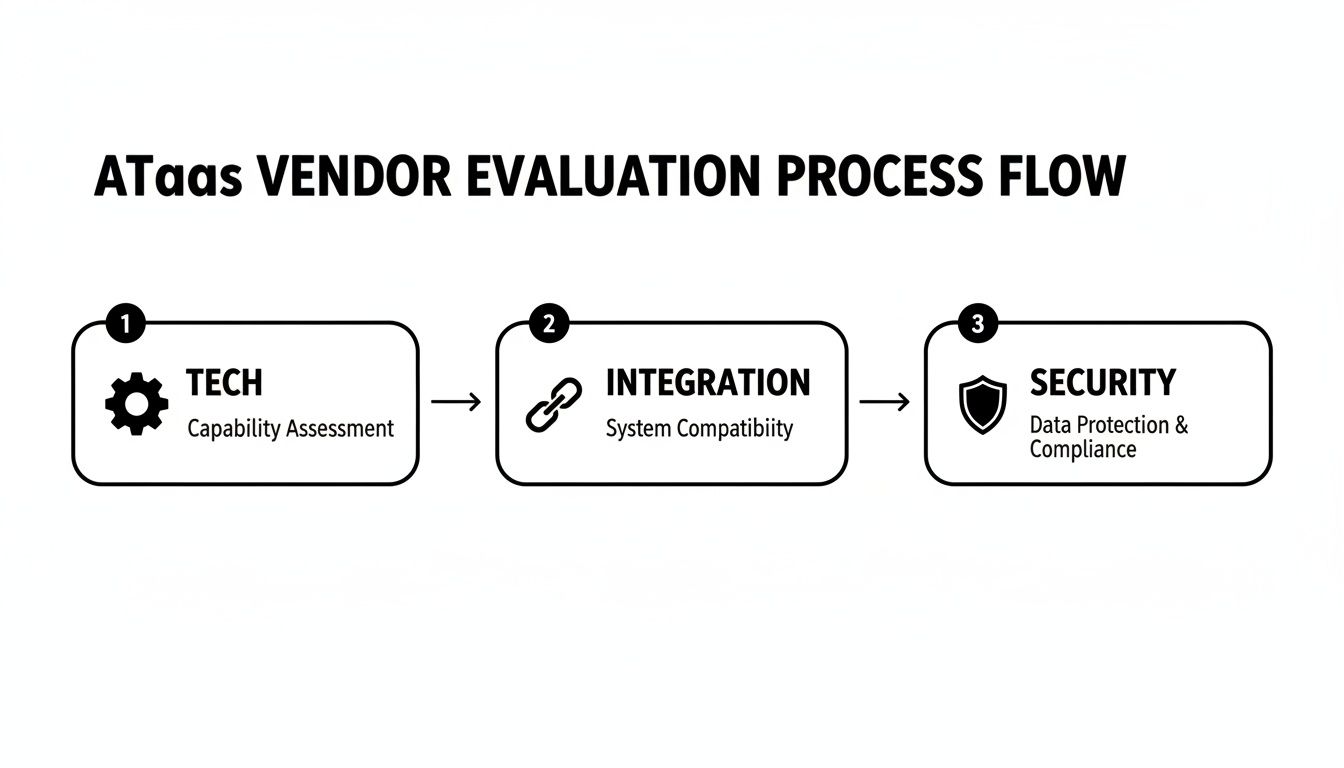
This flow underscores that seamless integration capabilities are just as critical as the core technology and security features of an ATaaS platform.
By taking the hard parts of test creation and infrastructure management off your plate, these platforms significantly lower the barrier to entry. This makes it easier to build a culture where quality is a shared responsibility and helps your team adopt best practices for integrating testing into your CI/CD pipeline.
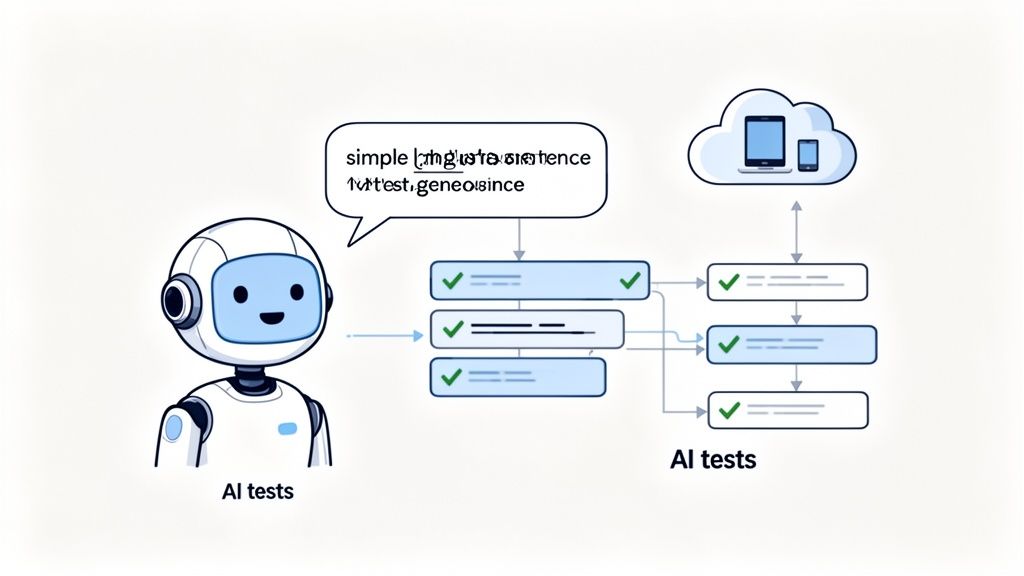
The next chapter for automation testing as a service is being written right now, and artificial intelligence is holding the pen. This isn’t just about making old processes a little quicker; it’s about fundamentally changing how we think about, create, and maintain tests. AI is pushing ATaaS beyond simply running pre-written scripts and into a new realm where the service actually understands user intent.
This shift finally closes the massive gap that has always existed between a product requirement and the code written to test it. No longer does a QA engineer have to painstakingly translate a feature description into a complex test script. Instead, an AI agent can read the requirement and get to work directly. It’s a move from human interpretation to direct, automated execution.
Think about a standard feature ticket from a product manager: “A user should be able to add an item to their cart, proceed to checkout, and complete the purchase with a credit card.” In a typical workflow, this simple sentence kicks off a long chain of manual test case writing, scripting, and debugging.
With AI-powered ATaaS, that plain-English prompt is the test. The AI agent parses the request, understands the user journey, and automatically generates the code needed to validate the entire end-to-end scenario. This isn’t just a small efficiency gain; it’s a complete transformation of the QA process.
This approach brings a few game-changing benefits to the table:
By translating natural language into executable tests, AI makes quality assurance a more democratic and collaborative activity. It moves testing from a specialized, often siloed, function to a shared responsibility across the entire product development team.
This shift empowers teams to build better software by making testing more accessible and deeply integrated into their daily work. You can explore the top AI-powered testing tools that are pioneering this change to see how it works in practice.
So, is this the end for QA engineers? Not at all. In fact, it elevates their role from script-writer to strategist. Instead of getting bogged down in the tedious mechanics of writing and debugging brittle code, engineers can focus on higher-level, more impactful work.
Their responsibilities naturally shift toward:
Ultimately, an AI-powered automation testing as a service platform acts as a force multiplier. It automates the repetitive, time-consuming grunt work, freeing up human experts to apply their creativity and critical thinking where it truly matters. This turns testing from a development bottleneck into a team-wide accelerator.
Even when you see the clear upside, bringing in a new service like automation testing as a service naturally raises a few questions. Let’s break down some of the most common ones we hear from developers, QA leads, and engineering managers to help you get the practical details sorted.
Not at all. Think of ATaaS as a powerful partner, not a replacement. It’s designed to take on the repetitive, soul-crushing work of regression testing and environment setup. This actually frees up your smart, creative QA engineers to do what they do best.
Once the grunt work is off their plate, your team can dive into:
Essentially, ATaaS handles the heavy lifting, allowing your experts to focus their brainpower where it delivers the most value.
ATaaS complements your team by taking over the robotic, predictable work. This lets your QA pros stop being script mechanics and start acting as true quality strategists, a much better use of their talent.
This is a huge, and valid, concern. You’re giving a third party access to your application, so you absolutely need to trust their security. Any serious ATaaS provider makes this a top priority and builds their platform on a foundation of robust security measures to protect your data and code.
Before you commit, look for a vendor that can prove its security chops with things like:
Always dig into a vendor’s security documentation and don’t be shy about asking direct questions about how they handle compliance and data protection.
Flaky tests, the ones that pass one minute and fail the next for no apparent reason, are the bane of every QA team’s existence. The good news is that modern ATaaS platforms, especially those built with AI, are designed specifically to tackle this problem.
Here’s how they do it:
This relentless focus on reliability means you can finally trust your test results and stop wasting hours chasing ghosts.
Ready to see how an AI-powered automation testing as a service can supercharge your team? TestDriver turns plain English into powerful end-to-end tests, closing the gap between what you want to test and how you get it done. Create your first test in minutes and see for yourself.
Discover how to automate GUI testing with our complete guide. Learn to choose the right tools, write effective tests, integrate with CI/CD, and leverage AI.
Learn how to automate UI testing with practical strategies for choosing tools, writing reliable tests, CI/CD integration, and using AI to speed up releases.
A practical guide to automated web application testing. Learn proven strategies, tools, and best practices to accelerate development and boost software quality.
Discover how automated testing DevOps transforms your CI/CD pipeline. This guide covers practical strategies, tools, and AI's role in accelerating releases.
TestDriver runs every pull request in a real desktop sandbox, finds bugs, and builds regression tests - right from your repo.