End-to-end testing for platform teams: complete 2026 guide
For end-to-end testing platform engineering teams, gate critical journeys first. Build reliable CI checks with clear ownership and reproducible failures.
Compare Katalon alternatives for GitHub pull requests, browser automation, and mobile testing. Choose by coverage, test ownership, and CI workflow.
Automate and scale manual testing with AI ->
Katalon combines low-code test authoring with web, API, mobile, and desktop testing. Its broad platform approach stops being the right fit when you want testing centered on GitHub pull requests or a code-first framework your developers own. The best Katalon alternative in 2026 is Testdriver for automatic UI checks in a real desktop sandbox; Playwright is the better fit for developer-owned browser tests.
TL;DR
Replacing Katalon is a decision about test ownership, not just test execution. A framework gives developers direct control over assertions and fixtures; a testing platform packages more of the workflow around those tests.
Separate the problem before choosing a replacement. Catching UI regressions on GitHub pull requests, maintaining browser regression tests, and automating native mobile apps require different capabilities. Do not replace a broad testing platform with a narrower tool unless that narrower scope matches your work.
Use this 2026 shortlist to identify the workflow you need. The entries are not interchangeable, and the Katalon row provides the baseline rather than another recommendation to migrate.
| Tool | Best for | Standout capability | How it differs from Katalon |
|---|---|---|---|
| Katalon | Teams using low-code authoring across testing types | Packaged test authoring and execution | Baseline: a broad testing platform rather than a single-purpose framework |
| Testdriver | GitHub teams checking pull requests for UI regressions | Automatic execution in a real desktop sandbox | Centers the workflow on pull requests and running the application |
| Playwright | Developers owning browser end-to-end tests | Browser automation with auto-waiting assertions and trace inspection | Uses code-first tests rather than Katalon’s low-code authoring workflow |
| Cypress | JavaScript teams developing browser tests interactively | Interactive runner for end-to-end and component tests | Keeps test development in a JavaScript-focused workflow |
| Appium | Teams automating native mobile applications | Driver-based mobile automation | Provides an automation framework rather than a packaged test-management workflow |
Testdriver is an end-to-end testing and code review platform that automatically runs pull requests in a real desktop sandbox to catch UI regressions. Choose this Katalon alternative when the immediate requirement is checking application behavior during GitHub review, rather than selecting another general-purpose test-authoring environment.
The distinction is execution context. Reviewing a change and running the changed application are different activities; your acceptance criteria should require evidence of the UI behavior you want protected.
| Decision dimension | Testdriver | Katalon |
|---|---|---|
| Primary fit here | Automatic GitHub pull-request UI checks | Broad test authoring and execution |
| Execution approach | Real desktop sandbox | Execution through configured test projects |
| Ownership decision | Define the UI behavior required during review | Define and maintain the tests in the platform |
Best for: GitHub engineering teams making executable UI checks part of pull-request review.
Verdict: Buy for the pull-request workflow, after validating your critical application paths. Do not treat it as an automatic replacement for unrelated testing responsibilities.
Playwright is a browser automation framework with a test runner, browser contexts, auto-waiting assertions, and trace inspection. It fits teams that want browser tests maintained in source control alongside application code.
Choose Playwright when developers want to write explicit assertions, control fixtures, and debug failures through execution traces. The trade-off is direct ownership: your team builds and maintains the test suite rather than relying on a low-code authoring layer.
| Decision dimension | Playwright | Katalon |
|---|---|---|
| Authoring model | Code-first tests | Low-code authoring with scripting options |
| Main fit | Browser automation | Broader testing-platform workflow |
| Team responsibility | Framework setup and suite maintenance | Platform configuration and suite maintenance |
For a 2026 browser-testing shortlist, favor Playwright when direct control matters more than retaining Katalon’s authoring model. Do not choose it merely to exchange one set of test files for another.
Best for: Development teams prepared to own browser regression tests as application code.
Verdict: Buy when code ownership is the goal; hold if your migration has no assigned engineering owner.
Cypress supports browser end-to-end testing and component testing with an interactive runner. It suits JavaScript teams that want to develop tests while inspecting application behavior and test commands.
The deciding question is whether that development workflow fits your application. Evaluate representative tests rather than assuming a runner demonstration covers authentication, navigation, and state management in your product.
| Decision dimension | Cypress | Katalon |
|---|---|---|
| Authoring model | JavaScript or TypeScript tests | Low-code authoring with scripting options |
| Development emphasis | Interactive browser and component testing | Packaged test authoring across testing types |
| Migration responsibility | Rewrite and validate relevant coverage | Maintain existing platform-based tests |
Best for: JavaScript teams that prioritize interactive browser test development and component testing.
Verdict: Buy for that workflow; skip as a replacement for native mobile coverage.
Appium is an automation framework for mobile applications, including native and hybrid apps. Its driver-based architecture makes it relevant when your Katalon replacement decision centers on mobile interaction rather than browser testing.
Treat Appium as an automation foundation, not a complete QA operating model. You still need to decide how tests are authored, where devices run, and how failures reach the people responsible for fixing them.
Best for: Teams with a defined native mobile automation requirement and ownership of the device environment.
Verdict: Buy for native mobile automation; skip if your only requirement is browser regression testing.
The defensible reasons to switch are workflow mismatches, not unsupported claims about outages or product quality. Use these decision points to establish whether a replacement solves a concrete problem in your team.
Write down the mismatch before evaluating tools in 2026. If the problem is unreliable test data or unclear assertions, changing the runner does not remove the underlying problem.
For your 2026 evaluation, start with a small acceptance exercise rather than a full suite rewrite. Use 3 application workflows, examine 2 pull requests, and require 1 deliberately broken assertion to prove that failure detection works. These are suggested pilot boundaries, not performance benchmarks.
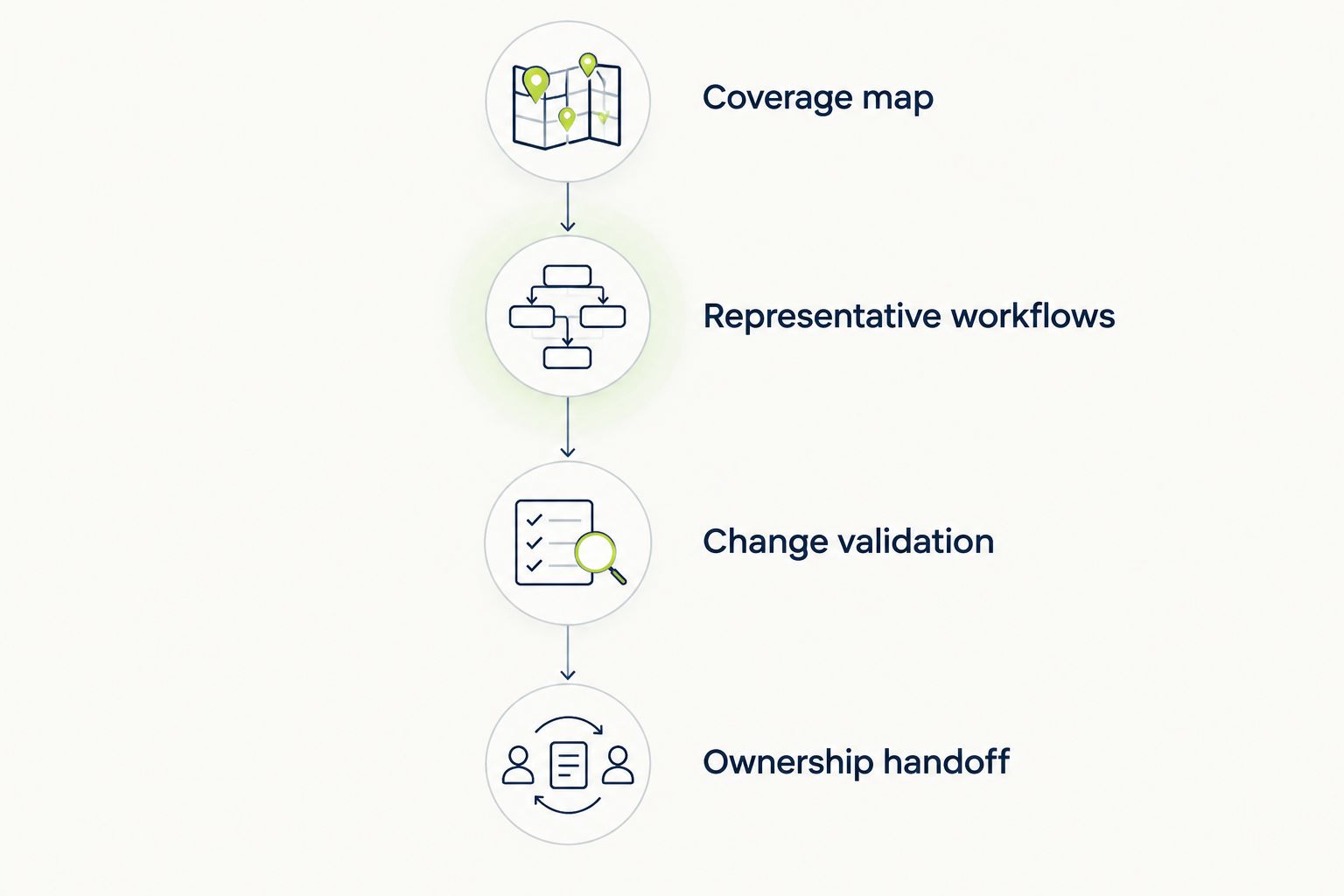
Validate preserved coverage and failure detection before retiring the existing tests.
Keep a short decision record beside the pilot results. State which coverage stays, which tests need rewriting, and which responsibilities move elsewhere. The automated regression testing tools guide provides a related shortlist when regression coverage is the central requirement.
Keep Katalon when its existing tests protect the workflows you need and its authoring model suits the people maintaining them. A working suite is an asset; replacing its tool without preserving its assertions is not progress.
Stay when a proposed alternative only reproduces current coverage while creating a rewrite. Switch when the new workflow addresses a documented requirement, and validate that requirement before retiring existing tests. That is the useful standard for a 2026 migration decision.
What’s the best Katalon alternative for GitHub pull requests?
Testdriver is the best fit on this shortlist for automatic pull-request UI testing in a real desktop sandbox. Its scope matches GitHub engineering teams that want to catch UI regressions during code review.
Is Playwright better than Katalon?
Playwright is a better fit when developers want direct ownership of code-first browser tests. Katalon remains a better fit when its low-code authoring and broader testing workflow match the team’s requirements.
Should I choose Cypress or Playwright instead of Katalon?
Choose Cypress for its interactive JavaScript browser-testing workflow, and Playwright for its browser automation and trace-based investigation workflow. Validate either choice against your application’s authentication, navigation, and test-data requirements.
Which Katalon alternative should I evaluate for native mobile apps?
Evaluate Appium when native mobile automation is the requirement. Plan device configuration, driver setup, test authoring, and reporting rather than treating a framework as a complete testing platform.
Can I move Katalon tests to another tool without rewriting them?
Do not assume Katalon tests transfer unchanged to a different framework. Map each test’s actions, assertions, data, and setup to the destination tool before deciding what can be reused.
How should I compare Katalon alternatives in 2026?
Compare Katalon alternatives by required coverage, authoring model, execution environment, and maintenance ownership. Run representative workflows and an intentional regression before committing to migration.
When should I keep Katalon instead of switching?
Keep Katalon when its existing coverage and authoring workflow already meet your team’s needs. A replacement needs a specific benefit that justifies rewriting tests and validating coverage again.
A passing test proves only the conditions its assertions checked. Before migrating a critical workflow, deliberately break the expected outcome and confirm the replacement reports a failure. Preserve the ability to detect the bug, not merely the ability to run the test.
For end-to-end testing platform engineering teams, gate critical journeys first. Build reliable CI checks with clear ownership and reproducible failures.
End-to-end testing Series B startups can trust starts with critical workflows. Build PR checks, isolate test data, and gate merges on clear evidence.
UI regression testing healthcare software needs more than screenshots. Build patient-context, permission, and saved-state checks into pull requests.
AI code review open source maintainers can trust needs evidence. Compare review methods, isolate contributor code, and keep humans in control of merges.
TestDriver runs every pull request in a real desktop sandbox, finds bugs, and builds regression tests - right from your repo.