End-to-end testing for platform teams: complete 2026 guide
For end-to-end testing platform engineering teams, gate critical journeys first. Build reliable CI checks with clear ownership and reproducible failures.
TestDriver vs Virtuoso QA: choose pull request testing or QA-led browser journeys. Compare workflow fit, regression coverage, and evaluation criteria.
Automate and scale manual testing with AI ->
Choose TestDriver if your GitHub team wants pull requests exercised in a real desktop sandbox to catch UI regressions; choose Virtuoso QA if your QA team wants natural-language authoring for browser-based test journeys. The deciding factor is where you want testing to start: a code change or a maintained user journey.
TL;DR
A testing platform should close a specific gap in your release process. Running another suite is not progress if developers still merge broken interactions or QA still spends release day repeating the same checks.
For your 2026 evaluation, separate change validation from journey coverage. Change validation asks whether a pull request breaks working behavior. Journey coverage asks whether a defined business process still produces the expected result. You need both, but the team responsible for each determines which workflow fits.
TestDriver is the better end-to-end testing fit for GitHub teams that want pull requests exercised in a real desktop sandbox. Virtuoso QA is the stronger starting point when your requirement centers on QA-authored browser journeys expressed in natural language.
| Dimension | TestDriver | Virtuoso QA |
|---|---|---|
| Best for | GitHub engineering teams validating pull requests | QA teams authoring browser test journeys |
| Change trigger | Automatic execution of pull requests | Journey-centered test definition and execution |
| Authoring approach | Automated testing and regression-test creation | Natural-language test authoring |
| Execution focus | Running changes in a real desktop sandbox | Browser-based application journeys |
| Acceptance criteria | Must verify intended behavior, not just execution | Must verify intended behavior, not just execution |
| Handoff | Connect the regression to the pull request under review | Organize the failure around the maintained test journey |
| Pricing model | Confirm billing basis and included execution | Confirm billing basis and included execution |
| Standout feature | Pull request execution combined with automated code review | Natural-language expression of browser test steps |
These are workflow distinctions, not a feature-exclusion list. A browser-testing platform is not automatically disconnected from CI, and desktop execution does not automatically establish coverage for every operating system or application. Verify those requirements against your actual deployment.
The clearest advantage of the pull request approach is its starting point. A developer submits a change, and the testing workflow exercises that change before the team decides whether to merge it. That puts behavioral validation beside the code review decision.
TestDriver automatically runs pull requests in a real desktop sandbox to catch UI regressions. For an engineering organization using GitHub, that directly matches the question reviewers need answered: does this change break the application when it runs?
The tradeoff is scope. Validating changed behavior does not replace deciding which business journeys matter, which edge cases deserve coverage, or which failures should block a release. Engineering still owns those decisions.
Choose this approach when your recurring problem is a pull request that looks acceptable in review but breaks an interaction. Do not select it merely because your team uses GitHub; select it because runtime validation belongs in your review process.
Virtuoso QA is the better starting point when the primary job is expressing browser workflows as readable test steps. Natural-language authoring gives a QA-led evaluation a concrete focus: how clearly can the team describe, execute, and maintain the journey?
Consider a browser workflow such as signing in, editing a record, and confirming that the change persists. The useful comparison is not which interface produces the first draft fastest. It is whether the person responsible for that workflow can understand its assertions and update it when requirements change.
Readable steps are an authoring benefit, not proof of test quality. A journey can describe the wrong behavior perfectly. Your QA owner still needs to define the expected result, meaningful negative cases, and acceptable failure conditions.
Choose Virtuoso QA for an authoring-centered requirement. If your main requirement is automatic execution of each pull request in a desktop sandbox, evaluate that workflow separately rather than treating natural-language authoring as a substitute.
A real desktop sandbox provides a place to exercise the application rather than judge the change only from its source. That distinction matters when the defect appears through interaction: a control does not respond, a screen fails to update, or a workflow stops before completion.
The supplied product scope combines end-to-end UI testing with automated code review. That makes the engineering-centered option relevant when you want review to include behavior in a running environment, not just comments about a diff.
Keep the boundary clear. A desktop sandbox is an execution environment, not a blanket compatibility claim. Confirm your operating system, application setup, authentication requirements, and test-data access during evaluation. Do not infer a supported device matrix from the word desktop.
Use the following flow to judge whether runtime feedback reaches the review decision:
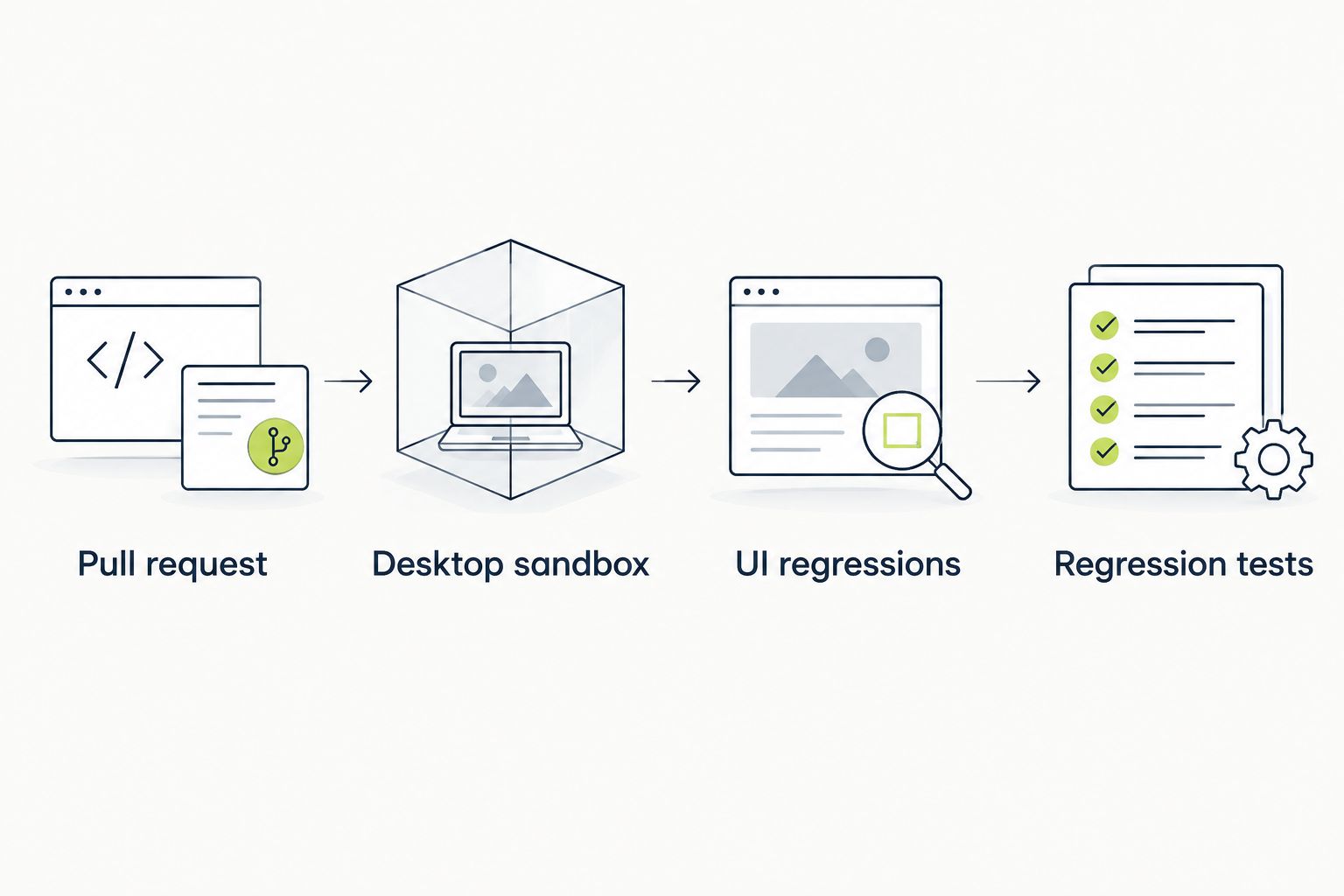
Runtime feedback is useful when it informs the pull request decision.
A journey-centered workflow starts from what a user must accomplish. That gives QA a stable reference even when several pull requests contribute to the same business process.
Virtuoso QA fits this requirement when natural-language browser tests are the artifact your team wants to maintain. The practical advantage is organizational: the journey can remain the unit of discussion while individual implementation changes come and go.
That approach also creates a maintenance obligation. Someone must distinguish a legitimate requirement change from a regression, update the expected behavior, and keep test data usable. Natural-language syntax does not remove those responsibilities.
For your 2026 shortlist, ask the eventual owner to edit a journey after a deliberate UI change. Judge the result by clarity and correctness, not by how little typing the initial demo required. A test that nobody understands is difficult to trust when it blocks a release.
Neither workflow wins on correctness by default. A test needs an observable result that distinguishes success from failure, regardless of whether it begins with a pull request or a written journey.
For a form submission, reaching a confirmation screen is one observation. Verifying that the intended record was created is another. Decide which observation proves the requirement before you compare platforms.
Build your evaluation around 3 workflows: a critical successful journey, a rejected action, and a previously broken interaction. These are proposed evaluation cases, not product coverage claims. They test different responsibilities without turning the pilot into a full migration.
For each workflow, write down:
Run each workflow against working behavior and a deliberately broken version. A green result on the working version is necessary; a red result on the broken version establishes whether the assertion detects the defect you care about.
A failure only helps when someone can act on it. The difference between these workflows is the natural destination of that information: the developer reviewing a change or the QA owner maintaining a journey.
For the pull request route, ask whether the reviewer can connect the observed failure to the change under review. For the journey route, ask whether the QA owner can identify the failed business step and explain its expected result.
Do not assume either handoff is complete because a dashboard shows a failed run. During your 2026 pilot, require a person who did not create the test to investigate the failure. That exposes unclear assertions and missing setup instructions.
Use 2 runs per workflow as an initial repeatability check with the same intended starting state. This is a proposed pilot procedure, not a reliability benchmark. Investigate any difference before treating the result as a merge or release gate.
Neither platform earns a reliability win from its authoring style. Judge whether repeated execution produces understandable results and whether your team can explain every failure.
Evaluate both commercial proposals using the same workload. A proposal built around occasional QA execution cannot be compared directly with one expected to validate every pull request.
Ask each vendor which billing model applies to your deployment and what drives additional charges. Confirm whether the agreement measures users, executions, runtime, concurrency, or another usage unit. Treat these as contract questions, not assumed features of either platform.
Your 2026 comparison should include:
The tradeoff is predictability versus flexibility. A fixed commitment is useful only if its included scope matches your workload; a usage-based agreement needs controls that your team understands. Compare the offered terms rather than assigning either model an automatic win.
Your priority is checking running behavior during pull request review. You want end-to-end UI testing and automated code review tied to changes, with execution in a real desktop sandbox.
TestDriver wins for this engineering-led profile. Its stated workflow matches the review event. Confirm environment requirements and failure ownership before making the result a merge gate.
Your priority is maintaining readable browser journeys, and natural-language authoring is a central selection criterion. You want the business workflow to remain the reference point for test ownership.
Virtuoso QA wins for this QA-led profile. Validate its fit by having the actual test owner author, change, and investigate a representative journey, not by watching a prepared demonstration.
| Dimension | Winner |
|---|---|
| GitHub pull request workflow | Engineering-led option |
| Natural-language browser authoring | Virtuoso QA |
| Real desktop sandbox requirement | Engineering-led option |
| QA-owned browser journey specification | Virtuoso QA |
| Acceptance criteria | Tie: validate explicitly |
| Failure handoff | Tie: validate with the responsible team |
| Commercial fit | Decide from matched proposals |
Is TestDriver better than Virtuoso QA for GitHub pull requests?
TestDriver is the better fit when your requirement is automatically running GitHub pull requests in a real desktop sandbox to catch UI regressions. Evaluate that workflow against your repository, application setup, and merge requirements.
When should a QA team choose Virtuoso QA?
Choose Virtuoso QA when natural-language authoring for browser test journeys is the primary requirement. Have the eventual QA owner demonstrate how a journey is maintained after the expected behavior changes.
Does natural-language test authoring remove the need for assertions?
No. Natural-language tests still need explicit expected outcomes that distinguish working behavior from a regression. Readable steps do not establish that the right behavior was tested.
Does a desktop sandbox prove cross-platform coverage?
No. A desktop sandbox describes an execution environment, not coverage across every operating system or device. Confirm the environments required by your application separately.
Can pull request testing replace a regression strategy?
No. Pull request testing validates changes, while a regression strategy defines which existing behaviors must remain protected. Assign ownership for that coverage even when execution is automated.
How should you evaluate these testing platforms in 2026?
Use the same critical journey, rejected action, and previously broken interaction for both evaluations. Check expected outcomes, repeatability, failure investigation, and maintenance with the people who will own the tests.
How should you compare commercial proposals?
Compare proposals against the same execution workload and team-access requirements. Confirm the billing basis, included scope, concurrency terms, and treatment of reruns before selecting a contract.
Introduce a known failure before you trust a passing test. A workflow that succeeds against working software proves execution; a workflow that rejects the deliberately broken version demonstrates that its assertion catches that specific defect. Make that check part of your 2026 selection process.
For end-to-end testing platform engineering teams, gate critical journeys first. Build reliable CI checks with clear ownership and reproducible failures.
End-to-end testing Series B startups can trust starts with critical workflows. Build PR checks, isolate test data, and gate merges on clear evidence.
UI regression testing healthcare software needs more than screenshots. Build patient-context, permission, and saved-state checks into pull requests.
AI code review open source maintainers can trust needs evidence. Compare review methods, isolate contributor code, and keep humans in control of merges.
TestDriver runs every pull request in a real desktop sandbox, finds bugs, and builds regression tests - right from your repo.