TestRigor alternatives in 2026
Compare testrigor alternatives: TestDriver for desktop PR testing, Playwright for coded browser tests. See trade-offs and decide what fits your team.
Compare ACCELQ alternatives: TestDriver for GitHub pull-request UI checks, Playwright for code-owned browser tests. See trade-offs and migration steps.
Automate and scale manual testing with AI ->
ACCELQ gives QA teams a codeless approach to test automation, including web, mobile, and API testing. That model stops being the right fit when your priority shifts to code-owned browser tests or executing GitHub pull requests to catch UI regressions. The best ACCELQ alternative in 2026 is TestDriver if you need pull-request UI testing in a real desktop sandbox; Playwright if you need browser tests your developers own in code.
TL;DR
Replacing ACCELQ changes who writes tests, who repairs failures, and where testing fits into delivery. A codeless QA workflow, a developer-owned browser suite, and pull-request execution solve different problems.
Your 2026 shortlist should start with the failure you need to catch, not the longest feature list. Separate application coverage from authoring preferences before comparing tools. A browser framework is not a replacement for every mobile or API workflow just because it runs in CI.
| Tool | Best for | Standout capability | Difference from ACCELQ | Main trade-off |
|---|---|---|---|---|
| ACCELQ | QA teams prioritizing codeless automation | Codeless testing across web, mobile, and APIs | Baseline: platform-led test authoring | Does not match a code-first ownership preference |
| TestDriver | GitHub teams checking pull requests for UI regressions | Runs pull requests in a real desktop sandbox | Centers testing and code review on pull requests | Not a like-for-like replacement for every codeless QA workflow |
| Playwright | Developers owning browser regression tests | Browser automation with Chromium, Firefox, and WebKit | Tests live in code under engineering ownership | Requires test code and ongoing maintenance |
| Cypress | JavaScript teams testing web applications | Browser end-to-end testing and component testing | JavaScript or TypeScript tests replace codeless authoring | Browser-focused rather than native mobile or desktop automation |
| Selenium | Teams needing WebDriver and language flexibility | Browser automation through language bindings and browser drivers | Framework-based automation instead of a codeless platform | Requires separate choices for test structure and reporting |
These are different replacement paths, not interchangeable products. Choose the ownership model first, then validate coverage against your application.
TestDriver is an end-to-end testing and code review platform that automatically runs pull requests in a real desktop sandbox to catch UI regressions. It fits engineering organizations using GitHub that want changes exercised before merge, rather than treating source review as proof that the interface works.
Best for: GitHub teams making pull-request UI regression detection the primary requirement.
| Dimension | This alternative | ACCELQ |
|---|---|---|
| Core focus | Pull-request UI testing and code review | Codeless test automation |
| Execution context | Real desktop sandbox for pull requests | Platform-managed automation workflows |
| Best-fit owner | GitHub engineering team | Team prioritizing codeless test authoring |
The distinction is where you want confidence to appear. If the decision is whether a proposed change breaks the UI, evaluate the pull-request workflow directly. If the decision is how a QA team authors and organizes codeless automation, retain that requirement in your comparison.
For a 2026 evaluation, use a pull request containing a known UI regression and inspect the result. Require evidence that the changed application ran and that the reported issue matches the behavior you introduced.
Verdict: Buy for GitHub-centered pull-request UI testing; hold if codeless QA authoring remains your primary requirement.
Playwright is a browser automation framework with support for Chromium, Firefox, and WebKit. Its test runner supports assertions, fixtures, parallel execution, and tracing, giving developers code-level control over browser regression tests.
Best for: Engineering teams that want browser tests reviewed and maintained alongside application code.
| Dimension | Playwright | ACCELQ |
|---|---|---|
| Authoring | Code-based tests | Codeless authoring |
| Primary fit | Developer-owned browser automation | Platform-led QA automation |
| Coverage emphasis | Browser applications | Web, mobile, and API testing |
| Ownership requirement | Engineers maintain test code | Teams maintain platform-authored automation |
Choose Playwright when code ownership is the goal, not merely an acceptable inconvenience. Assign test maintenance to the team changing the application, and require assertions that prove outcomes rather than just successful clicks.
If browser coverage drives your decision, use the cross-browser testing tools guide to separate automation frameworks from execution services.
Verdict: Buy for code-owned browser regression testing; skip as a direct replacement for native mobile coverage.
Cypress supports browser end-to-end tests and component testing using JavaScript or TypeScript. It fits web teams that want to inspect application behavior during test development and keep test authoring close to their existing frontend skills.
Best for: JavaScript and TypeScript teams testing web journeys and individual UI components.
| Dimension | Cypress | ACCELQ |
|---|---|---|
| Authoring | JavaScript or TypeScript | Codeless authoring |
| Core use case | Web end-to-end and component testing | Web, mobile, and API automation |
| Ownership fit | Frontend development teams | Teams prioritizing platform-led QA |
For a 2026 shortlist, Cypress earns consideration when frontend developers will own the suite. Run both a component test and a complete user journey before choosing it; success at the component level does not establish end-to-end coverage.
Verdict: Buy for JavaScript-centered web testing; skip when native application coverage is mandatory.
Selenium provides browser automation through WebDriver, with bindings for multiple programming languages. Selenium Grid supports remote browser execution, making Selenium relevant when your team needs a WebDriver-based approach and control over execution infrastructure.
Best for: Teams with established Selenium expertise, language requirements, or browser infrastructure.
| Dimension | Selenium | ACCELQ |
|---|---|---|
| Authoring | Code through language bindings | Codeless authoring |
| Execution approach | WebDriver and optional Grid | Platform-managed automation |
| Team responsibility | Assemble and maintain the test framework | Maintain automation within the platform |
Do not choose Selenium simply because your team recognizes the name. Choose it when WebDriver, language flexibility, or existing infrastructure is an actual requirement.
Verdict: Buy for an established WebDriver strategy; skip if your goal is less framework assembly.
The defensible reasons to switch are changes in requirements. None requires treating ACCELQ as a bad product.
Write the reason for switching as an acceptance criterion. Replace vague goals such as easier automation with a concrete requirement: the developer responsible for a change must be able to reproduce and diagnose its failing regression test.
Use a small, deliberate pilot for your 2026 decision. Keep the application behavior and expected outcomes identical across candidates so authoring style does not obscure coverage gaps.
Select 3 user journeys: a critical successful path, a validation failure, and an authentication-dependent action. State the expected application outcome for each before building tests.
Prepare 2 pull requests: a valid change and a change with 1 known UI regression. Run each candidate against both changes and check whether the result distinguishes expected behavior from the regression.
Review what a developer receives after failure. Require enough context to identify the broken journey, reproduce the issue, and distinguish application behavior from an environment problem.
Name the person or team responsible for test updates, execution configuration, and failed-run triage. Do not migrate until those responsibilities are accepted.
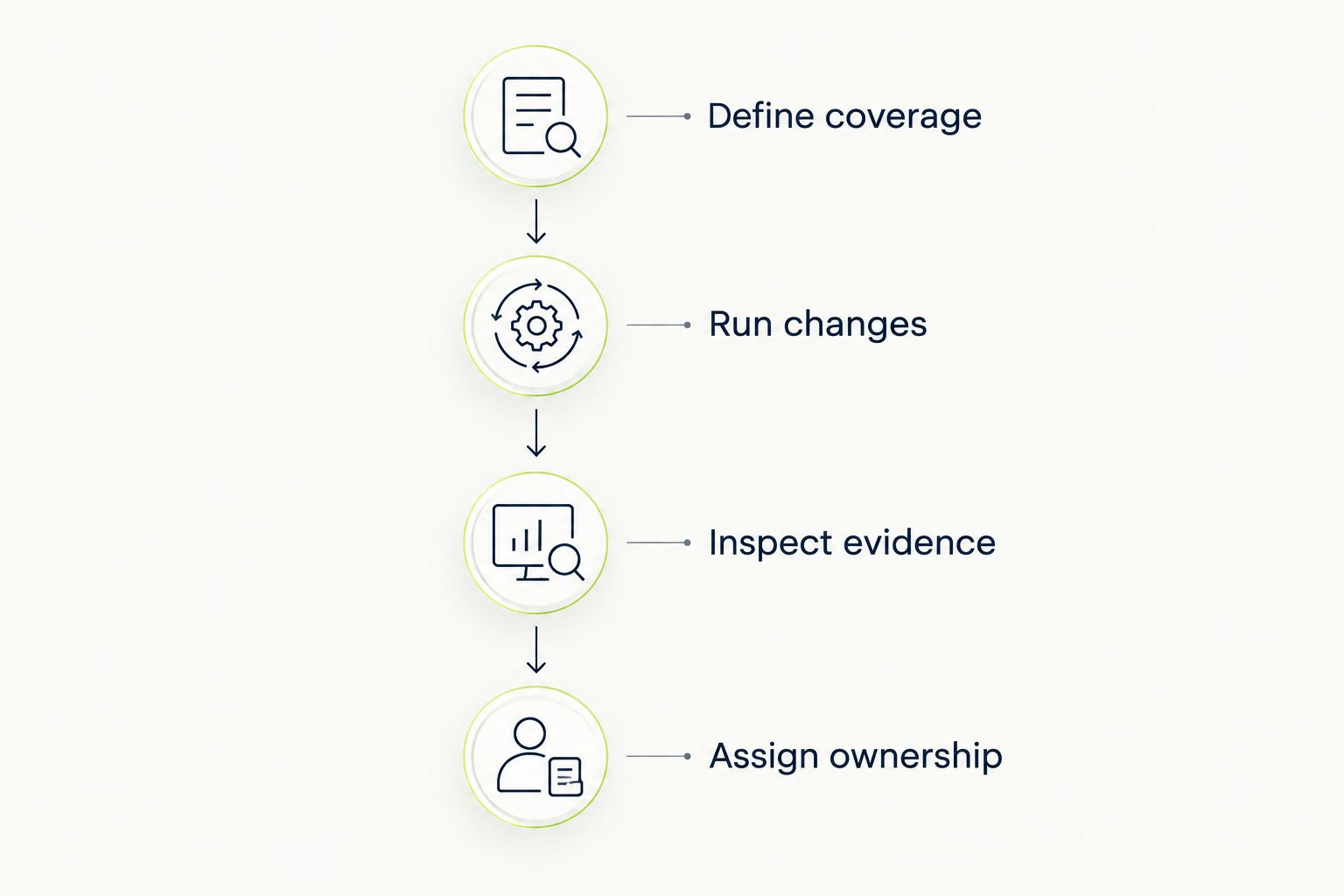
Validate behavior and failure evidence before committing to a migration.
Treat these pilot counts as a starting checklist, not a coverage benchmark. Expand the evaluation wherever your application depends on browser differences, native interfaces, APIs, or external services.
Stay with ACCELQ when codeless test ownership remains a requirement and your current workflows cover the applications you need to test. Moving to a code-first framework exchanges platform conventions for engineering responsibilities; that is not automatically an improvement.
Keep working coverage until its replacement proves the same outcomes. A targeted addition to your workflow is a better decision than a wholesale migration that leaves important journeys untested.
What’s the best ACCELQ alternative in 2026?
TestDriver is the best fit for GitHub teams that need pull-request UI testing in a real desktop sandbox. Playwright is the stronger fit when developers want to write and maintain browser tests in code.
Is Playwright better than ACCELQ?
Playwright is a better fit when code-owned browser automation is your requirement. ACCELQ is a better fit when codeless test authoring matters more than direct ownership of test code.
Can Cypress replace ACCELQ?
Cypress can replace web testing workflows that fit its browser and component testing model. It is not a like-for-like replacement for native mobile testing or every workflow managed in a broader automation platform.
Is Selenium an alternative to ACCELQ?
Selenium is an alternative for code-based browser automation. Your team must also choose and maintain the surrounding test structure, reporting, and execution setup.
Which ACCELQ alternative works for native mobile testing?
Do not select a browser framework as a native mobile replacement. Compare your required devices, operating systems, and native interactions separately from browser coverage.
How do I compare ACCELQ alternatives without rebuilding every test?
Run a focused pilot using representative journeys and a known regression. Compare coverage, failure evidence, and maintenance ownership before migrating the remaining suite.
Should I replace ACCELQ or add another testing tool?
Keep ACCELQ when its codeless workflows still meet your requirements, and evaluate another tool for a specific uncovered need. Replace the platform only after the new workflow proves equivalent coverage for the scenarios you depend on.
A passing test is only useful if it fails when the application is wrong. For your 2026 selection, deliberately introduce a known regression and require the candidate to identify it; a clean run against a healthy application proves less.
Compare testrigor alternatives: TestDriver for desktop PR testing, Playwright for coded browser tests. See trade-offs and decide what fits your team.
Compare Virtuoso QA alternatives: TestDriver for GitHub pull-request UI testing, Playwright for code-owned tests. See trade-offs and evaluation steps.
Test automation tools pricing comparison for 2026: choose by workflow fit, then compare CI execution, maintenance, and failure investigation work.
Compare TestMu alternatives for pull-request testing, browser automation, and device coverage. Choose TestDriver for GitHub UI regression checks.
TestDriver runs every pull request in a real desktop sandbox, finds bugs, and builds regression tests - right from your repo.