End-to-end testing for platform teams: complete 2026 guide
For end-to-end testing platform engineering teams, gate critical journeys first. Build reliable CI checks with clear ownership and reproducible failures.
TestDriver vs Katalon: choose pull request UI checks or a QA-owned automation suite. Compare authoring, coverage, CI fit, and evaluation criteria.
Automate and scale manual testing with AI ->
Choose TestDriver if your GitHub team wants pull requests run in a real desktop sandbox to catch UI regressions; choose Katalon if your QA team needs an authoring environment for web, mobile, API, and desktop test suites. The deciding axis in 2026 is pull request review versus a broader, deliberately authored automation program.
TL;DR
A test authoring platform and a pull request testing platform solve different operational problems. Buying the broader option does not automatically improve review, and adding automated review does not replace an established QA program.
For your 2026 evaluation, start with the failure you need to prevent. A broken interaction introduced by a pull request calls for execution against that change. A release spanning mobile clients, browser flows, and APIs calls for a planned suite with explicit coverage and ownership.
Choose the workflow you need to improve, not the longest feature list. Neither product name tells you whether your application starts correctly in CI, whether test data is repeatable, or whether a failure gives a developer enough information to fix it.
| Dimension | TestDriver | Katalon |
|---|---|---|
| Best for | GitHub engineering teams checking pull requests for UI regressions | QA teams building and maintaining broader automation suites |
| Standout feature | Automatically runs pull requests in a real desktop sandbox | Katalon Studio combines low-code authoring with scripting |
| Test authoring | Centers the workflow on automated end-to-end testing and code review | Supports keyword-driven tests and Groovy scripting |
| Coverage breadth | Explicit focus on end-to-end UI testing and pull request review | Web, mobile, API, and desktop testing capabilities |
| Execution readiness | Application startup, access, and test data still need validation | Application startup, access, and test data still need validation |
| Failure usefulness | Judge whether findings explain the changed UI behavior | Judge whether failed tests explain the unmet expectation |
| Pricing model | Confirm the billing unit for the intended pull request workload | License-based tooling; confirm authoring and execution requirements |
| Existing-suite fit | Evaluate against the pull request review gap | Stronger starting point for teams already maintaining Katalon suites |
TestDriver is best for GitHub engineering teams that want end-to-end UI testing tied to pull request review. Its stated workflow automatically runs pull requests in a real desktop sandbox to catch UI regressions. That connects the proposed change to observed application behavior.
This matters when a review comment needs evidence beyond the code diff. A component change can look reasonable while breaking the interaction around it. Running the application addresses a different question from reading the implementation: does the changed flow still work?
The tradeoff is scope. A pull request review workflow is not, by itself, a coverage plan for every release requirement. Keep explicit ownership for critical journeys, integration contracts, and release acceptance criteria.
Choose this workflow when developers own the merge decision and UI regressions are the immediate problem. Do not choose it on the assumption that automated review proves every supported environment or business rule has been tested.
Katalon Studio supports keyword-driven test authoring and Groovy scripting. That gives QA teams a concrete place to define steps, reusable logic, and assertions rather than treating test behavior as an unspecified part of automated review.
Katalon wins when maintaining an explicit test suite is the main job. A team can organize expected behavior into cases that remain useful across releases. Scripted logic also gives technical contributors a way to express behavior that does not fit neatly into recorded steps.
That control brings responsibility. Someone must own assertions, test data, reusable components, and changes to the suite. A recorded interaction is not a complete specification, and a script that executes successfully still needs a meaningful check.
During evaluation, ask the future suite owner to change an existing test after a UI update. Watch the maintenance task, not just the initial recording. The authoring experience matters most after the application changes.
Katalon supports web, mobile, API, and desktop testing. That breadth makes it the stronger starting point when your procurement requirement explicitly spans those categories.
A browser journey and an API assertion answer different questions. The browser checks the interaction a user sees; the API check can target a response or contract without driving the interface. Keeping those distinctions visible helps you avoid forcing every requirement through a UI test.
The stated focus of the competing platform is end-to-end UI testing and automated pull request review. Treat that as the basis for evaluation, not as proof of equivalent coverage across every testing category.
Katalon wins on documented category breadth, not on demonstrated coverage of your application. Validate the actual operating systems, application technologies, authentication flows, and execution environments you require. A platform-level capability does not guarantee compatibility with a particular application.
Neither option removes the need to prepare the application under test. You still need a reachable build, usable credentials, suitable permissions, and data that makes the expected journey possible.
For your 2026 pilot, define 3 representative workflows: a routine success path, a permission-sensitive path, and a recovery path after invalid input. These are proposed evaluation cases, not a claim about either product’s coverage.
Use the same build and starting state when comparing results. If one run starts with an authenticated user and the other starts at a login screen, the comparison measures setup differences rather than testing quality.
Keep these prerequisites separate:
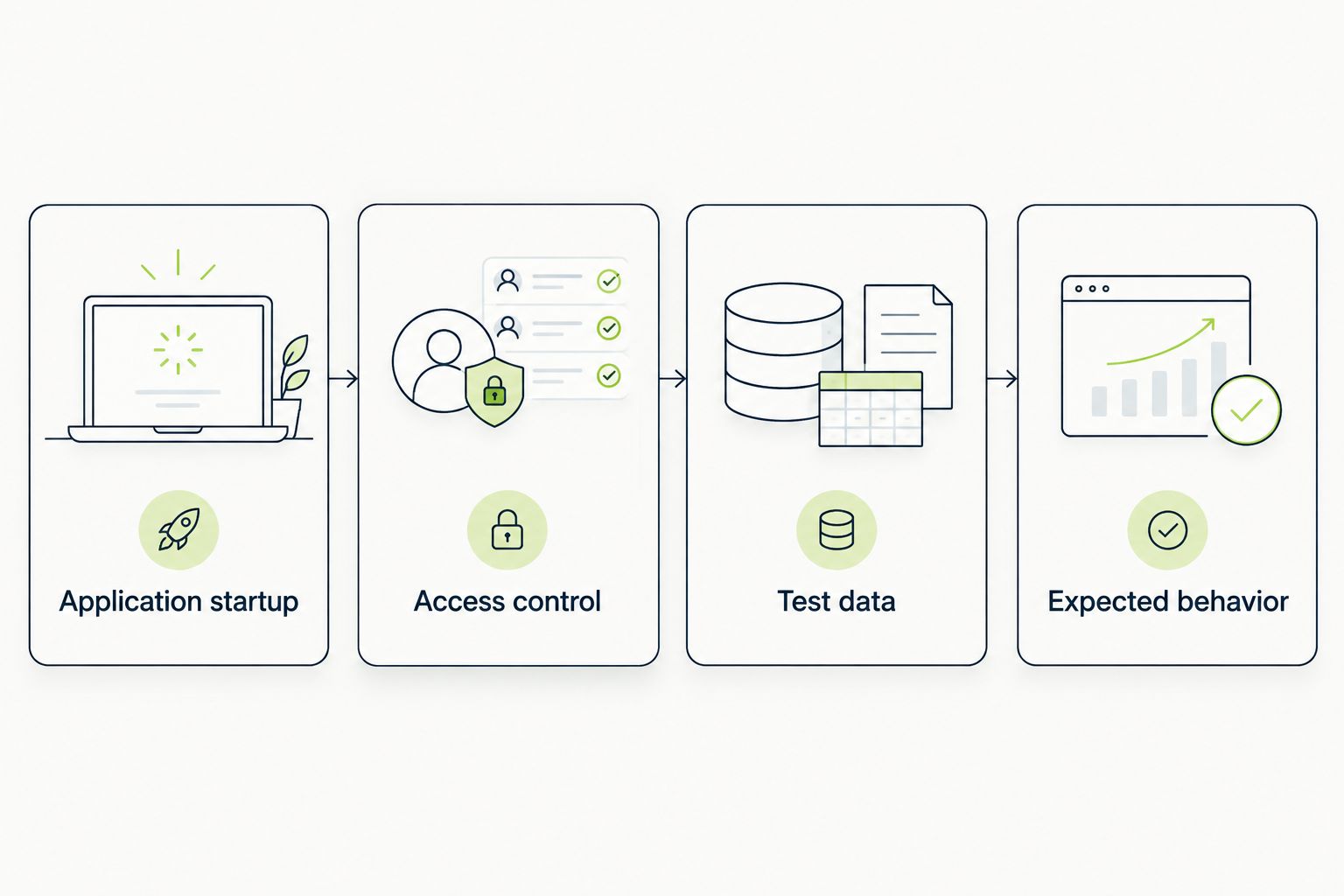
Establish the same starting conditions before comparing test results.
This dimension is a tie. Evaluate how each workflow handles your prerequisites, but do not mistake a configuration problem for a product verdict.
A red status is useful only when it points toward the broken expectation. For either platform, the acceptance criterion should be whether a developer can connect the finding to an observable failure.
Use 2 explicit assertions per pilot workflow as an evaluation exercise: one for the visible outcome and one for the resulting application state. For example, submitting a form should show the expected confirmation and persist the intended change. These are suggested checks, not product limits.
Ask the developer receiving the result to identify:
Do not award a winner because one output contains more text. Likewise, a passing run is not evidence of correctness if its assertions never examine the behavior you care about.
Failure usefulness is a tie until your own application supplies evidence. The product description establishes the workflow; the pilot establishes whether its output supports your merge or release decision.
For a 2026 purchase, compare the commercial model against the workload you intend to run. A headline plan name does not tell you whether your team has budgeted for authoring, unattended execution, concurrency, or the surrounding infrastructure.
Katalon’s license-based tooling makes the distinction between authoring and execution important. Confirm which components your proposed setup requires and which rights cover automated execution. Do not assume an editor license answers every CI requirement.
For the pull request workflow, confirm the billing unit and how your intended repository activity maps to it. Ask how usage is measured, what execution rights apply, and which workload assumptions the proposal includes.
The tradeoff is predictability versus workload flexibility. Seat-oriented arrangements need to match the people doing the work; usage-oriented arrangements need to match execution volume. Those are purchasing criteria, not claims that both vendors use the same structure.
Include maintenance in the decision. Your team still spends engineering time preparing environments, investigating failures, and updating expectations. Compare that work alongside the commercial terms rather than treating subscription structure as the entire cost decision.
If your QA team already maintains useful Katalon cases, Katalon is the stronger starting point for extending that suite. Existing assertions, reusable logic, and team knowledge are assets you would otherwise need to replace or preserve through another workflow.
That is not a reason to keep ineffective tests indefinitely. Inspect whether the suite catches important regressions and whether its owner can maintain it. Familiarity alone does not make a test valuable.
A pull request review gap is a separate decision from a suite replacement. You can evaluate additional UI checking without assuming that it should absorb API coverage, mobile coverage, or every release gate.
For the 2026 decision, write down 1 accountable owner per pilot workflow. This is an ownership recommendation, not a staffing requirement. The owner should decide whether a failure represents a defect, an obsolete expectation, or an environment problem.
Katalon wins for preserving an effective existing Katalon suite. Replacing it requires evidence that the replacement handles the responsibilities you would remove, not just a successful demonstration of a different task.
Your team uses GitHub, developers make merge decisions, and you want proposed changes exercised in a real desktop sandbox. TestDriver wins for this pull request-centered end-to-end testing scenario.
Keep the acceptance criteria concrete. Select a changed UI journey, define its expected outcome, and assess whether the resulting finding helps the author fix a regression. Broader QA coverage remains a separate responsibility.
Your team needs a maintained automation suite across web, mobile, API, or desktop requirements. Katalon wins when explicit authoring and category breadth drive the decision.
Choose it with an owner and a maintenance process. Low-code authoring does not eliminate the need for assertions, controlled data, or decisions about which tests belong in CI.
| Dimension | Winner |
|---|---|
| GitHub pull request UI review | TestDriver |
| Explicit test authoring | Katalon |
| Named testing-category breadth | Katalon |
| Application and data readiness | Tie: validate both against the same prerequisites |
| Actionable failure evidence | Tie: requires an application-specific pilot |
| Pricing-model fit | No universal winner: match terms to workload |
| Preserving useful existing Katalon suites | Katalon |
Which is better in 2026, TestDriver or Katalon?
TestDriver is the better fit for GitHub pull request UI review; Katalon is the better fit for QA-owned automation authoring across several testing categories. Choose according to the workflow your team needs to own, then validate it against your application.
Is Katalon only for browser testing?
No. Katalon supports web, mobile, API, and desktop testing. Verify support for your specific application technologies and required execution environments before selecting it.
Can I use Katalon without writing every test in code?
Yes. Katalon Studio supports keyword-driven test authoring alongside Groovy scripting. Your team still needs to define useful assertions and maintain the resulting cases.
Does running a pull request prove the whole application works?
No. Running a pull request provides evidence about the behavior exercised during that run. It does not establish coverage of every business rule, environment, or integration.
Should I replace an existing Katalon suite with pull request testing?
Do not replace a useful suite solely to add pull request testing. First identify its responsibilities and verify that any replacement covers the tests and decisions you intend to remove.
How should I compare the commercial models?
Compare billing units, authoring rights, execution rights, and expected workload. Include environment preparation and test maintenance in the purchasing decision rather than comparing subscription structure alone.
What should I test during a head-to-head pilot?
Use the same build, credentials, data, and expected outcomes for both workflows. Include a routine success path, a permission-sensitive path, and an invalid-input recovery path, then judge the usefulness of the failures.
Run a deliberately broken change before accepting a successful demo. A passing test proves little if it also passes when the intended behavior is wrong.
In your 2026 pilot, alter a disposable branch so a critical action no longer produces its expected result. Then check whether the testing workflow identifies that failure and gives its owner enough evidence to act. This evaluates the decision you are buying: whether the next broken change reaches a reviewer with a useful warning.
For end-to-end testing platform engineering teams, gate critical journeys first. Build reliable CI checks with clear ownership and reproducible failures.
End-to-end testing Series B startups can trust starts with critical workflows. Build PR checks, isolate test data, and gate merges on clear evidence.
UI regression testing healthcare software needs more than screenshots. Build patient-context, permission, and saved-state checks into pull requests.
AI code review open source maintainers can trust needs evidence. Compare review methods, isolate contributor code, and keep humans in control of merges.
TestDriver runs every pull request in a real desktop sandbox, finds bugs, and builds regression tests - right from your repo.