End-to-end testing for platform teams: complete 2026 guide
For end-to-end testing platform engineering teams, gate critical journeys first. Build reliable CI checks with clear ownership and reproducible failures.
Compare PractiTest alternatives: TestDriver for pull request UI checks, TestRail for test management, and options for Jira teams and browser automation.
Automate and scale manual testing with AI ->
PractiTest gives QA teams a central place to manage test cases, test runs, and results, but test management is not the same job as executing UI checks against a pull request. If your bottleneck is catching regressions before merge, compare execution tools alongside test management replacements. The best PractiTest alternative in 2026 is TestDriver for GitHub teams that need automated desktop UI testing; TestRail for teams replacing their test case management system.
TL;DR
A test management replacement and a test automation framework solve different problems. One organizes what needs testing and records outcomes; the other interacts with an application and checks its behavior.
That distinction matters more than a long feature checklist. Moving test cases into another repository does not, by itself, make a broken checkout flow fail a pull request.
For your 2026 shortlist, write down the missing capability first. Is it clearer test organization, closer Jira coordination, or executable regression coverage? Use that answer to decide which products belong in the evaluation.
The table separates management from execution. These tools are not interchangeable, and a team can need both categories.
| Tool | Best for | Standout capability | Difference from PractiTest |
|---|---|---|---|
| PractiTest | Centralized QA management | Organizing test cases, runs, and results | The baseline for managing testing activity |
| TestDriver | GitHub pull request UI checks | Automatically running pull requests in a real desktop sandbox | Focuses on executing changes and catching UI regressions |
| TestRail | Dedicated test case management | Structured test cases and test runs | Another dedicated management system to evaluate against your existing workflow |
| Xray | Testing managed inside Jira | Jira-based test management | Places testing work in the Jira environment |
| Playwright | Developer-owned browser regression tests | Code-based browser automation and assertions | Executes browser tests rather than replacing a test management repository |
Choose the category before the product. If you still need a test case repository, do not treat a browser automation framework as a complete migration destination.
TestDriver is an end-to-end testing and code review platform that automatically runs pull requests in a real desktop sandbox to catch UI regressions. It serves development teams and engineering organizations using GitHub. Its strongest fit is the gap between reviewing a change and checking what that change actually does in the interface.
That makes it an execution-focused alternative, not a reason to discard a useful test management process. Evaluate it when your immediate problem is untested application behavior before merge.
| Dimension | This alternative | PractiTest |
|---|---|---|
| Primary job | Execute pull requests and catch UI regressions | Manage test cases, runs, and results |
| Main context | GitHub development workflow | QA management workflow |
| Evaluation evidence | A pull request exercised in a desktop sandbox | A representative test plan organized and tracked |
Best for: GitHub engineering teams that need automated UI checks on proposed changes.
Verdict: Buy for the execution gap; do not assume a full test management replacement.
TestRail belongs on your shortlist when you want to replace the management layer itself. Its core model centers on test cases, test runs, and results, making it a closer category match to PractiTest than an execution framework.
Compare the work your QA team performs repeatedly. A product demonstration is less useful than having your own testers organize a representative suite, run it, and explain the outcome.
| Dimension | TestRail | PractiTest |
|---|---|---|
| Primary category | Test management | Test management |
| Evaluation focus | Case organization, runs, and results | Your current organization, runs, and results |
| Execution question | How will actual checks run? | How do actual checks run today? |
Best for: QA teams seeking another dedicated home for test cases and test runs.
Verdict: Hold until your own workflow demonstrates a clear management improvement.
Xray is a test management option for teams that want testing work inside Jira. Its distinction is where the workflow lives, not a blanket promise of better testing.
Choose this evaluation path when Jira is already central to planning and issue tracking. Ask testers and developers to follow a requirement through its associated testing activity without relying on a prepared demonstration.
| Dimension | Xray | PractiTest |
|---|---|---|
| Workflow home | Jira-based test management | Dedicated test management platform |
| Main selection question | Should testing live inside Jira? | Should testing have a dedicated management workspace? |
| Proof to request | A requirement-to-test workflow in Jira | Your equivalent workflow in PractiTest |
Best for: teams deliberately standardizing testing work around Jira.
Verdict: Buy for a Jira-centered operating model; skip if that is not your goal.
Playwright is a browser automation framework, not a test case management replacement. Developers write tests that interact with pages and assert expected behavior.
It fits teams that want browser regression checks maintained as code. Keep the evaluation separate from the question of where manual test plans and release evidence belong.
| Dimension | Playwright | PractiTest |
|---|---|---|
| Primary artifact | Executable browser test | Managed test case and recorded result |
| Main work | Writing and maintaining automation | Organizing and tracking testing |
| Replacement scope | Browser execution layer | QA management layer |
Best for: engineering teams prepared to own browser automation as code.
Verdict: Buy for browser regression execution; skip as a standalone management replacement.
There is no reason to assume a pricing change, outage, or service problem to justify an evaluation. The useful question is whether your testing requirements now demand a different operating model.
These are specific reasons to consider a switch or an additional tool, not claims about how frequently customers leave PractiTest:
For a 2026 selection, distinguish replacement from addition. If management works but execution is missing, changing the management system targets the wrong layer.
Use a bounded pilot with the same application behavior across candidates. For an execution comparison, select 3 workflows: a normal success path, a validation failure, and a permission-sensitive action. This is a suggested pilot scope, not a coverage benchmark.
For a management comparison, use those same workflows as test cases. Ask 2 reviewers, one from engineering and one from QA, to assess whether they can understand the expected behavior, find the outcome, and identify the next action.
Follow this sequence:
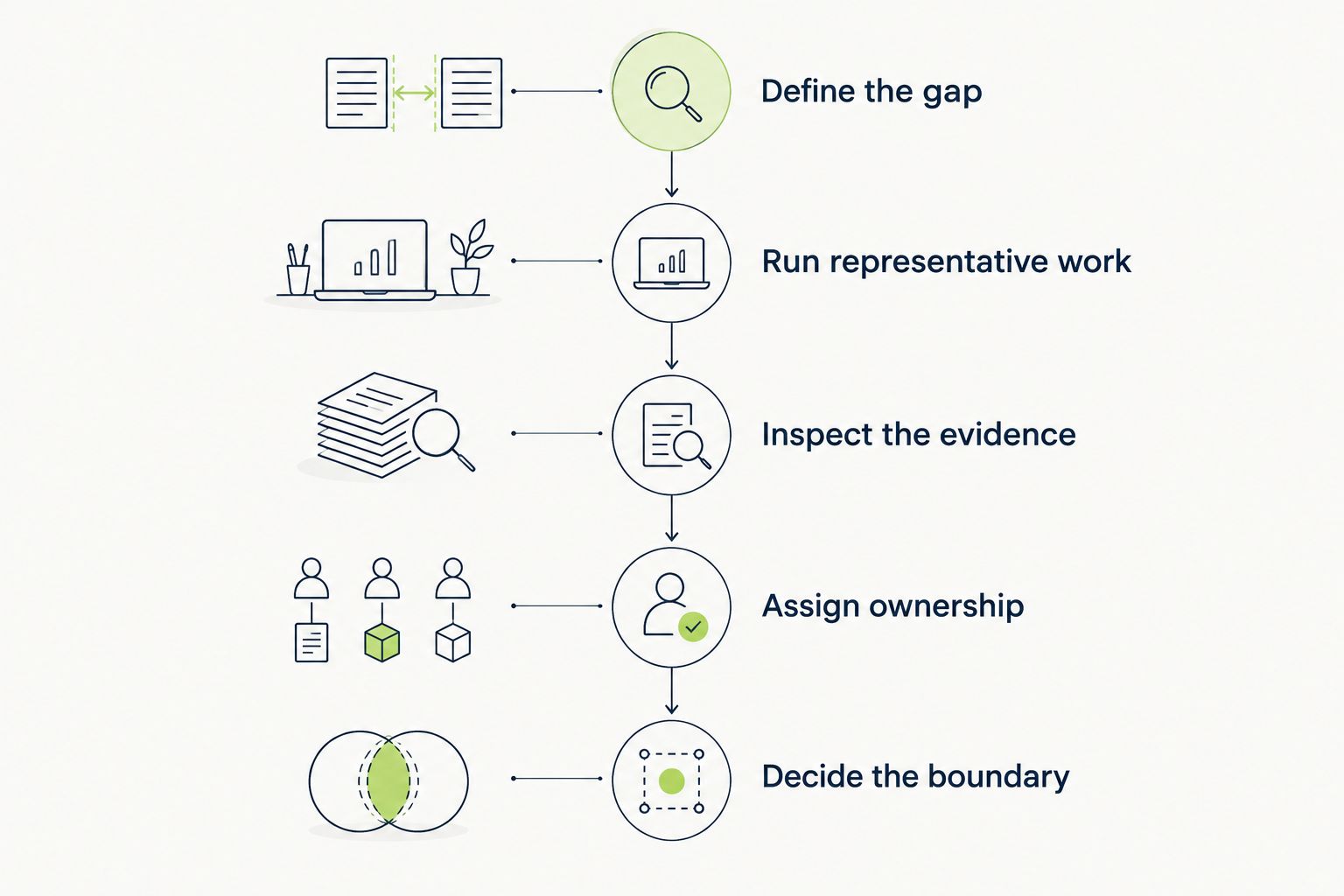
Decide what needs replacing only after checking representative work and ownership.
Do not collapse management and execution into one score. A clear test plan and a reproducible application failure are different outputs; evaluate each against the job you need done.
If execution is your priority, compare the approaches in the guide to automated UI testing software. Keep your 2026 acceptance criteria specific enough that a candidate can fail them.
Stay with PractiTest when its management workflow meets your requirements and your missing capability belongs elsewhere. Existing test cases, results, and team habits have practical value when people can use them effectively.
PractiTest’s strength is centralized test management. Its limitation in this comparison is that managing a test is a different job from executing application checks. If that distinction explains your problem, assess an execution layer before planning a management migration.
A useful 2026 decision is not necessarily a platform switch. It is a clear answer to who defines the test, what executes it, and where the result is recorded.
What’s the best PractiTest alternative in 2026?
TestDriver is the best fit here for GitHub teams seeking automated pull request UI testing in a real desktop sandbox. TestRail is the closer category match when the goal is replacing dedicated test case management.
Is TestRail a direct alternative to PractiTest?
Yes. TestRail and PractiTest both address test management, so compare case organization, test runs, results, and your reporting requirements using representative work.
Is Playwright a replacement for PractiTest?
Playwright is not a like-for-like PractiTest replacement. It executes code-based browser tests, while PractiTest manages testing activity; decide separately where manual cases and release evidence will live.
Which PractiTest alternative fits a Jira-based team?
Xray fits teams that deliberately want test management inside Jira. Choose it for that operating model, not on the assumption that changing the workflow’s location automatically improves coverage.
Do I need to migrate test cases to improve regression testing?
Not necessarily. If your test management process works, adding executable regression checks addresses a different problem without requiring a management migration.
How should I compare test management and test automation tools?
Evaluate them against separate outputs. A management tool should make cases and outcomes usable; an execution tool should exercise the application and produce evidence you can investigate.
What should a PractiTest replacement pilot include?
Include representative test cases, application workflows, failure evidence, and named maintenance owners. Decide in advance whether success means better management, better execution, or both.
A managed test case and an executable assertion are different artifacts. Before switching tools, take a critical case and ask someone to show exactly what runs, what constitutes failure, and who investigates it.
If the answer stops at a written procedure, the immediate gap is execution, not necessarily PractiTest.
For end-to-end testing platform engineering teams, gate critical journeys first. Build reliable CI checks with clear ownership and reproducible failures.
End-to-end testing Series B startups can trust starts with critical workflows. Build PR checks, isolate test data, and gate merges on clear evidence.
UI regression testing healthcare software needs more than screenshots. Build patient-context, permission, and saved-state checks into pull requests.
AI code review open source maintainers can trust needs evidence. Compare review methods, isolate contributor code, and keep humans in control of merges.
TestDriver runs every pull request in a real desktop sandbox, finds bugs, and builds regression tests - right from your repo.